
Search and AI Max Campaigns
Keyword and intent capture, responsive search ad asset testing, and disciplined search-term governance so broad matching expands into demand rather than noise.
Every month, businesses hand Google a budget and hope the auction is kind to them. Some of that money buys customers. A surprising share of it buys clicks from people who were never going to convert — irrelevant search terms, placements nobody vetted, a conversion action that fires on a thank-you page load whether or not the lead was real. As a Google Ads management services company, our job is to close that gap: to make sure the budget you approve is spent against demand you can actually sell to, and to prove it with numbers your finance team recognises.
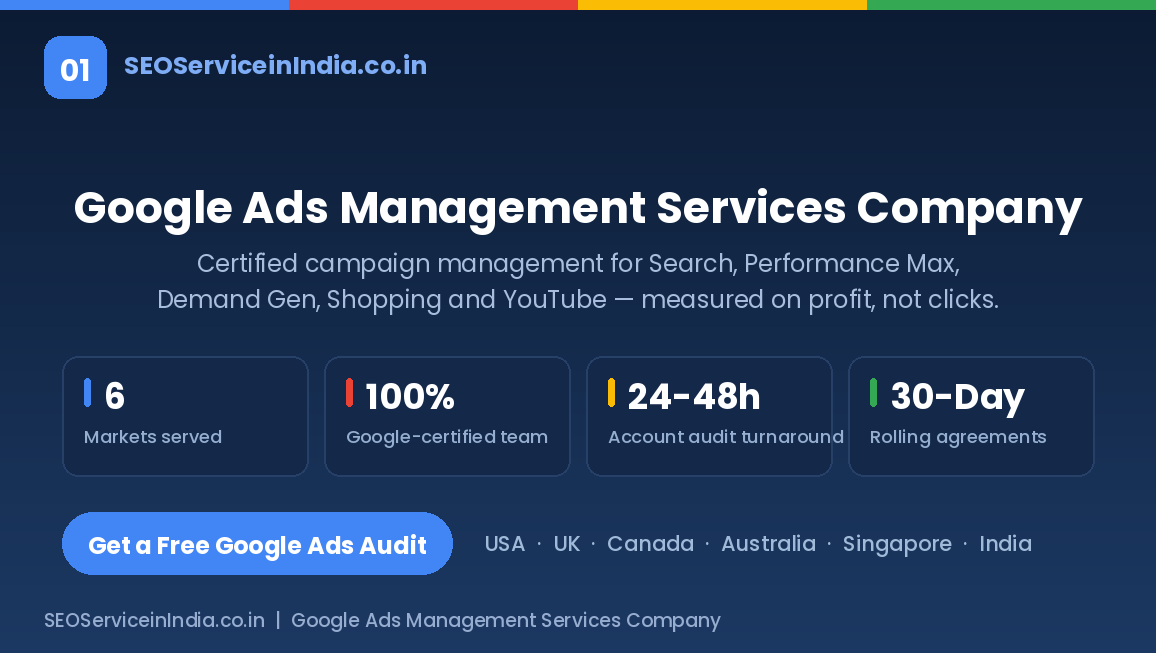
SEOServiceinIndia manages Google Ads accounts for businesses in the United States, United Kingdom, Canada, Australia, Singapore and India — from single-market lead generation to multi-currency ecommerce accounts running Search, Performance Max, Shopping, Demand Gen and YouTube side by side. We are a paid media team that reports on cost per qualified lead and return on ad spend, not on impressions.
Google Ads management is often sold as "we'll run your ads", which tells you nothing about what happens between the invoice and the result. In practice the work sits in six connected areas, and weakness in any one of them caps what the other five can achieve.
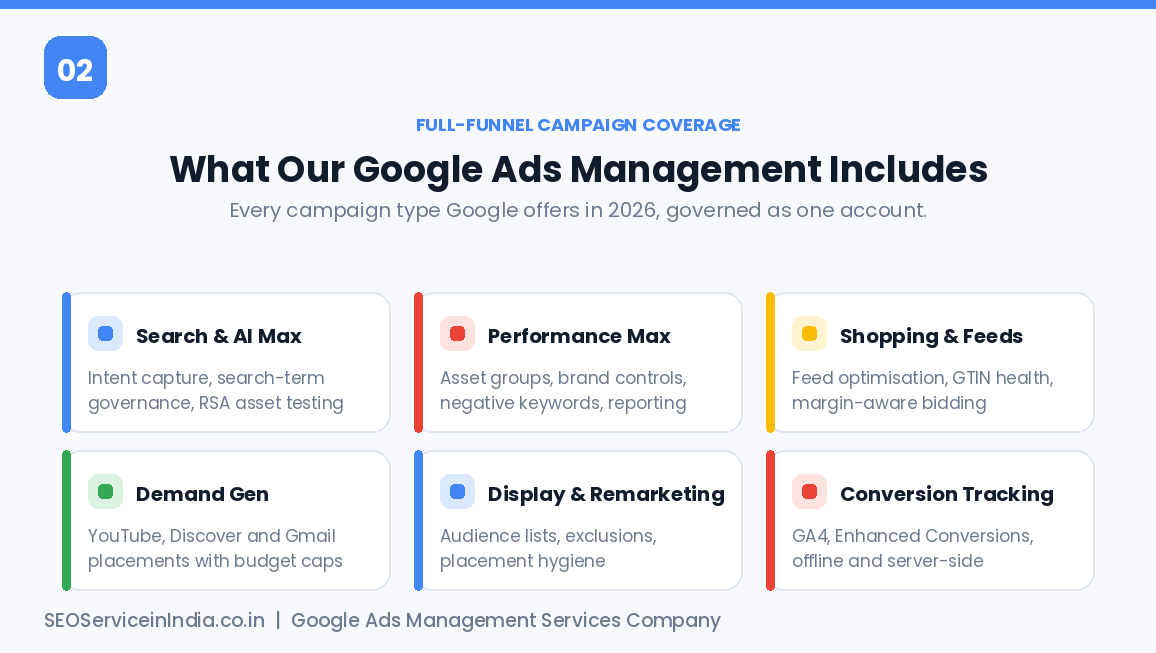
Keyword and intent capture, responsive search ad asset testing, and disciplined search-term governance so broad matching expands into demand rather than noise.
Asset group structure, audience signals, brand exclusions, negative keyword lists and channel-level reporting, so PMax behaves like a managed campaign rather than a black box.
Product feed optimisation, title and attribute fixes, GTIN and disapproval clean-up, and margin-aware bidding instead of flat ROAS targets across unequal products.
YouTube, Discover and Gmail placements for demand creation, run with budget caps and creative rotation so upper-funnel spend stays accountable.
Audience lists, exclusion rules and placement hygiene, which is where a great deal of quiet waste hides in inherited accounts.
GA4 configuration, Enhanced Conversions, Consent Mode, offline conversion imports and CRM matching, because Smart Bidding can only optimise toward the signal you give it.
Those six areas are the service. Everything else — the reporting, the calls, the roadmap — exists to keep them honest.
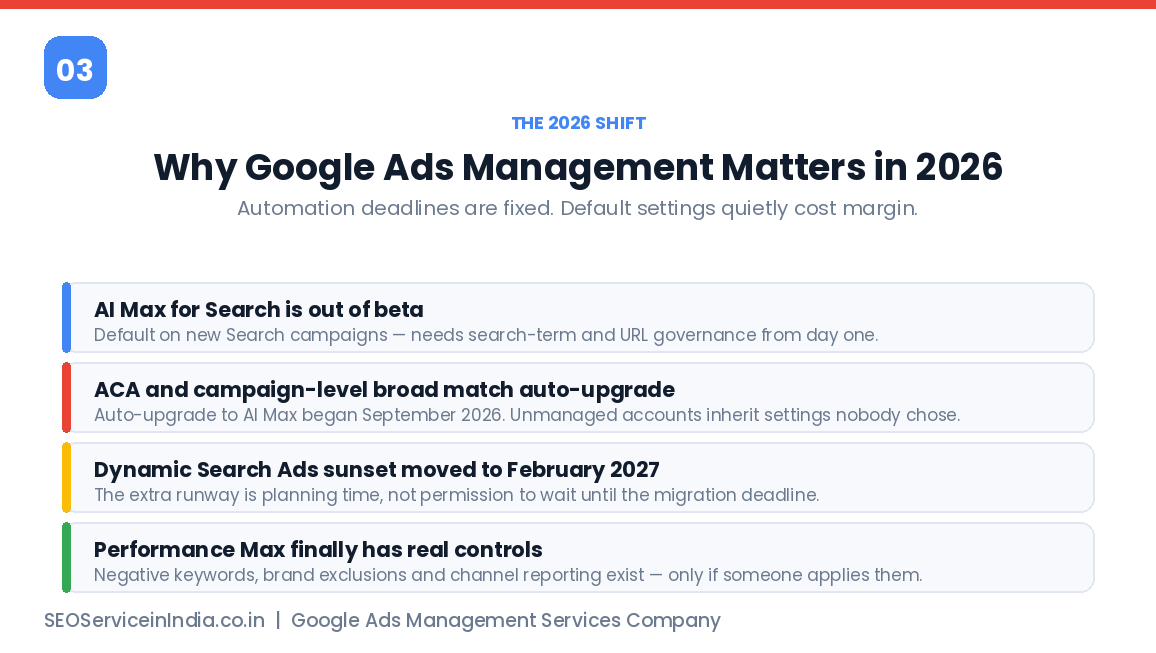
If your account has been running on the same settings for two years, it is not running the way you set it up. Google has shipped more consequential change in the last eighteen months than in the several years before it, and most of that change arrives switched on by default.
AI Max for Search left beta and is now the default on new Search campaigns. Campaigns relying on automatically created assets and the campaign-level broad match setting began auto-upgrading to AI Max in September 2026, and the Dynamic Search Ads migration follows in February 2027. An account with nobody watching it does not opt out of these changes — it simply inherits settings that were never chosen deliberately, and the first sign is usually a cost-per-acquisition drift that nobody can explain.
Performance Max moved in the opposite direction. The early "trust the algorithm" version has been replaced by one with negative keyword support, brand controls, demographic targeting, customer exclusions and channel-level reporting. Those controls only help if someone applies them every month. This is precisely why Google Ads management services have shifted from button-pressing to governance: the platform now offers real levers, deadlines that do not move, and defaults that quietly cost margin when they go unexamined.
There is a quality dimension too. Google's limited ad serving policy means advertisers with unclear business identity, weak landing pages or persistent negative user feedback can see reduced visibility regardless of budget. Trust is now an advertising input, not just an SEO one — which is why our management work always includes the landing page design and tracking layer, not only the campaigns.
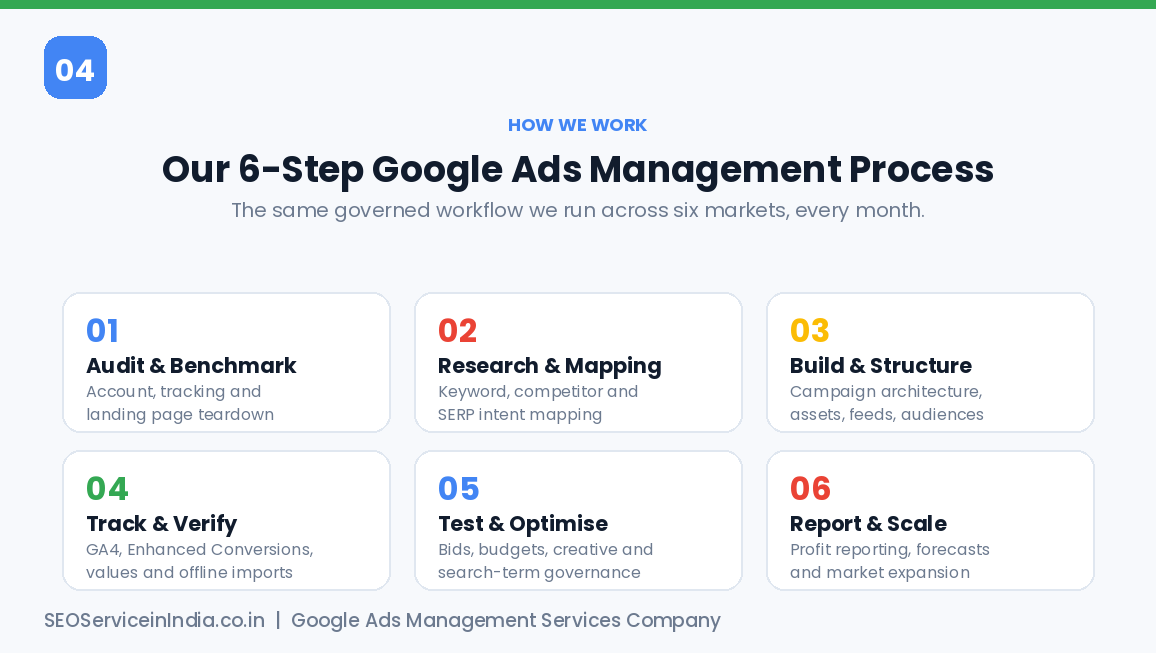
The same workflow runs on every account we take over, whether the monthly budget is four figures or six. It exists so that decisions are traceable and nothing important depends on one person's memory.
We start with a full Google Ads audit: account structure, wasted spend in the search terms report, conversion action accuracy, bidding strategy fit, asset quality, Merchant Center health and landing page experience. You receive the findings whether or not you go on to hire us, alongside a baseline of current cost per acquisition and return on ad spend.
Keyword, competitor and SERP research per market, mapped to funnel stage. This is where we decide what deserves exact match protection, what belongs to broad matching with tight negatives, what should sit in Shopping rather than Search, and which queries you should stop paying for entirely.
Campaign architecture is rebuilt or repaired around themes with enough conversion volume to bid on: asset groups, responsive search ad assets, product feed segmentation, audience signals, geo and schedule settings. Structure decides how quickly Smart Bidding learns, so this step disproportionately determines month three.
Nothing is optimised until the measurement is trustworthy. We configure GA4, Enhanced Conversions and consent handling, deduplicate conversion actions, apply conversion value rules where margins differ, and import offline conversions from your CRM so the algorithm learns from closed revenue instead of raw form fills.
Ongoing bid and budget management, search-term governance, negative keyword maintenance, creative and landing page testing, audience and exclusion refinement. Every test is documented with a hypothesis and a result, so the account has a history rather than a series of untraceable tweaks.
Monthly profit reporting, a forecast for the next period, and a considered view on where scale is available — a new market, a new campaign type, an increase in budget the account can genuinely absorb without pushing cost per acquisition past your break-even point.
A Google Ads agency that treats every country as the same auction will overspend in at least four of them. Auction density, click costs, consent regimes and buyer behaviour all differ, and campaign settings have to reflect that.
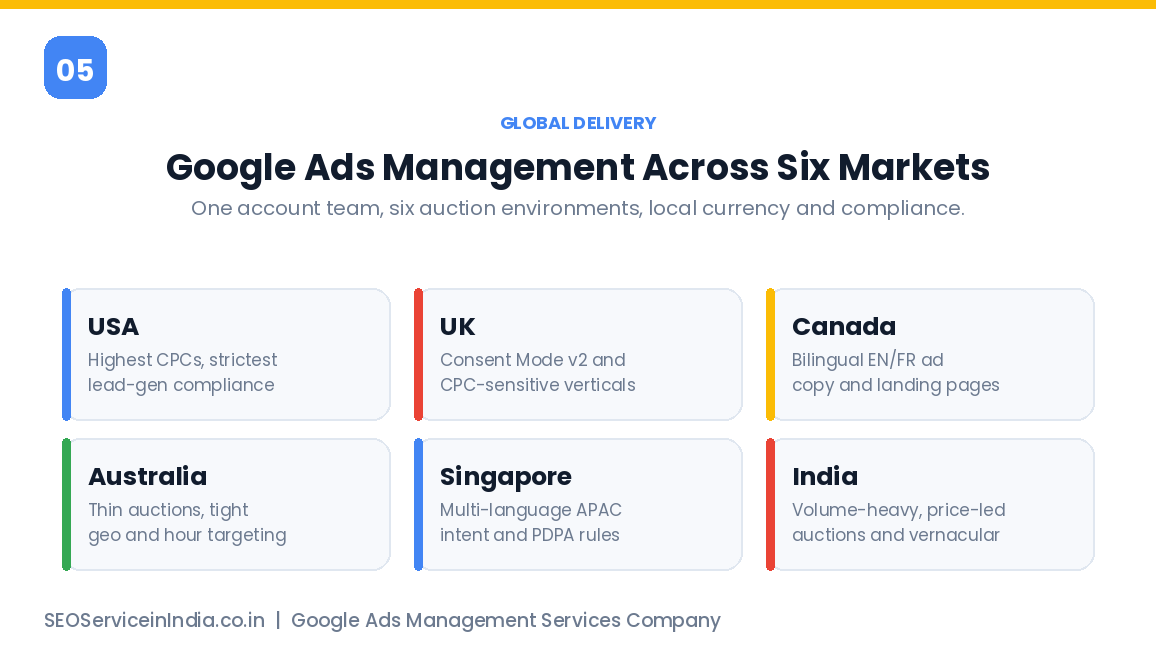
The most expensive and most competitive auctions we work in, with strict compliance expectations in regulated lead-generation verticals. Structure and negative keyword discipline matter more here than anywhere else.
Consent Mode v2 and modelled conversions change what your reports show, so measurement setup has to be right before bidding decisions are trusted.
Bilingual English and French ad copy and landing pages, plus provincial geo-targeting that stops budget leaking into regions you cannot service.
Thinner auctions in many niches, where tight geo-targeting, ad scheduling and lower daily budgets outperform aggressive nationwide bidding.
A compact, high-intent market with multi-language search behaviour and PDPA considerations in how audience data is handled.
High volume, price-sensitive auctions where vernacular queries, call extensions and lead quality filtering do more for cost per qualified lead than raw click growth.
Multi-country accounts are managed as one structure with market-level budgets, currencies and reporting, so you can compare performance across regions without three separate agencies telling three different stories.
Our paid media team works across both lead generation and ecommerce, and the split matters: one optimises toward qualified conversations, the other toward margin per order.
Shopping, Performance Max and feed management, with profit-aware ROAS targets rather than blended platform ROAS, supported by our ecommerce SEO services.
Long consideration cycles, trial-to-paid tracking and offline conversion imports from the CRM.
Legal, accounting, financial advisory and consulting, where a single qualified enquiry justifies a high cost per click.
Geo-tight campaigns, call tracking and policy-compliant creative in a sensitive advertising category.
High-consideration purchases that need remarketing and Demand Gen alongside intent capture.
Call-first campaigns, service-area targeting and lead quality filtering.
White label Google Ads management delivered under your brand, with reporting you can pass straight to your own clients.
There are three common ways to price Google Ads management services, and it is worth knowing which one you are being sold. A percentage of ad spend is simple but rewards the agency for spending more of your money. Performance-only pricing sounds attractive but tends to push agencies toward safe, brand-heavy campaigns that would have converted anyway. We work on a flat monthly management fee scoped to the number of markets, campaign types and feeds in the account — so scaling your budget does not automatically scale your invoice.
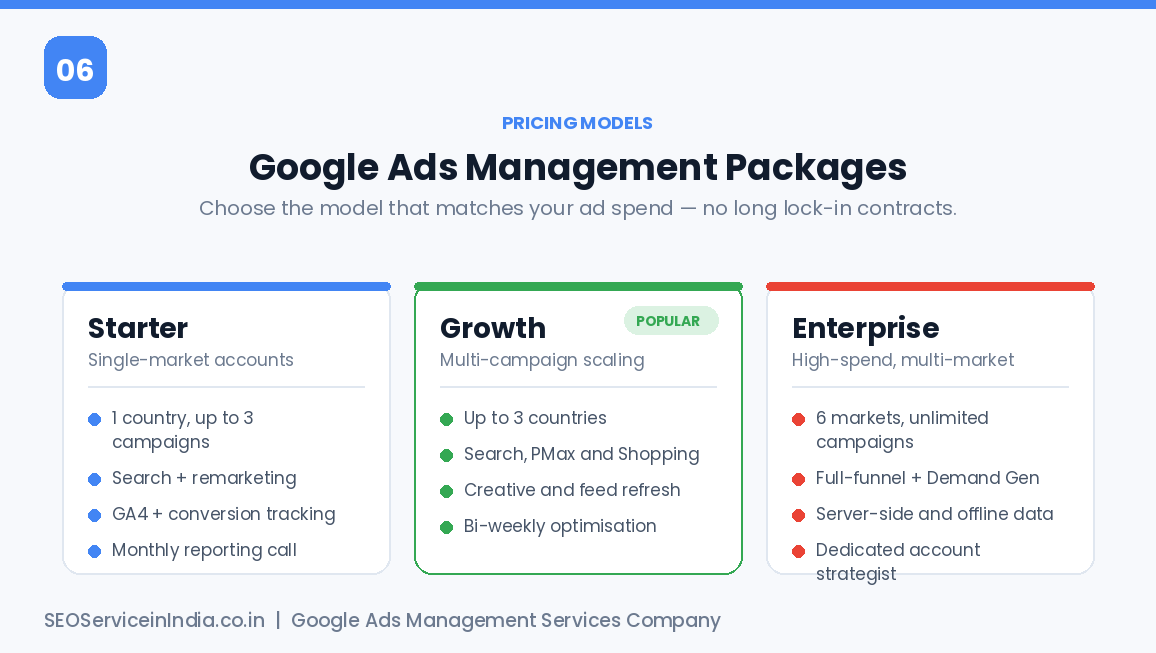
A single market with up to three campaigns, Search plus remarketing, GA4 and conversion tracking, and a monthly reporting call. Built for businesses proving the channel before committing heavier budget.
Up to three markets across Search, Performance Max and Shopping, with creative and feed refresh cycles and bi-weekly optimisation. The tier most scaling ecommerce and lead-gen accounts sit in.
All six markets, unlimited campaign count, full-funnel coverage including Demand Gen, server-side and offline conversion data, and a dedicated account strategist.
Every package is a rolling 30-day agreement. There is no annual lock-in, no markup added to your media spend, and no charge for handing the account back if you decide to bring management in-house. Ad spend is paid by you, directly to Google, on your own billing profile.
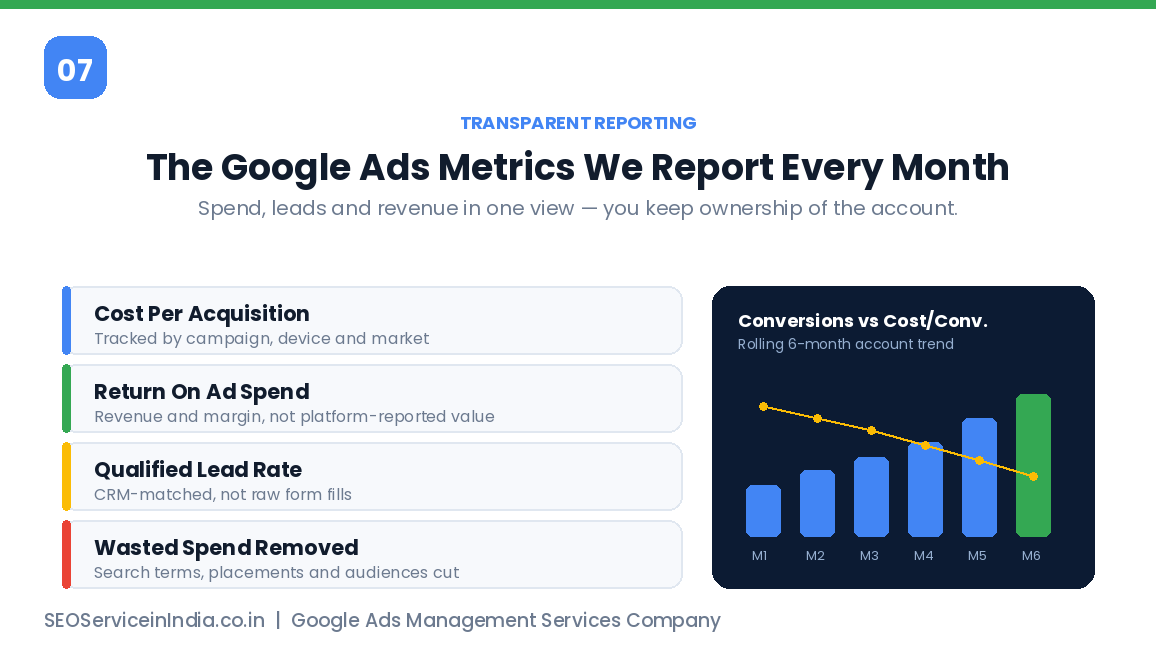
Reporting is where most agency relationships quietly fail. A dashboard full of impressions, click-through rate and platform-reported conversions can look excellent in a month where the business sold nothing. We report on four things that survive contact with a finance meeting.
Broken out by campaign, device and market, compared against the baseline recorded in the audit.
Measured on real revenue and, where you can share margin data, on contribution rather than headline revenue.
Leads matched back to your CRM and marked as genuine opportunities, not raw form submissions.
The search terms, placements and audiences excluded this month, and what that recovered.
Alongside the numbers you get a written commentary explaining what changed and why, plus the plan for the coming month. Reports are yours to keep, built on dashboards inside your own accounts.
Our team has managed live Google Ads budgets across six markets and both sides of the funnel — ecommerce feeds and long-cycle B2B lead generation. That range matters because the mistakes are different: an ecommerce account usually bleeds through feed and bidding problems, a lead-gen account through conversion definitions that count the wrong thing.
Campaigns are handled by Google Ads certified specialists who work in these accounts daily, not by a generalist juggling six disciplines. When Google ships a change — AI Max leaving beta, new PMax controls, a GA4 attribution update — it is evaluated against your specific account rather than applied because it is new.
SEOServiceinIndia is part of MysticDigi Pvt. Ltd., a full-service digital marketing company serving clients in India, Singapore, the UAE, the United Kingdom and the United States. Paid media sits alongside our SEO, content and web development teams, which means landing page and tracking problems get fixed rather than escalated into someone else's queue.
You own the Google Ads account, the Merchant Center, the analytics property and the data inside them. We work through manager-level access, quote a transparent management fee with no markup on spend, and operate on rolling 30-day terms. If we cannot see a credible path to improving your cost per acquisition, we will say so during the audit rather than after you have signed.
Send us read access to your Google Ads account and we will return a written audit within 48 hours: where the budget is leaking, which settings changed without your approval, what your realistic cost per acquisition should be, and the three fixes we would make first. There is no obligation attached and no pressure to switch agencies — plenty of businesses use the audit to brief their existing team.
Request My Free AuditManagement is usually priced as a flat monthly retainer, a percentage of ad spend, or a hybrid. We quote a flat fee scoped to the number of markets, campaign types and product feeds in the account, which means your management cost does not rise automatically the moment you increase budget. Ad spend is separate and paid by you directly to Google.
Yes, always. Campaigns are built inside your own Google Ads, Merchant Center and GA4 properties, and we operate through manager-level access. If the relationship ends, the account, the historical performance data and the conversion setup stay with you.
Tracking corrections and wasted-spend removal typically show inside the first two to three weeks. Smart Bidding needs a stable conversion signal before it settles, so meaningful movement in cost per acquisition usually appears from about week four and compounds across the first quarter.
The audit decides. Where structure, tracking and conversion history are sound, we optimise in place to protect the learning the account has already accumulated. Where the account is fragmented or the conversion signal is unreliable, we rebuild in stages so performance is never switched off overnight.
Below roughly one thousand US dollars a month, most accounts are better served by a single tightly controlled Search campaign than by a managed multi-campaign structure — the data volume simply is not there for automated bidding to learn. We will tell you honestly if that is your situation.
Yes. Search, AI Max, Performance Max, Shopping, Demand Gen, Display and YouTube are all in scope, along with Merchant Center feed management. Which mix you run depends on your margins and sales cycle, not on which campaign type is currently fashionable.
Google Ads captures demand that already exists — people actively searching for what you sell — while Meta creates demand among people who were not looking. Most mature accounts run both, but if budget forces a choice, high-intent search usually pays back faster for services and considered purchases.
Yes. We manage accounts under your brand with reporting you can pass directly to your own clients, including a named strategist who joins client calls where you want one.
Request your free Google Ads audit today and see exactly what your account is capable of.

Speak with our SEO Company Experts
Give us a Ring, e-Mail, WhatsApp, or Skype.