
D2C and eCommerce
Brands running catalogue and Advantage+ sales campaigns, judged on return on ad spend and blended margin, usually alongside eCommerce SEO services.
Most Instagram advertising goes wrong in the same two places. The account is set up to optimise towards a conversion event the platform cannot see properly, and the campaign is fed two or three pieces of creative and expected to perform for months. Everything else — the audience debates, the bid strategy arguments, the endless placement tinkering — matters far less than those two things, and automated delivery has made that gap wider every year.
Our Instagram ads management packages, part of our wider advertising packages, are built around fixing both. We install clean conversion signal so the system is optimising towards something real, then run a creative programme with enough volume and variety for it to find winners. Campaigns are managed inside Meta Ads Manager across Reels, Stories, Feed, Explore and Threads, for advertisers in the United States, the United Kingdom, Canada, Australia, Singapore and India, and every month the report opens with cost per result rather than reach.
This is the first thing we explain to almost every new client, because it changes what you should expect from an Instagram campaign.
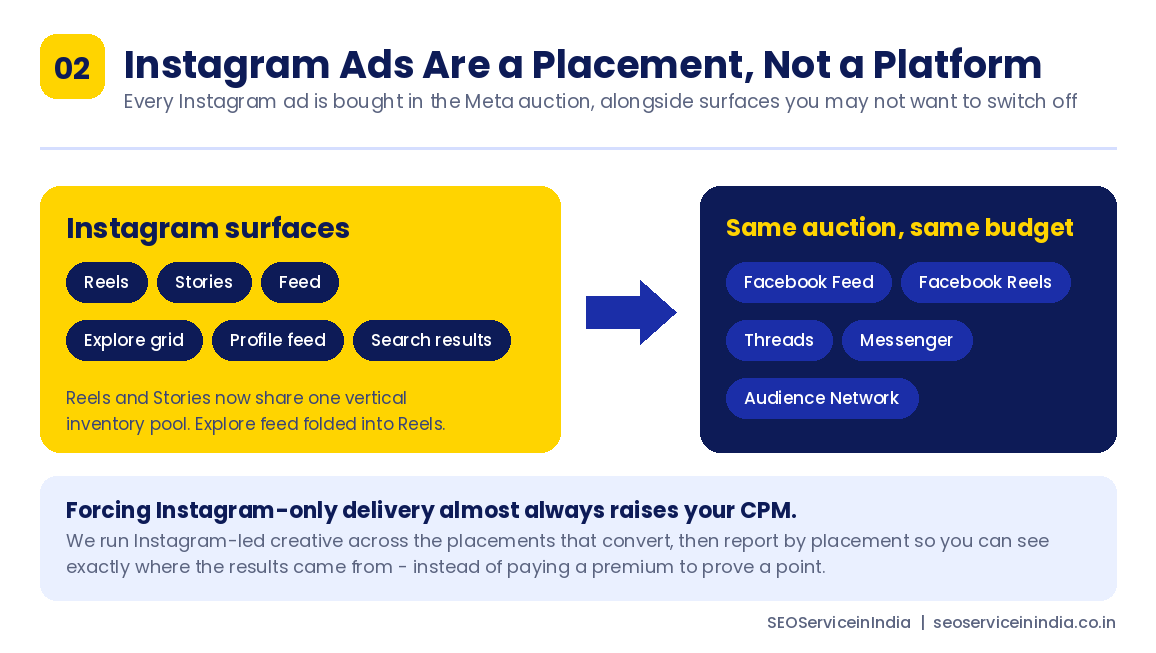
There is no separate Instagram ad system. Every Instagram ad is created, targeted, billed and reported inside Meta Ads Manager, competing in the same auction as Facebook Feed, Facebook Reels, Threads, Messenger and Audience Network — the same budget-follows-attention principle we apply in Google Ads management. That is a good thing. It means your budget follows attention rather than sitting in one app while cheaper conversions go begging elsewhere.
Advertisers often ask us to restrict delivery to Instagram alone. We will do it when there is a real brand reason, but we tell you what it costs first: narrowing placements removes the system's cheapest options and, in most accounts we audit, pushes the effective cost per result up. The better answer is Instagram-led creative delivered across placements, with reporting broken out by placement so you can see precisely how much of the result Instagram earned.
Instagram's ad surfaces are not static. Reels and Stories inventory has been consolidated, the scrollable Explore feed now delivers through Reels, and Threads has become a live placement. Each shift changes which aspect ratio wins and where budget lands. Part of what a managed package buys you is somebody tracking those changes so your creative library does not quietly become the wrong shape.
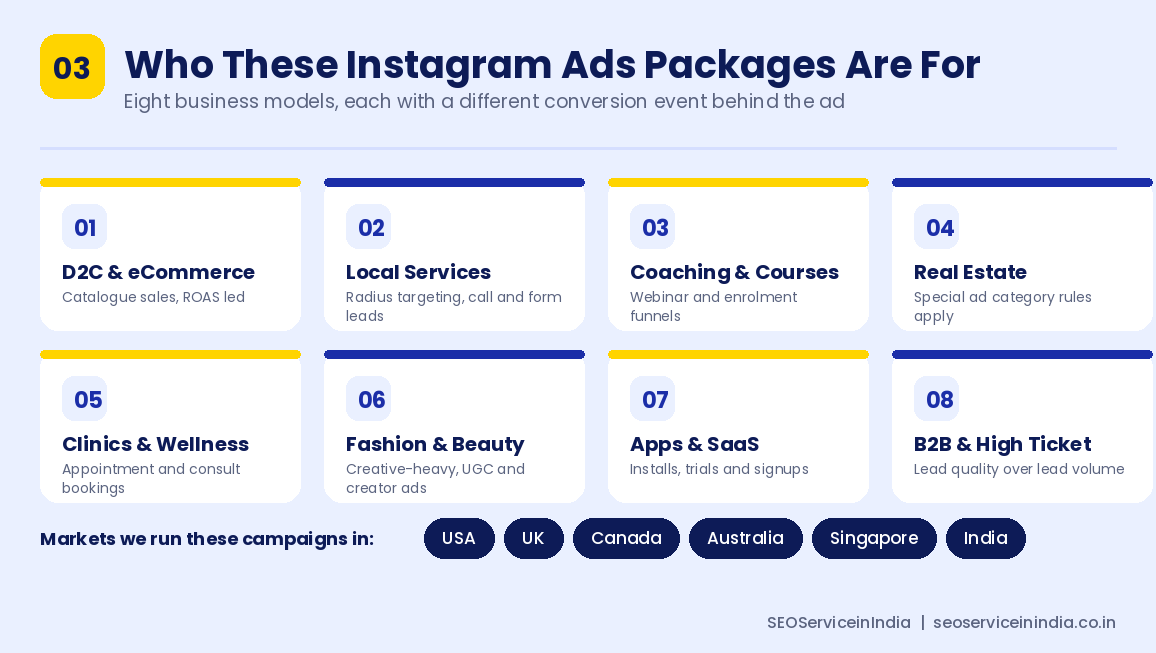
Eight business models, each with a different conversion event sitting behind the ad — which is what actually determines how the account gets built.
Brands running catalogue and Advantage+ sales campaigns, judged on return on ad spend and blended margin, usually alongside eCommerce SEO services.
Radius targeting, call and form leads, and a lead-quality problem that volume alone never fixes.
Webinar, application and enrolment funnels where the creative carries the whole pitch.
A special ad category on Meta, with real targeting restrictions we plan around rather than discover later.
Appointment and consultation bookings, plus advertising policy limits on health and body claims.
The most creative-hungry category on the platform, where UGC and creator partnership ads do the heavy lifting alongside organic social media marketing.
Installs, trials and signups, measured properly through the app events rather than the click.
Where lead quality beats lead volume, and the wrong optimisation event fills your CRM with nothing.
Across markets the same account can behave very differently. Costs per thousand impressions in the United States, the United Kingdom, Canada and Australia sit far above India, so the same budget buys a very different amount of learning. Click-to-WhatsApp campaigns are a primary conversion path in India and much of Asia and the Gulf, and barely used in North America. We plan the offer, the budget and the conversion event around the market you are actually advertising in.
Automated delivery has absorbed most of the levers advertisers used to pull. Detailed interest stacking, manual bid tinkering and placement micro-management no longer move results the way they did. What moves results now is how much good, varied creative the system has to choose from.
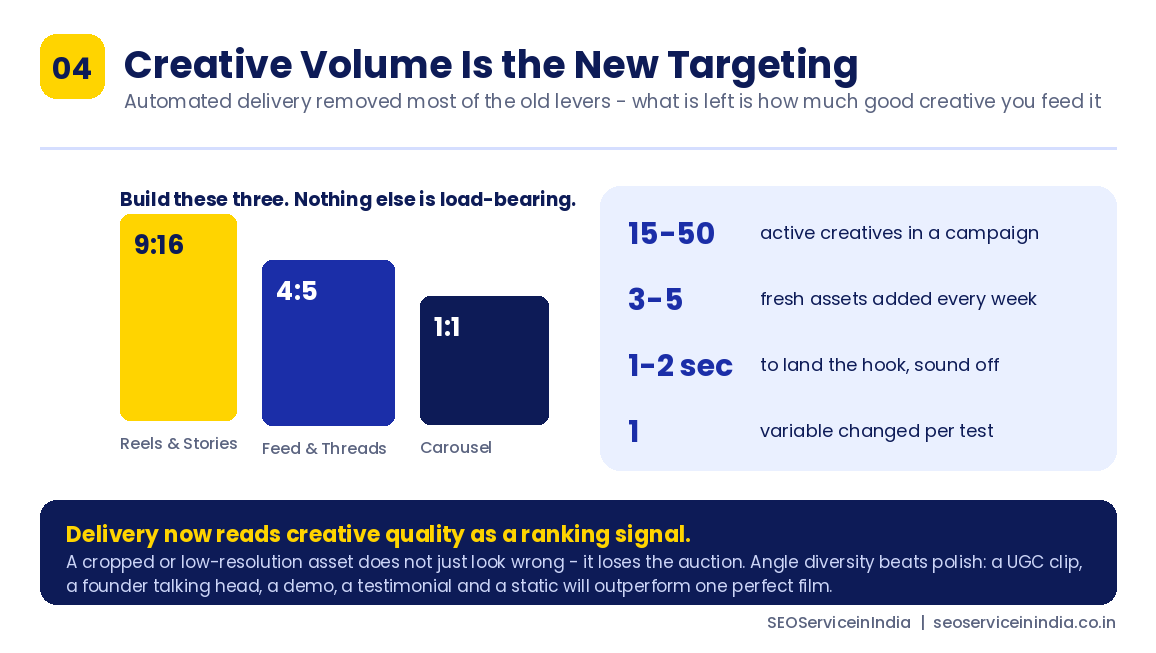
A campaign running two assets is asking the system to optimise with almost no options. Healthy accounts hold a substantial pool of active creatives and add fresh assets every week, because delivery favours new material and every winning ad eventually fatigues. That cadence is the single biggest difference between an account that plateaus in month two and one that keeps improving.
Vertical is now the overwhelming majority of Meta inventory and almost all of it is viewed on a phone. Three ratios cover nearly everything: 9:16 for Reels and Stories, 4:5 for Feed and Threads, 1:1 for carousel. Delivery also reads creative quality as a ranking input, so a low-resolution or auto-cropped asset does not merely look wrong — it loses auctions and quietly raises your costs.
Five different angles will out-perform one expensive film almost every time: a UGC clip, a founder talking to camera, a product demo, a customer testimonial and a clean static. We change one variable per test — hook, or offer, or format, never all three — so that when something wins we know what won, and we can build the next batch from it rather than guessing.
Eight workstreams run every month on every account we manage. What changes between scopes is creative output, testing volume and the number of markets covered.
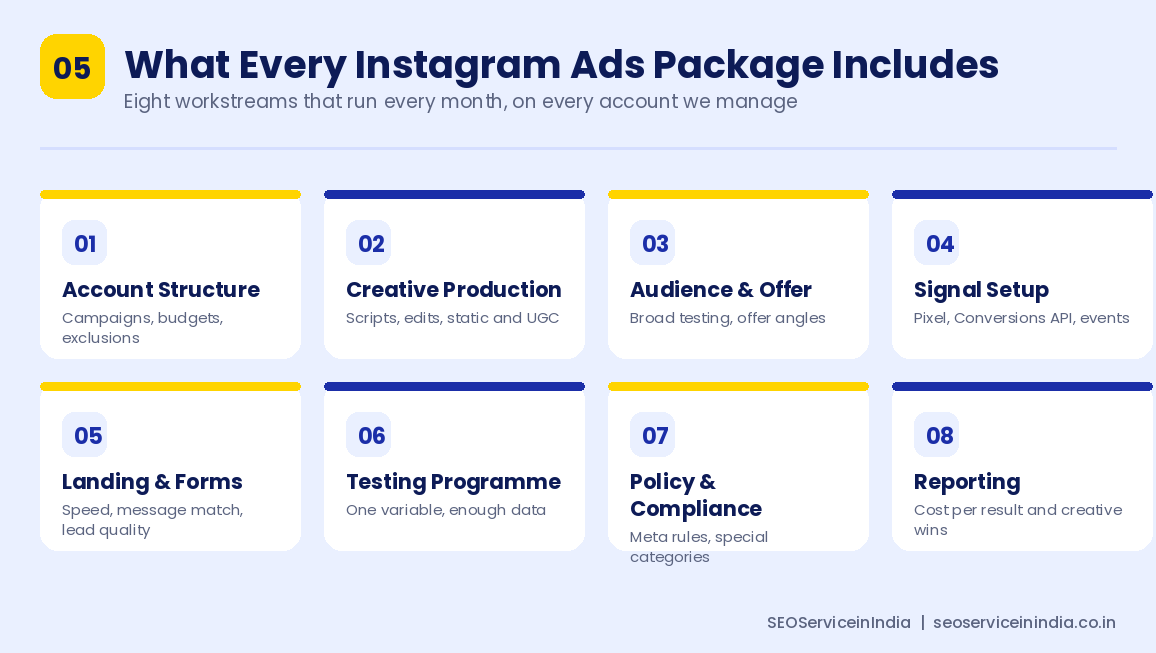
Campaign and budget architecture, audience exclusions, and a testing structure that produces readable results instead of overlapping ad sets bidding against each other.
Scripting, editing and static design for a steady stream of new assets, including UGC-style and creator formats where they suit the category.
Broad-first testing with the offer and hook as the real variables, plus retargeting pools built from meaningful actions rather than any page view.
Meta pixel plus Conversions API with proper event deduplication and match quality, so the system optimises towards conversions it can actually see.
Speed, message match between ad and page, landing page design where you need it, and form design tuned for lead quality — the cheapest lead is worthless if sales cannot close it.
One variable at a time, run long enough to leave the learning phase and gather enough events to mean something.
Meta advertising policies, special ad category handling, and claim language reviewed before launch rather than after a rejection.
Cost per result, creative win rate, placement breakdown and the platform-versus-analytics gap explained rather than hidden.
Packages are scoped by monthly ad spend and creative output rather than by a fixed hour bank, because those two things determine how fast an account can learn.
Scoping this way also keeps the incentive honest. An hours-based retainer rewards activity; a spend-and-output scope rewards getting your cost per result down, because the next tier only makes sense for you once the current one is working. All three scopes include the same eight workstreams — what changes is how many creatives we ship each week, how many tests run in parallel, and how many markets or product lines we can hold at once.
For advertisers proving the channel or running a single offer in one country. Full account build and signal setup, a modest but steady creative cadence, one primary conversion event and monthly reporting. Honest note: below a certain daily budget the system cannot gather enough events to optimise, so we will tell you if your spend is too thin before we take the work.
For accounts already converting that need more creative throughput and a real testing programme. Everything in Starter, plus a larger weekly creative batch, systematic angle testing, retargeting and catalogue campaigns, and landing page or form iteration alongside the ads.
For advertisers running several markets, currencies or product lines. Everything in Growth, plus market-by-market budget planning, creative localisation, seasonal and sale-period planning, incrementality checks on the biggest spend lines, and a named strategist working with your marketing and sales teams.
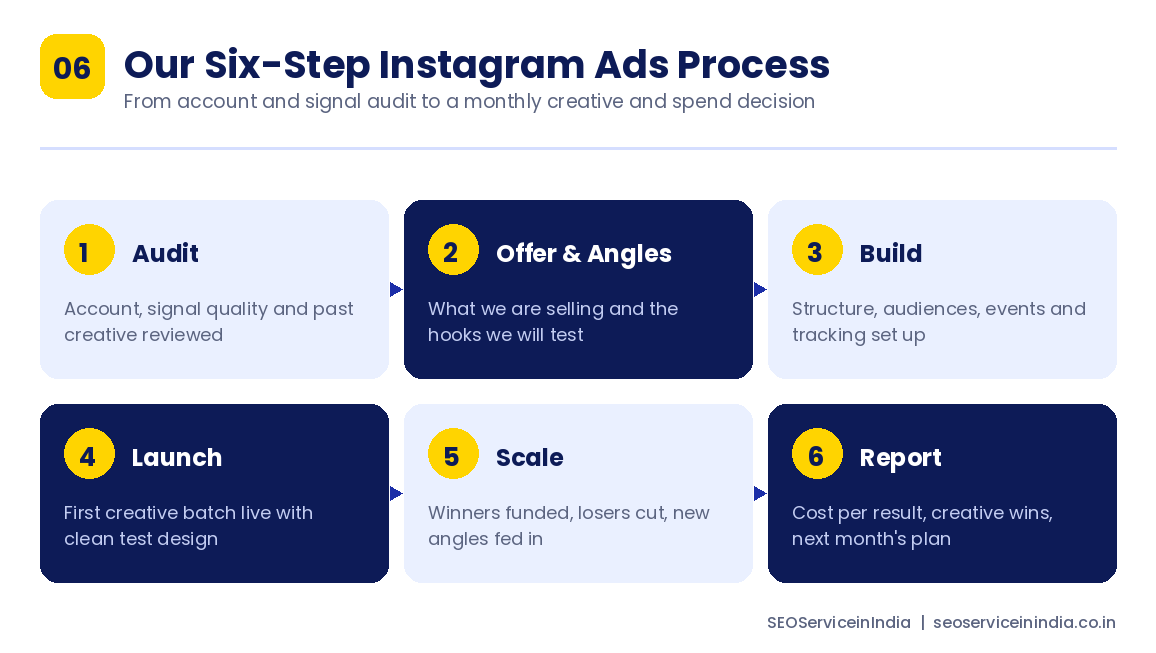
Every account we take on runs through the same sequence, so you always know which stage the work is at and what comes next.
Account structure, signal quality, past creative and historic cost per result. You get the findings as a prioritised sheet, and they are yours whether or not you continue with us.
We agree what is being sold, to whom, and the hooks worth testing first. This session is with your sales or founder side, not just marketing, because the objections that kill deals are the angles that win ads.
Campaign structure, audiences, exclusions, pixel and Conversions API, event mapping and reporting setup. Nothing launches until the conversion signal is verified end to end.
The first creative batch goes live with a clean test design and enough budget per variant to exit the learning phase, rather than five variants starved into meaninglessness.
Winners get funded, losers get cut, and new angles are produced from what the winners taught us. Frequency and fatigue are watched so a good ad is replaced before it starts costing you.
A monthly report that leads with cost per result, explains what moved it, and sets the spend and creative plan for the next cycle.
Three jobs, three creative styles, three different measures of success. Judging all of them on the same metric is how good campaigns get switched off, and it is usually where conversion rate optimisation earns its place beside the media buying.
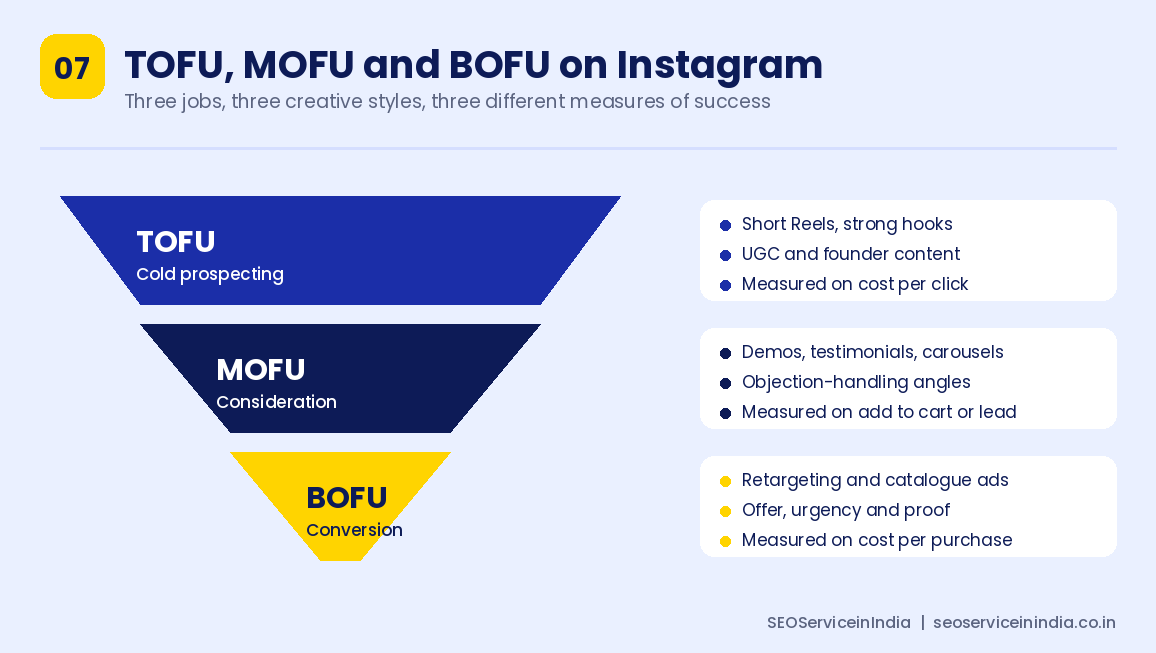
Short Reels with strong hooks, UGC and founder-led content aimed at people who have never heard of you. Success here is cheap qualified attention — cost per click and hook rate — not immediate purchases, and expecting a first-touch sale from cold traffic is the most common reason advertisers kill campaigns too early.
Demos, testimonials, comparison carousels and objection-handling angles for people who have engaged but not bought. Measured on add-to-cart, lead or booking volume.
Retargeting, catalogue and dynamic product ads carrying offer, urgency and proof. This is where cost per purchase looks flattering, which is exactly why it must never be read on its own — bottom-funnel results depend entirely on what the layers above delivered.
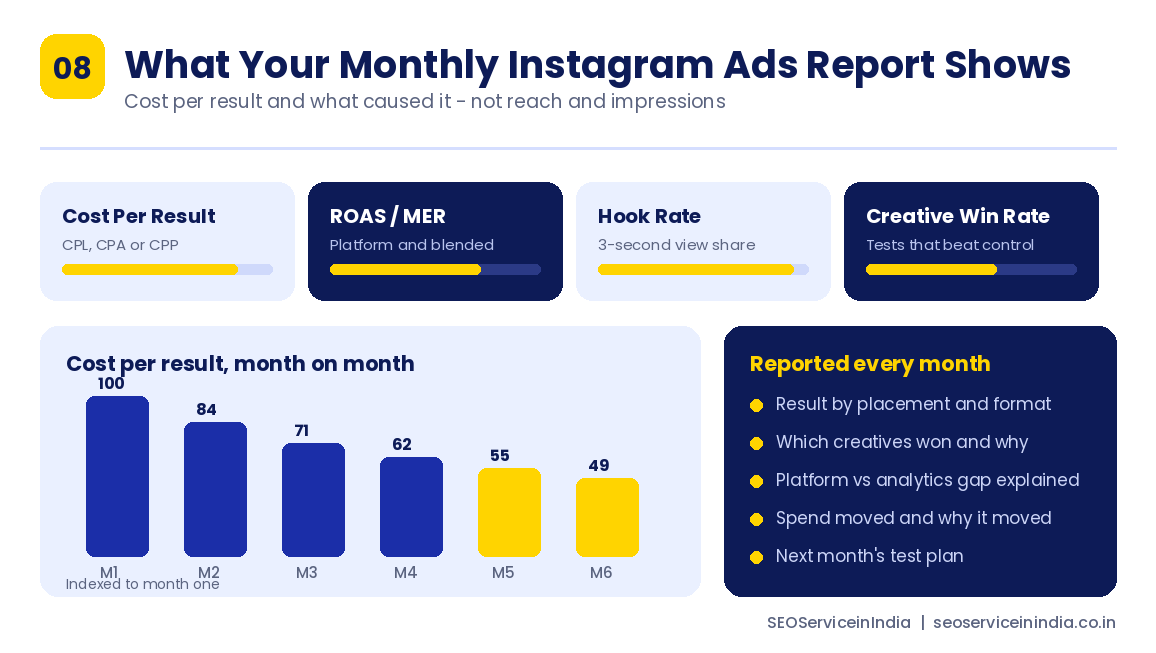
Reach and impressions describe activity, not outcome. Our monthly report leads with cost per result — cost per lead, acquisition or purchase — alongside platform and blended return, hook rate and the share of creative tests that beat the control.
We break results down by placement so the Instagram contribution is visible rather than assumed, and we explain the gap between Meta's reported conversions and your analytics instead of pretending it does not exist. Those two numbers will never match, because they count differently, and an agency that cannot explain the difference is usually reporting whichever one flatters it.
SEOServiceinIndia has run paid media and search programmes since 2015 from our Delhi base, across North America, Europe and Asia-Pacific. Instagram is a channel where the difference between accounts is rarely clever settings; it is creative throughput, signal hygiene and the discipline to read tests properly.
Creative production is inside the retainer, not an extra invoice, because volume is the lever.
Tracking is verified end to end before launch, not assumed from a pixel that fires.
Placement-level reporting, so you see what Instagram actually contributed.
Market-aware planning — click-to-WhatsApp funnels in Asia, lead forms or landing pages elsewhere.
Reporting that names what did not work, with the correction attached.
We are also straight about what paid social cannot do. It will not fix a weak offer, and it will not carry a product with no margin for acquisition cost. If the numbers do not work, we would rather say so in the audit than take a retainer for six months and blame the algorithm.
Enough for the campaign to gather a meaningful number of conversion events each week, which depends entirely on your cost per result. A business with a fifteen-dollar lead needs far less than one with a two-hundred-dollar booking. We work the minimum backwards from your numbers in the audit and tell you plainly if the budget is too thin to learn from.
The first fortnight is learning, not performance. Most accounts show a readable direction by week three or four, and a stable cost per result somewhere in month two or three once a few creative tests have resolved. Anyone promising profitable scale in week one is describing luck.
Both, because they are the same auction. Instagram-led creative usually delivers across several placements, and we report which ones earned the results. If you want strictly Instagram delivery we will set it up and show you the cost difference.
We do, as part of the package: scripts, edits, statics and UGC-style assets. Where you already have a creator or in-house team, we brief them and handle testing. Either way, creative volume is planned as part of the scope rather than treated as an afterthought.
We review policy risk before launch, particularly for health, finance, real estate and employment advertisers where special category rules apply. If a restriction still happens, we handle the appeal and keep spend moving through compliant campaigns while it is resolved.
Because they count differently. Meta credits conversions within its attribution window, including view-through, while analytics tools generally credit last click. Neither is lying. We report both, explain the gap, and use blended figures at the account level for spending decisions.
It depends on which side of the trade you need. Instant forms win on volume and cost per lead because nobody leaves the app; landing pages win on lead quality because the visitor has read something before converting. For high-ticket and B2B we usually start with a landing page, and for local services and events we usually start with a form, then test the other.
Give us access to your ad account and we will come back with a prioritised free account audit: whether your conversion signal is clean, where your creative is fatiguing, which campaigns are competing with each other, what your realistic cost per result looks like, and whether your current budget is enough to get there. No obligation, and the findings are yours to keep.
Speak with our SEO Company Experts
Give us a Ring, e-Mail, WhatsApp, or Skype.