Home/SEO for Logistics Companies | Freight & 3PL SEO Agency
SEO for Logistics Companies | Freight & 3PL SEO Agency
Logistics · Freight & 3PL SEO
SEO for Logistics Companies: Rank for the Lanes, Services and Facilities That Bring Freight
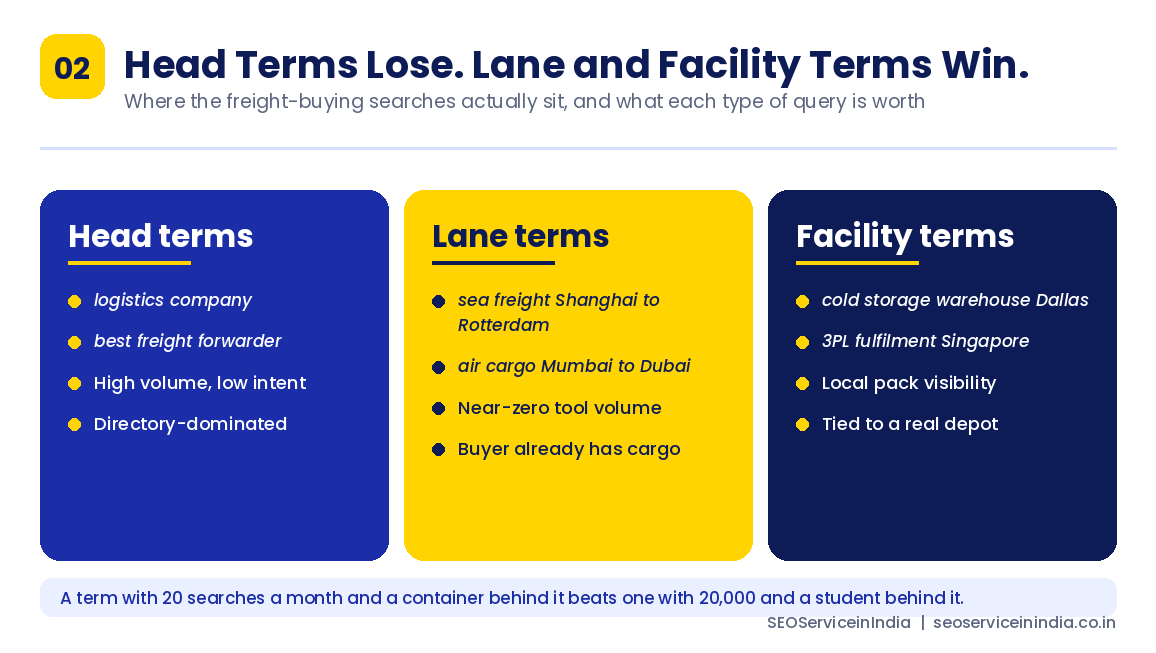
A shipper with forty containers to move does not search for ‘best logistics company’. They search for sea freight from Shanghai to Rotterdam, or LTL rates Chicago to Dallas, or cold storage warehouse near Heathrow. Those queries look almost worthless in a keyword tool — a handful of searches a month, sometimes none at all — and every one of them has real cargo behind it. Meanwhile the head terms that do report volume are crowded with directories, job seekers, students and people tracking a parcel.
That mismatch is why so much logistics SEO spend produces traffic charts and no freight. Our work is built the other way round: an architecture of mode, lane and facility pages that catches buyers at the moment they have something to move, supported by the technical, local and authority work that makes those pages rank. We do this for freight forwarders, 3PLs, road carriers, customs brokers, warehousing operators and last-mile networks across the United States, the United Kingdom, Canada, Australia, Singapore and India, as one of our SEO packages by industry.
Why Most Logistics SEO Never Produces a Quote Request
Four things go wrong, and they go wrong in the same order at almost every logistics company we audit.
The head terms are the wrong prize
Terms like ‘logistics company’ or ‘freight forwarder’ carry the volume, so they get the budget. But the intent behind them is a mess: students researching a career, candidates looking for jobs, consumers chasing a delivery, and a minority of actual buyers who are still weeks from a decision. The first page is usually held by directories and aggregators with domain authority no operating company will out-rank quickly. Even winning that term rarely produces a tender.
The queries that convert barely register in keyword tools
Lane searches — service plus origin plus destination — are the opposite. A tool might report thirty searches a month for air freight from Mumbai to Dubai, or nothing at all, because it under-samples low-frequency B2B queries. But the person typing it has cargo, a date and a budget. Individually these terms look pointless. Across two hundred lanes they become the most commercially productive part of a logistics website, and almost nobody is competing for them properly.
The buying committee arrives late and reads carefully
Freight is bought by a committee — operations, procurement, sometimes finance and compliance — over weeks or months, and most of the evaluation happens before anyone contacts you. That has a direct content consequence: your pages are read by people who know the work. Vague copy about ‘end-to-end solutions’ and ‘seamless supply chains’ tells an operations manager nothing and quietly disqualifies you. Transit times, equipment, port pairs, customs handling and named accreditations are what hold attention.
AI assistants now sit in the shortlisting step
A growing share of buyers ask an AI assistant to shortlist providers for a lane, a commodity or a compliance requirement before they open a search results page at all. Those systems assemble answers from structured, well-attributed sources: clear service entities, consistent business information, credentials that can be verified, and third-party mentions in trade media. Sites built as brochure pages with no structured data and no external footprint tend not to appear in that shortlist, and their owners never see the impression that was lost.
Segments
Who We Build Logistics SEO For
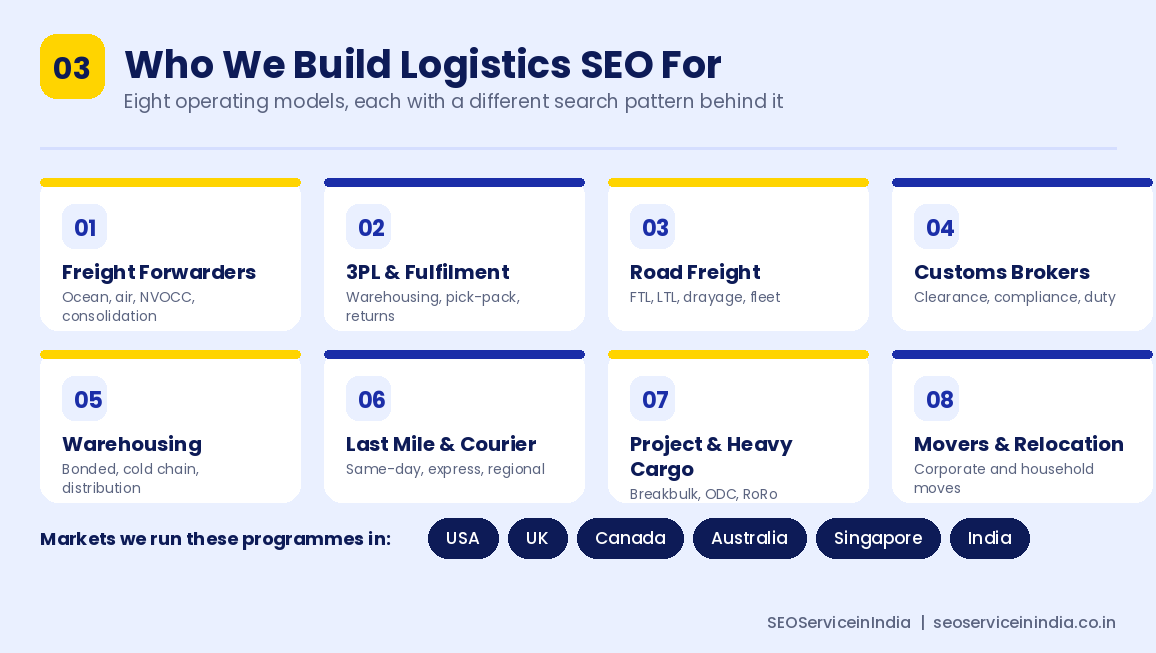
Each of these operating models has a different search pattern behind it, so the architecture we build is different in each case.
Geographically this is a genuinely multi-country service, which is not true of every industry we write for. Freight moves between the United States, the United Kingdom, Canada, Australia, Singapore and India in every direction, and buyers search from both ends of a lane. That has structural implications we handle from the start: how country sections are separated, where hreflang belongs, which entity owns which facility, and how to avoid the duplication that multi-market logistics sites usually collapse into.
Freight forwarders and NVOCCs — lane pages, port-pair content, consolidation and Incoterms guidance, often run alongside SEO for trading companies.
3PL and fulfilment providers — facility pages, capability content on pick-pack, returns and integrations, plus fulfilment-by-region searches and the eCommerce SEO services their clients depend on.
Road freight carriers and brokers — FTL, LTL, drayage and reefer pages tied to real terminals and traffic corridors.
Customs brokers — clearance, duty, HS classification and compliance content, which is unusually strong at capturing early-stage searches.
Warehousing and cold chain operators — depot-level local SEO, capacity and certification content, temperature and bonded-storage terms.
Last mile and courier networks — service-area pages and same-day or express terms, where the local pack does most of the work.
Project cargo and heavy-lift specialists — low-volume, very high-value terms where a single ranking page can pay for the year.
Movers and relocation companies — corporate and household relocation, one of the few logistics segments with genuine consumer search volume.
Architecture
The Lane and Facility Architecture That Ranks
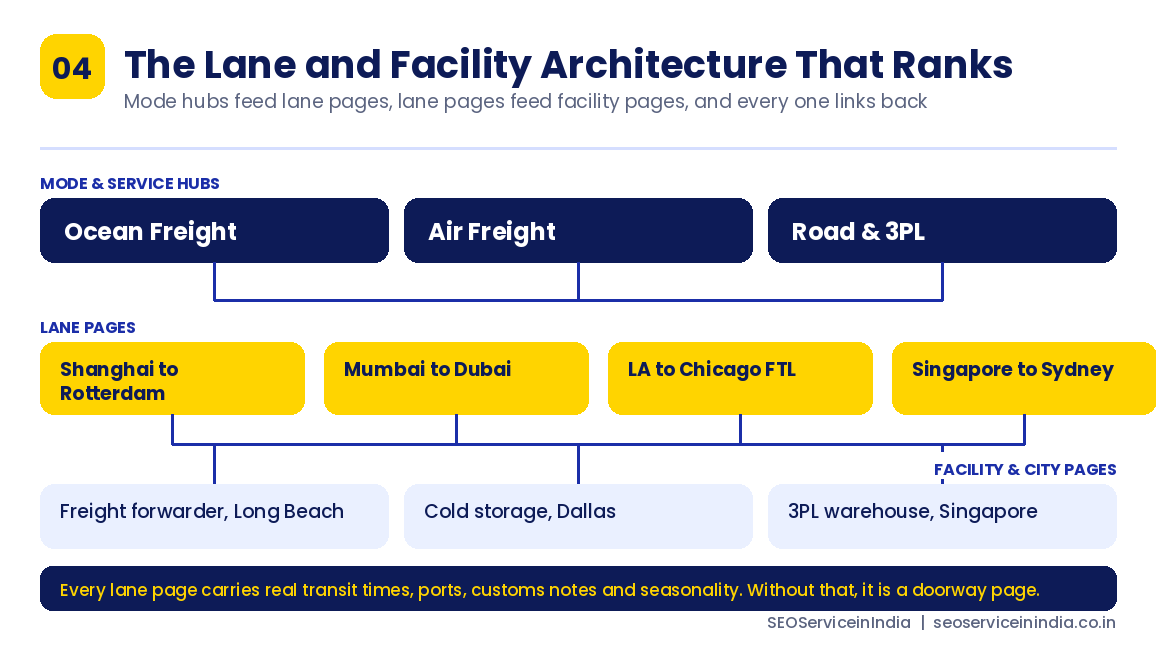
Almost every logistics site we take over has the same shape: a services page, an about page, and a blog. That structure has nowhere to put the queries that actually convert. We rebuild it in three connected layers.
Layer 01
Mode and service hubs
Ocean freight, air freight, road, warehousing, customs and last mile each get a hub page that owns the category term, explains the service properly, and links down to everything beneath it. These pages rarely convert on their own. Their job is to hold topical authority and distribute it.
Layer 02
Lane pages built on your operating data
Each lane page targets a real service-origin-destination combination and is built from information only you have: typical transit times, the ports or airports you route through, the equipment you run, customs and documentation notes, seasonal capacity behaviour and the commodities you handle on that corridor. This is the part agencies get wrong and get penalised for. A hundred lane pages spun from a template with the city name swapped are doorway pages, which Google treats as spam. A hundred lane pages carrying genuine operating detail are an asset no competitor can copy without doing the same work.
Layer 03
Facility pages and the local pack
Every depot, warehouse, terminal and office you actually operate gets its own page and its own Google Business Profile, with consistent naming, correct categories, service areas, photographs of the site and the certifications held there. For warehousing, cold chain and last-mile operators the local SEO services layer is often the single largest source of qualified enquiries, and it is the fastest-moving part of a logistics SEO programme.
Layer 04
Industry and commodity pages
The fourth layer matters most for brokers and asset-light operators who have no depots to anchor local pages to. Pharmaceutical cold chain, automotive parts, hazardous goods, perishables, retail replenishment and project equipment each carry their own vocabulary, compliance requirements and search behaviour. A page written for a pharma supply chain manager, naming the certifications and temperature tolerances that matter to them, competes on ground the generalists never enter.
Eight Workstreams
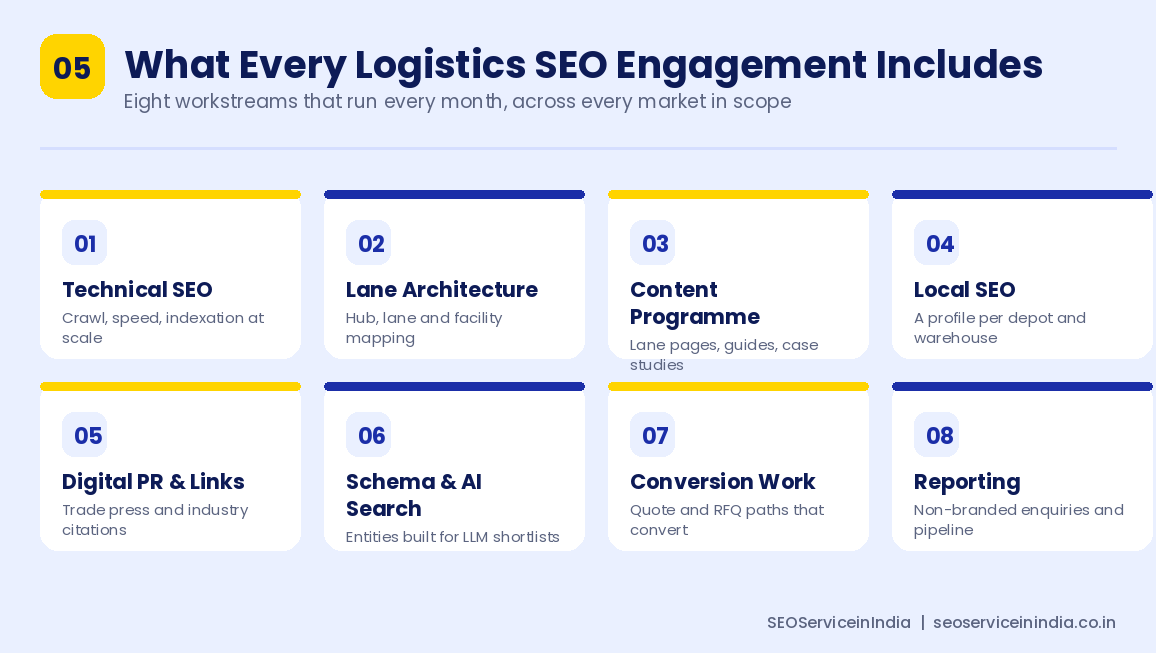
What Every Logistics SEO Engagement Includes
Eight workstreams run every month, across every market in scope. What changes between engagements is the number of lanes, facilities and countries covered.
01
Technical SEO
Crawl efficiency, site speed, indexation control and log-file review, because a lane architecture only works if a few hundred new pages get crawled and indexed rather than ignored. This is the technical SEO services layer the whole build sits on.
02
Lane and facility architecture
Mode hubs, lane pages and facility pages mapped against your actual network, with internal linking planned before anything is written.
03
Content programme
Lane pages, operator-level guides, compliance explainers and case studies written with your ops team rather than around them.
04
Local SEO
A claimed, optimised and monitored profile for every real site, with review generation and consistent business information across directories.
05
Digital PR and authority
Trade media coverage, industry association citations and data-led stories that earn the links a logistics domain needs to compete.
06
Structured data and AI search
Organisation, Service, LocalBusiness and FAQ markup, plus the entity and attribution work that decides whether AI assistants include you in a shortlist.
07
Conversion work
Quote and RFQ paths rebuilt so a lane page ends in a form an operations manager will actually complete, not a generic contact box.
08
Reporting
Non-branded enquiry volume, lane rankings, local actions and pipeline value, reported monthly against the previous period.
Workflow
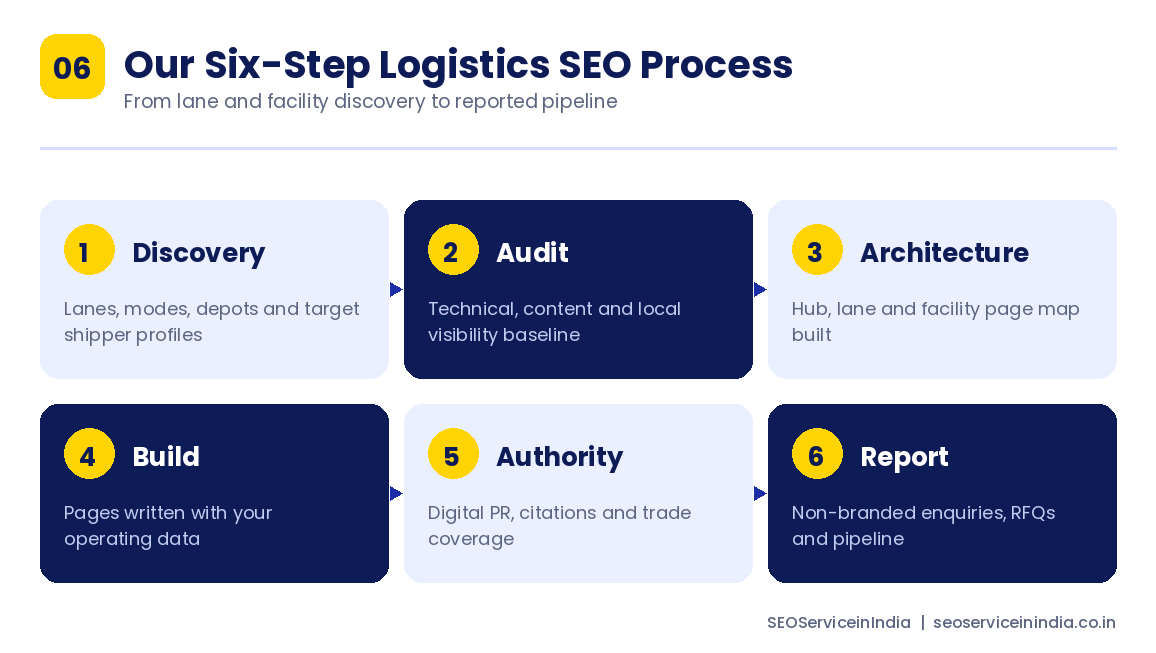
Our Six-Step Logistics SEO Process
The same six steps run on every account, whether you book ten corridors out of one depot or a network spanning all six markets.
01
Step 1 — Discovery
We sit with your commercial team and map what you actually do: the lanes you book regularly, the lanes you want more of, the depots and terminals you run, the commodities you handle and the shipper profiles you sell to best. Nothing else in the programme works without this.
02
Step 2 — Audit and baseline
Technical health, existing content, local visibility and backlink profile, benchmarked against three named competitors. You get the audit as a prioritised sheet, and it is yours whether or not you continue with us.
03
Step 3 — Architecture
The hub, lane and facility map is built and signed off before writing starts, including URL patterns, internal linking rules and, for multi-country clients, how the markets are separated. Retrofitting this later is expensive.
04
Step 4 — Build
Pages are written in priority order, highest-value lanes and busiest facilities first, using your operating data. Drafts go to your ops team for accuracy, not just to marketing for tone.
05
Step 5 — Authority
Digital PR, trade publication coverage, association and directory citations, and review generation at facility level. This is what closes the domain-authority gap against the directories sitting above you.
06
Step 6 — Report and iterate
Monthly reporting on non-branded enquiries, lane rankings, local actions and pipeline contribution, followed by the lane and facility priorities for the next cycle.
Content Funnel
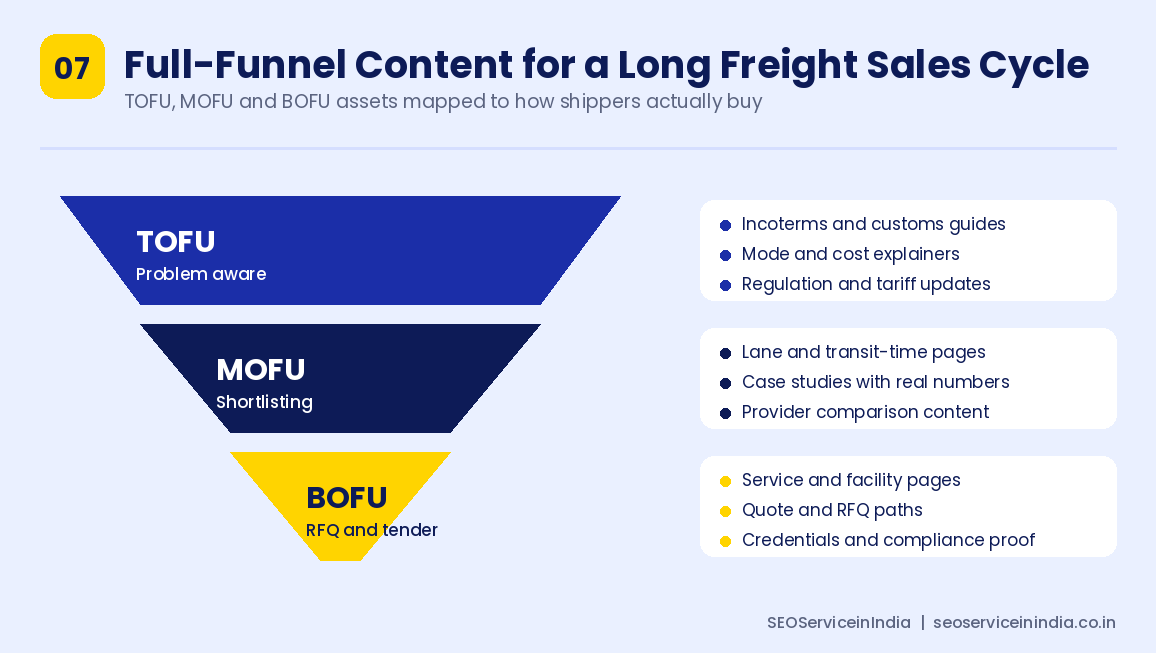
TOFU, MOFU and BOFU: Content for a Long Freight Sales Cycle
Freight is rarely bought on first contact. The content has to hold a buyer across a cycle that can run for months, which means each stage needs assets built for it.
TOFU
Top of funnel — the problem-aware shipper
Incoterms explainers, customs and documentation guides, mode and cost comparisons, tariff and regulation updates. These attract buyers long before a tender exists and, done properly, are what an AI assistant cites when someone asks how a process works.
MOFU
Middle of funnel — the shortlist
Lane and transit-time pages, case studies with real shippers and real numbers, capability comparisons and capacity content. This is the layer that decides whether you make the list, and it is the layer most logistics sites are missing entirely.
BOFU
Bottom of funnel — the RFQ and the tender
Service and facility pages, quote paths, credentials, certifications, insurance and compliance proof. Everything above exists to bring a warmer buyer to these pages, which is why enquiry quality usually improves before enquiry volume does.
Reporting
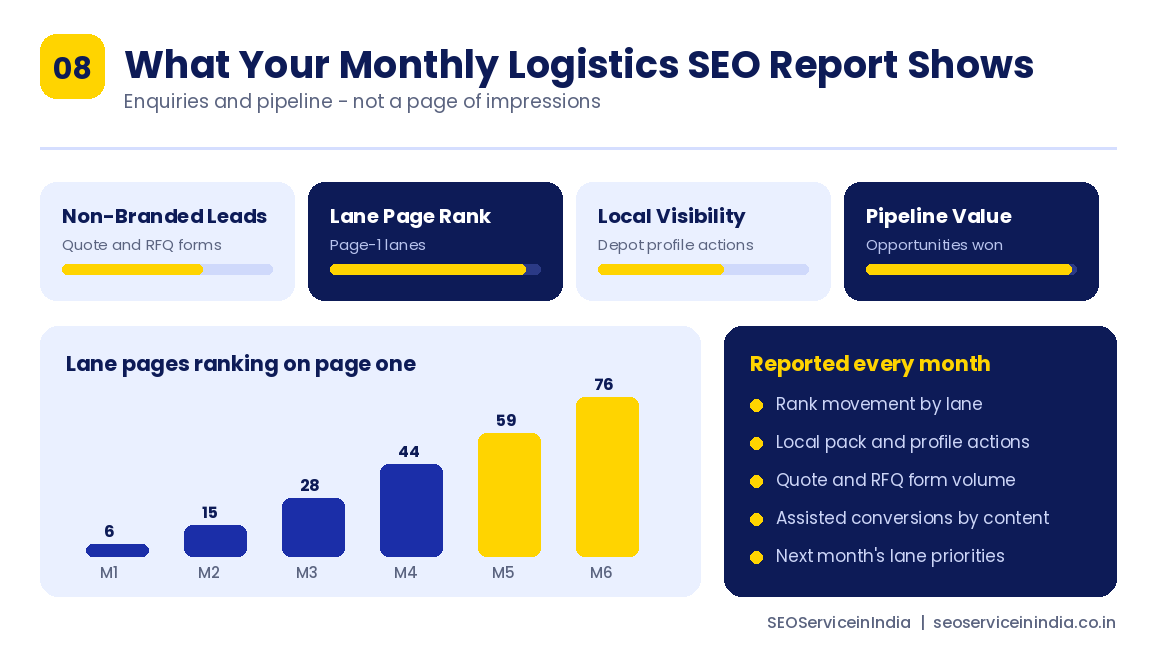
Reporting You Can Take Into a Board Meeting
Rankings and sessions are intermediate signals, useful for diagnosis and useless as a board metric. Our monthly report leads with non-branded enquiries — quote requests, RFQ submissions and proposal requests from people who did not already know your name — then shows lane pages holding page one, local actions at each facility, assisted conversions from content, and pipeline value where your CRM lets us connect the two, including anything running through Google Ads management.
We also separate branded from non-branded performance, because a growing brand can flatter a report that is otherwise going nowhere. If a month goes badly, the report says so and explains what we are changing.
E-E-A-T
Why Logistics Companies Choose SEOServiceinIndia
SEOServiceinIndia has run search programmes since 2015 from our Delhi base, across markets in North America, Europe, the Gulf and Asia-Pacific. Logistics is a category where generic agencies struggle, because the work depends on understanding freight rather than only understanding search.
We build from your operating data, not from a template with city names swapped in.
Ops-team review is part of the process, so pages survive being read by people who do the job.
Multi-country structure handled properly — hreflang, entity ownership and market separation planned before the build.
Local SEO at facility level, which most B2B agencies treat as an afterthought.
Reporting that names what did not work, with the correction attached.
We are also clear about timelines. Logistics SEO is not a fast channel: facility and local work can move within weeks, but lane architecture and authority building usually take six to nine months to show properly in pipeline, and any agency promising contracts in sixty days is describing paid search, not organic.
Local and facility visibility can move within four to eight weeks, since profile and citation work is mechanical. Lane pages typically start ranking in two to four months because competition is thin. Head terms and overall domain authority take six to twelve months, and pipeline impact usually becomes clear somewhere between month six and month nine.
Often more so. A specialist with ten strong corridors can dominate those searches in a way a generalist never will, because the pages can carry a level of operating detail a large network would not bother to write. Small lane counts also mean a shorter build and a faster payback.
We write them, but not from imagination. We interview your operations team, work from your rate and routing data, and send drafts back for accuracy checks. That review step is what separates a lane page that ranks from a template that gets ignored or flagged as a doorway page.
Yes. Multi-market structure is planned in the architecture step: how country content is separated, where hreflang applies, which legal entity owns each facility profile, and how to prevent the near-duplicate pages that multi-country logistics sites usually accumulate.
They serve different jobs. Paid search buys immediate visibility on lanes you want tomorrow; organic builds the enquiry channel you stop paying for. Most of our logistics clients run both, using paid data to prove which lane terms convert before committing content budget to them.
Analytics and Search Console access, your site and CMS, a list of lanes and facilities, and one person on the operations side who can answer questions and check drafts. The audit runs without any of it, but the build does not.
Yes. Asset-light businesses cannot use facility pages the same way, so the weight shifts to lane content, industry and commodity pages, and authority building. The architecture changes; the principle does not.
Free Audit
Start With a Free Logistics Visibility Audit
Send us your website and the lanes or facilities that matter most, and we will come back with a prioritised free SEO audit: which lane and service queries you are invisible for, which competitors hold them, what your facility profiles are losing, and what a realistic twelve-month picture looks like for your network. No obligation, no generic template, and the findings are yours to keep.
Fill in the enquiry form, call us, message us on WhatsApp, or email the team — whichever suits your time zone. We reply within one business day.