Pinterest Ads Management Packages: Reach Shoppers While They Are Still Planning
Pinterest sits in an unusual spot between search and social, and most advertisers treat it as neither. They either run it like Instagram — square creative, feed-style copy, an audience built on interests alone — or they ignore it because it does not report the way other channels do. Both mistakes come from the same misunderstanding: Pinterest is a visual search engine where people plan purchases weeks or months before they make them.
That planning window is the opportunity. You are reaching someone deciding what their kitchen will look like, what to wear to a wedding, what to serve at Christmas — before they have chosen a brand, and often before they have searched Google at all. Our Pinterest ads management packages are built around that behaviour: keyword-led targeting, vertical creative made specifically for the platform, catalogue and shopping campaigns for retail, tracking that survives a long conversion window, and a seasonal calendar planned well ahead of the moment you are selling into. We manage Pinterest advertising for brands across the USA, UK, Canada, Australia, Singapore and India.
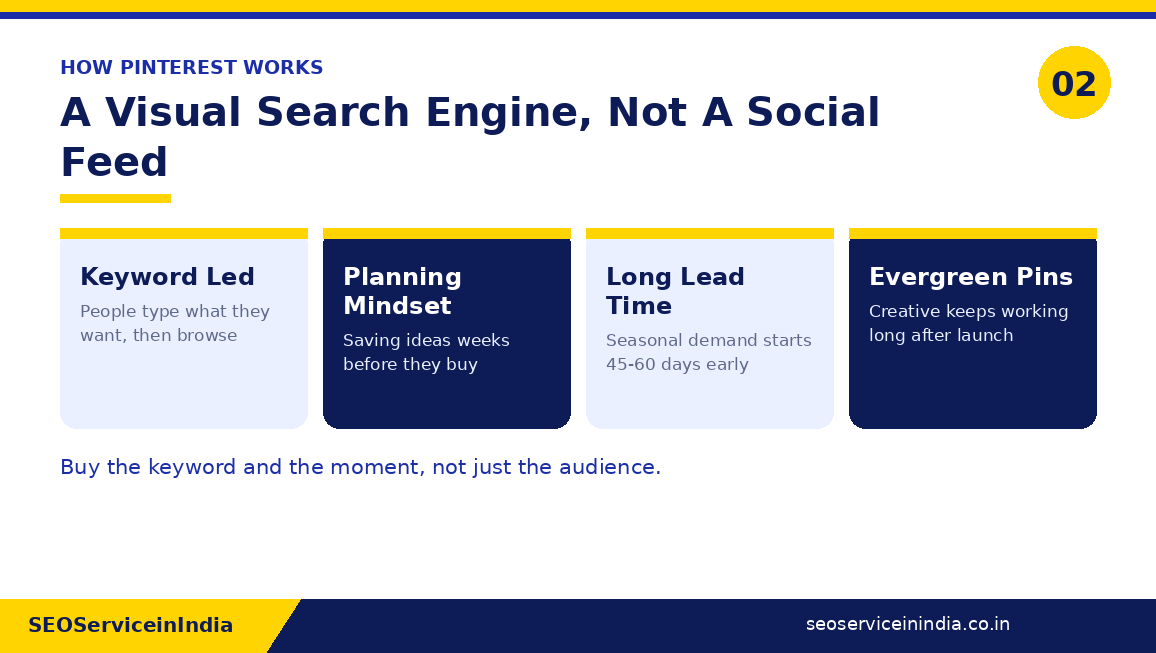
Four behaviours separate Pinterest from every other paid channel you run. Get these right and the account structure, the creative and the way you measure all change with them.
01
People Search First, Then Browse
The journey usually starts with a typed query, not an algorithmic feed. That makes keyword targeting the primary lever here — closer to how you would build a search campaign than a social one. We research the terms your buyers actually use on the platform, which are frequently more descriptive and more visual than their Google equivalents, and layer interests and audiences around that keyword core rather than in place of it.
02
The Mindset Is Planning, Not Impulse
Pinterest users are usually assembling an idea rather than making an immediate purchase. This is why a Pin can earn thousands of saves and few same-day sales, and why judging the channel on a seven-day last-click window makes it look like it failed. The right response is not to force urgency into the creative — it is to capture the person now, retarget them as the decision nears, and measure over a window that matches how they actually buy.
03
Demand Arrives Early and Seasonally
Seasonal searching starts far earlier here than on other platforms. People plan Christmas in September and summer weddings in winter. A campaign launched in the week of the event is competing for people who have already decided. Our packages include a calendar that puts campaigns live roughly 45 to 60 days ahead of each moment, which for seasonal businesses is often the single biggest change we make.
04
Creative Has a Long Shelf Life
Unlike a feed post that dies in 48 hours, a strong Pin keeps earning impressions and saves for months, and a promoted Pin also builds organic distribution on the same asset. That changes the economics of creative production: you are building a library rather than feeding a machine, and the winners are worth investing in properly.
Formats
The Ad Formats We Run and When Each Works
Every format on Pinterest earns its place for a different job. We choose them against your product, your margin and the stage of the journey you are buying, not because a format is new.
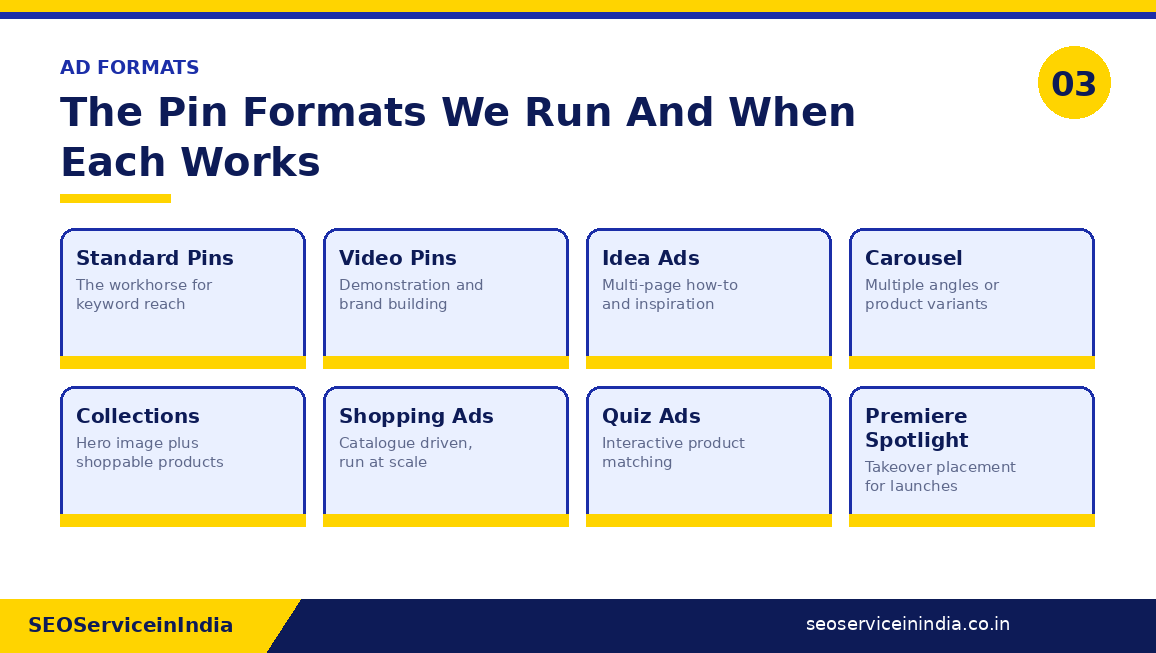
Standard Pins
The workhorse. Cheap to produce, easy to iterate, and the format that carries most keyword-led reach. Vertical 2:3 creative with legible text overlay outperforms repurposed square assets consistently, which is why we never simply port Instagram creative across.
Video Pins
Best for demonstration, transformation and anything where the product needs to be shown working — before and after, texture, scale, assembly. Video also holds attention in categories where static images all start to look alike.
Idea Ads
Multi-page, how-to style content that fits the platform's native behaviour rather than interrupting it. Strong for top of funnel in food, DIY, beauty and home, where teaching something buys you the attention that a hard sell would not.
Carousel and Collections
Carousel earns its place when one product has several angles worth showing or when you are presenting variants. Collections pair a hero lifestyle image with shoppable products underneath, which suits retail brands whose products are bought as a set rather than individually.
Shopping and Catalogue Ads
For eCommerce this is usually where the revenue is. We connect and clean the product feed, build product groups that reflect your margin rather than just your category tree, and run catalogue-driven campaigns and retargeting that scale without needing a new creative for every SKU.
Quiz Ads and Premiere Spotlight
Quiz ads work well for matching a customer to the right product in ranges where choice is confusing — skincare, paint, furniture. Premiere Spotlight is a premium takeover placement worth considering for launches and major seasonal pushes, but only when there is a budget and an event big enough to justify it. We will say when there is not.
Package Inclusions
What Is Included in Every Package
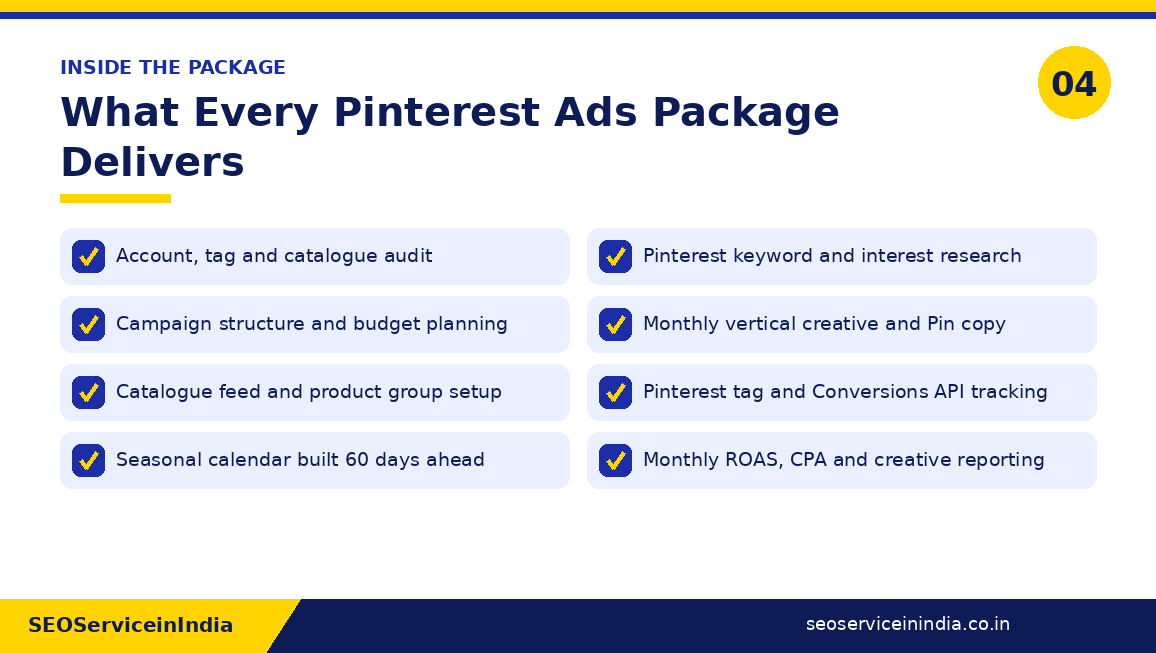
Every package includes the work below at every price point. What changes between tiers is creative volume, catalogue scope and the number of markets we run.
01
Account, Tag and Catalogue Audit
Before spending, we check the Pinterest tag, conversion events, catalogue connection, claimed website and any historical campaign data. Feed and tag problems are the most common reason a Pinterest account reports poorly, and both are fixable in the first fortnight.
02
Keyword and Interest Research
A proper keyword set built from Pinterest's own search behaviour, with negatives to keep you out of irrelevant queries, plus the interest and audience layers that broaden reach once the keyword core is performing. We also mine your organic Pin data, which often shows exactly which language your audience already responds to.
03
Campaign Structure and Budget Planning
Campaigns separated by objective and funnel stage, budgets set so each can gather enough conversions to optimise, bidding chosen deliberately, and audiences sized against spend. Naming conventions are standardised so the account is still readable a year later.
04
Creative Production Built for the Platform
Monthly vertical Pins and Pin copy designed for how people scan a Pinterest grid: strong visual hierarchy, readable text overlay, a clear subject and lifestyle context. We plan concepts against specific hypotheses, iterate winners, and retire what has stopped earning saves.
05
Catalogue Feed and Product Groups
Feed connection, disapproval fixes, attribute enrichment and product grouping aligned to margin and stock levels, so the algorithm is not spending your budget on your least profitable or least available items.
06
Pinterest Tag, Conversions API and Attribution Setup
Browser tag plus server-side events, deduplicated, with conversion windows configured to reflect Pinterest's longer decision cycle. We set the reporting view before the campaign starts, so nobody is arguing about attribution three months in.
07
Seasonal Planning Calendar
A documented calendar of the moments your category sells into, with launch dates set 45 to 60 days ahead, creative deadlines working backwards from those dates, and budget shaped around the peaks rather than spread evenly across the year.
08
Reporting You Can Act On
Monthly reporting on spend, revenue or leads, cost per acquisition, ROAS on both Pinterest's window and your own analytics, saves and outbound clicks as leading indicators, creative-level results, and what changes next month.
Audit to Scale
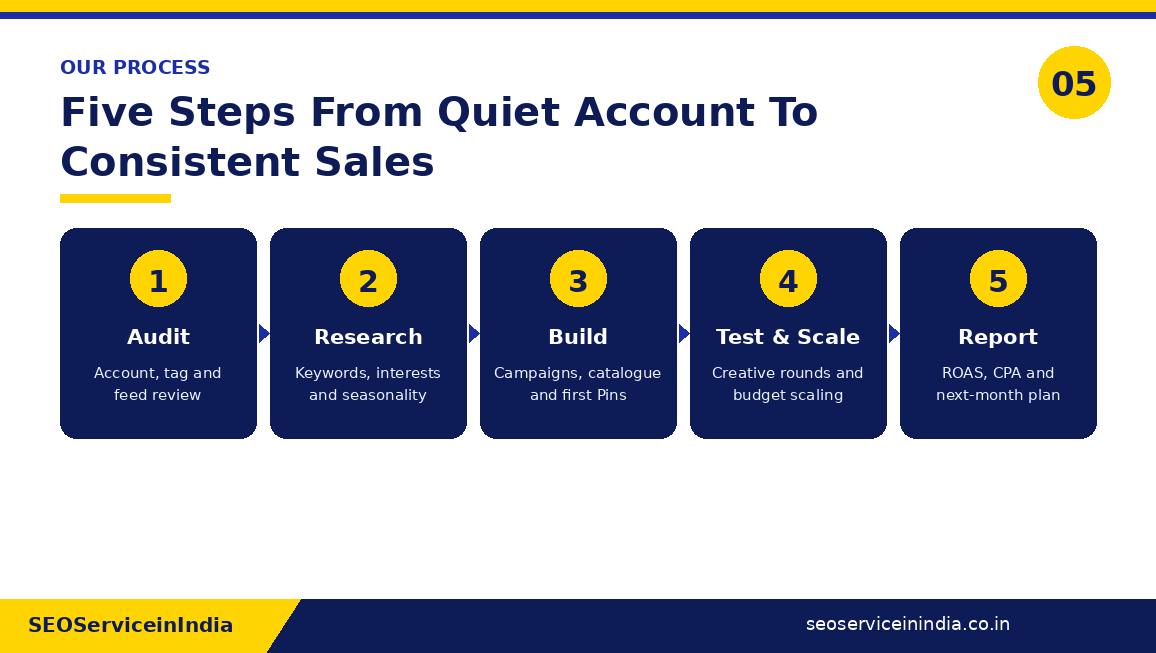
Our Five-Step Process
The same sequence runs on every account, so you always know what is happening this month and what is being decided next.
01
Step 1 — Audit
Account, tag, catalogue, organic Pin performance and past campaigns reviewed and benchmarked against your category. The findings are yours whether or not you proceed.
02
Step 2 — Research
Keyword and interest sets, competitor Pin analysis and the seasonal map for your category, agreed with you before anything is built.
03
Step 3 — Build
Campaigns, audiences, catalogue groups, tracking and the first creative round go live against an agreed target cost per acquisition.
04
Step 4 — Test and Scale
Structured creative rounds, keyword and placement refinement, and measured budget increases into what is working — with the seasonal calendar driving when each push happens.
05
Step 5 — Report and Plan
Monthly review against the agreed targets, with next month's creative and campaign hypotheses attached so the plan keeps moving.
Packages
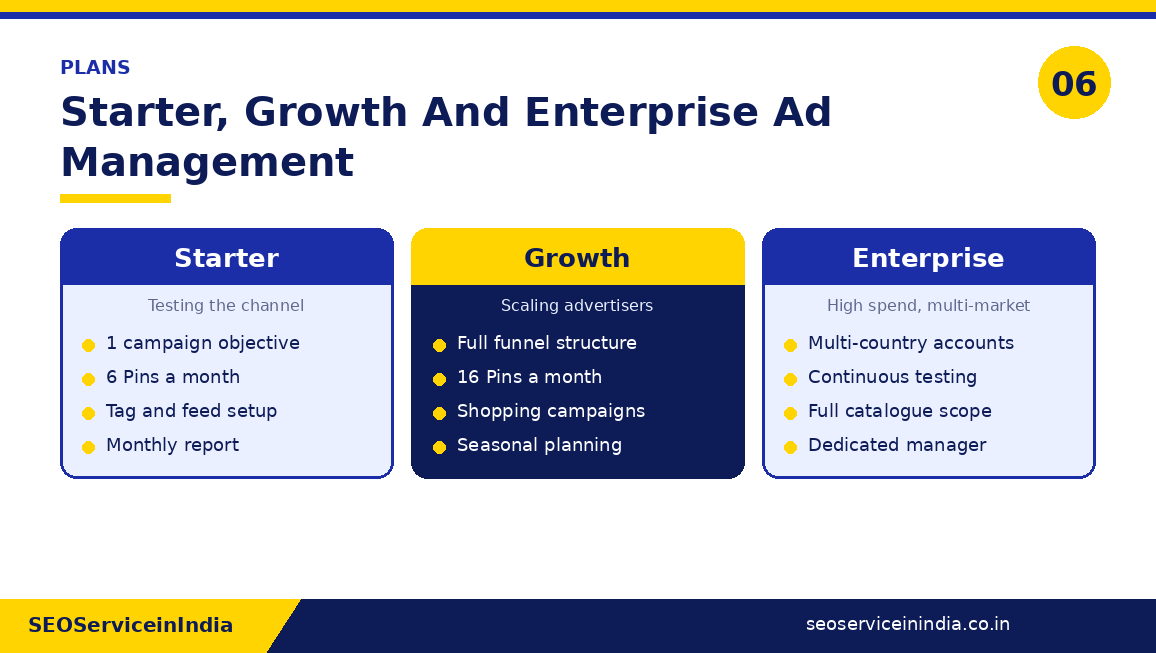
Choose Your Pinterest Ads Package
Pricing depends on monthly ad spend, catalogue size, how many markets you run and whether creative production sits with us. Management fees are quoted upfront as a flat retainer or a percentage of spend, and your ad spend is billed by Pinterest directly to your own account.
Starter — Testing the Channel
For brands proving Pinterest works for them. One primary objective, keyword-led prospecting with retargeting, six Pins a month, tag and catalogue setup, and monthly reporting.
Growth — Scaling Advertisers
Our most common plan. Full funnel structure, sixteen Pins a month across static and video, shopping campaigns with managed product groups, seasonal calendar planning, audience expansion and competitor monitoring.
Enterprise — High Spend and Multi-Market
For larger retailers and multi-country brands. Multi-market account management, full catalogue scope, continuous creative testing, incrementality checks against your other channels, a dedicated manager and quarterly strategy sessions.
Realistic Timelines
Results Advertisers See
Month by month
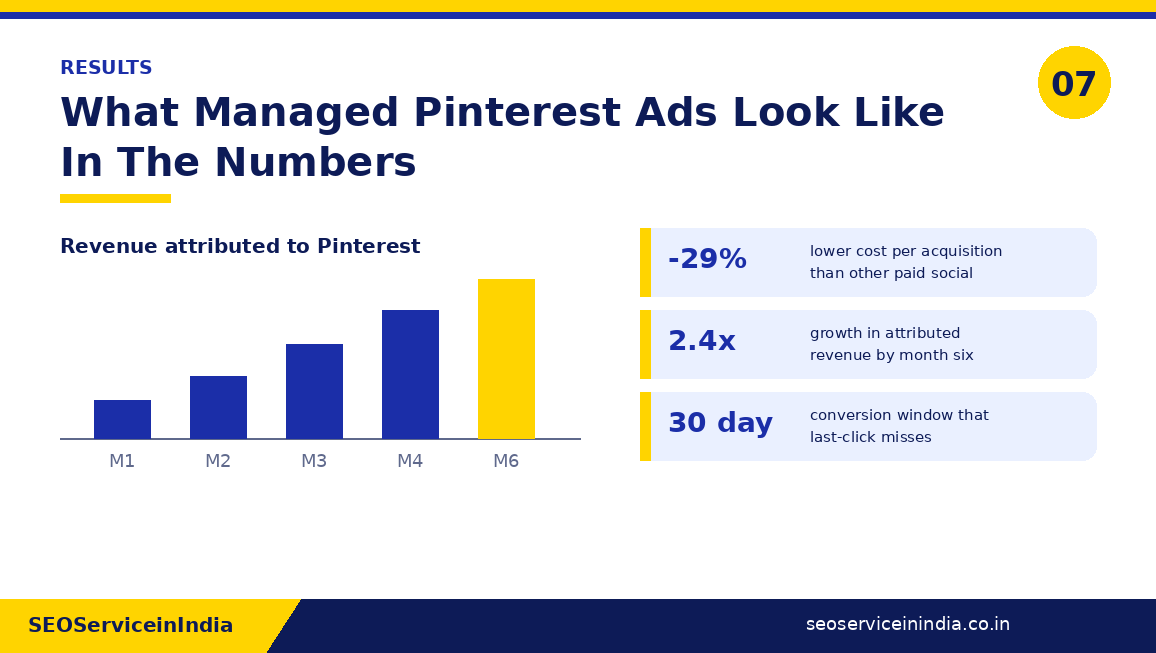
Pinterest builds rather than spikes. The first month is usually tag and feed repair plus the first creative round. Cost per acquisition typically improves through months two and three as keyword sets tighten and winning Pins emerge, and the compounding effect — evergreen creative continuing to earn impressions while new Pins are added — shows most clearly from month four onwards. For brands in the platform's strong categories, cost per acquisition often lands below what they pay on other paid social channels, though volume is usually smaller.
Those are patterns, not promises. Results depend heavily on category fit, creative quality, average order value and how well your market is served by the platform. Pinterest's audience is deepest in the US, UK, Canada and Australia; if your market or category is thin, we will tell you at the audit rather than take a retainer for a channel that cannot deliver your volume.
Why Us
Why Advertisers Choose SEOServiceinIndia
We Treat Pinterest as Search, Not Social
Keyword structure, negatives and query intent are handled the way a search specialist would handle them, then combined with the creative discipline the platform demands. Accounts run purely on interest targeting leave most of the platform's advantage unused.
Creative Made for the Grid
Vertical formats, readable overlays and lifestyle context are written into every package with a monthly volume attached — not treated as an add-on. Repurposed square Instagram assets are the most common reason a Pinterest account underperforms, and we do not run them.
Honest Attribution and Honest Fit
We set the attribution window with you before launch, report Pinterest's numbers alongside your own analytics, and explain the gap rather than quoting whichever is flattering. And where Pinterest is not the right channel for your category, we say so — there are businesses we have turned down for exactly this reason.
Working Across the USA, UK, Canada, Australia, Singapore and India
Account management runs on your working hours, with keyword research done in each target market and seasonal calendars built to local moments rather than a single Northern Hemisphere calendar copied everywhere.
Your Account Stays Yours
We work inside your Pinterest Ads Manager and business account, never a hidden agency account. Your tag history, audiences and catalogue stay with you if we part ways.
Category Fit
Who These Packages Are Built For
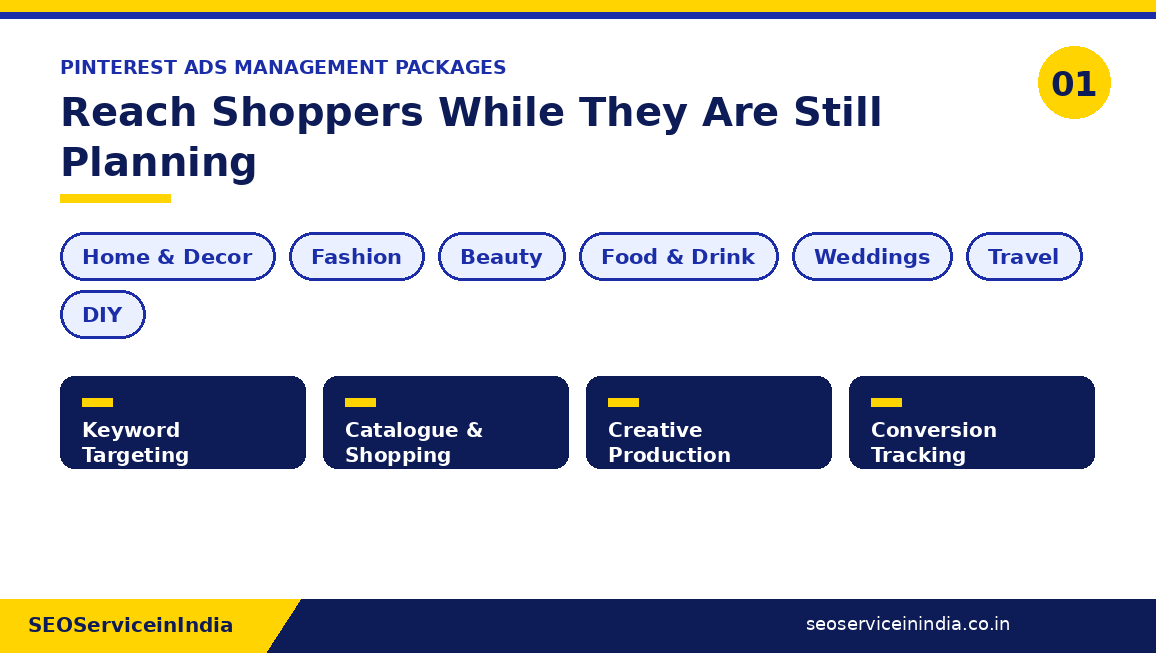
Home, furniture and decor brands, where Pinterest is often the strongest performing paid channel available. Fashion, jewellery and accessories retailers. Beauty and skincare brands with a visual before-and-after story. Food, drink and recipe businesses. Wedding and event suppliers, whose customers plan months ahead. Travel and hospitality brands selling a destination rather than a transaction. DIY, craft and garden retailers. And subscription or digital products in planning-led categories such as budgeting, fitness and organisation.
If your product is bought urgently rather than planned, sold to a narrow professional audience, or sits in a category with little visual appeal, Pinterest is unlikely to be your best first channel — and that is what we will recommend at the audit.
Free Audit
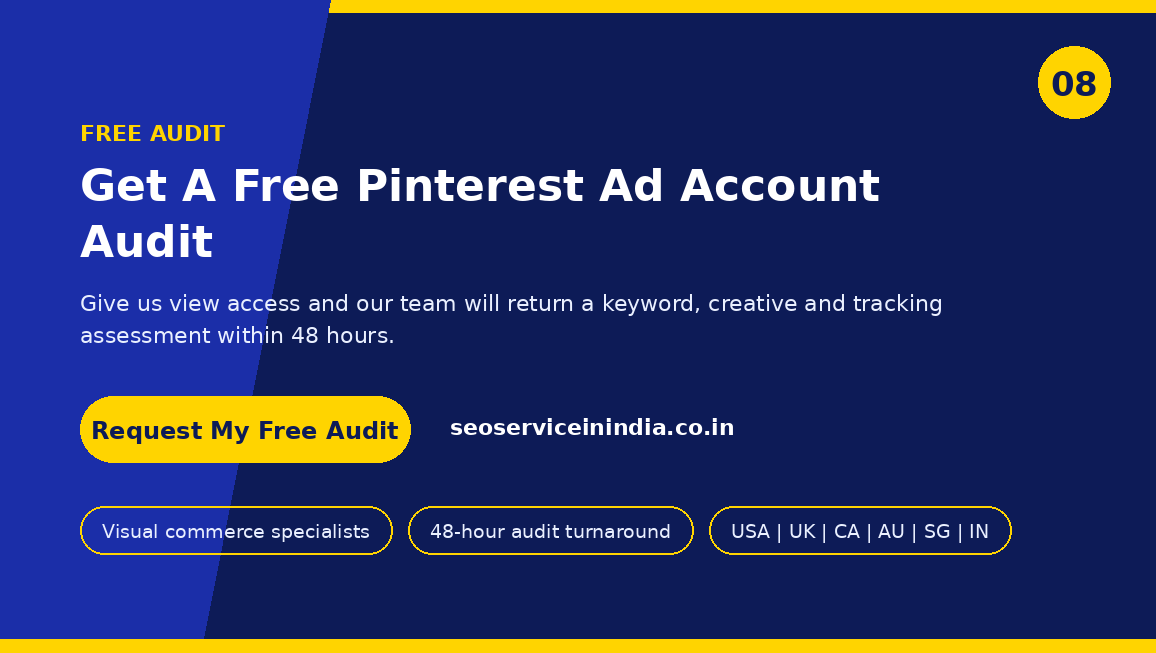
Start With a Free Pinterest Ad Account Audit
Give us view access to your Pinterest Ads Manager and we will return an assessment within 48 hours: whether your tag and catalogue are reporting correctly, which keywords you are missing, how your creative compares with the Pins winning in your category, whether your seasonal timing is too late, and what the first 60 days would target.
No obligation, and the findings are yours to keep whether or not you hire us. Talk to a Pinterest ads specialist today and find out whether the channel deserves a place in your mix.
They work well in planning-led, visual categories — home, fashion, beauty, food, weddings, travel, DIY — where people are choosing what to buy before they choose where to buy it. They work poorly for urgent purchases and narrow professional audiences. The honest answer is category-dependent, and the audit tells you which side you are on.
Enough for campaigns to gather conversion data within a month, and enough runway to see a longer decision cycle play out — usually a minimum of three months rather than a four-week trial. Judging Pinterest on thirty days of spend produces a misleading answer in either direction.
Pinterest counts conversions within a longer click and view window than a last-click analytics setup, because its users take longer to decide. Neither number is wrong, they are measuring different things. We agree the reporting view before launch and show both, so the comparison is settled early rather than argued over later.
You can, and it usually underperforms. Pinterest is a vertical, text-friendly, search-led grid; square feed creative with social-style copy is visually weaker and semantically thinner there. Producing platform-native Pins is one of the cheapest performance gains available.
Roughly 45 to 60 days before the moment, sometimes more for major seasons. Pinterest users plan earlier than users of any other major platform, so campaigns launched in the event week are reaching people who have already decided.
Both, at the level each package specifies. We plan concepts and write Pin copy in every plan, and can design the Pins, edit video and direct shoots, or brief your in-house design team. Given how much creative drives results here, media buying alone rarely justifies the retainer.
It is usually cheaper per acquisition and smaller in volume. Most retail brands should run both: Facebook and Instagram for scale, Pinterest for efficient reach into planning-stage demand your other channels never see. If budget only stretches to one, category fit decides it.
A flat monthly retainer or a percentage of ad spend, agreed upfront, with ad spend billed by Pinterest directly to your own payment method. We ask for an initial three months because of the longer decision cycle, then it runs monthly.