Home/Digital Podcast Submission Services | Get Found Fast
Digital Podcast Submission Services | Get Found Fast
Podcast distribution
Digital Podcast Submission Services
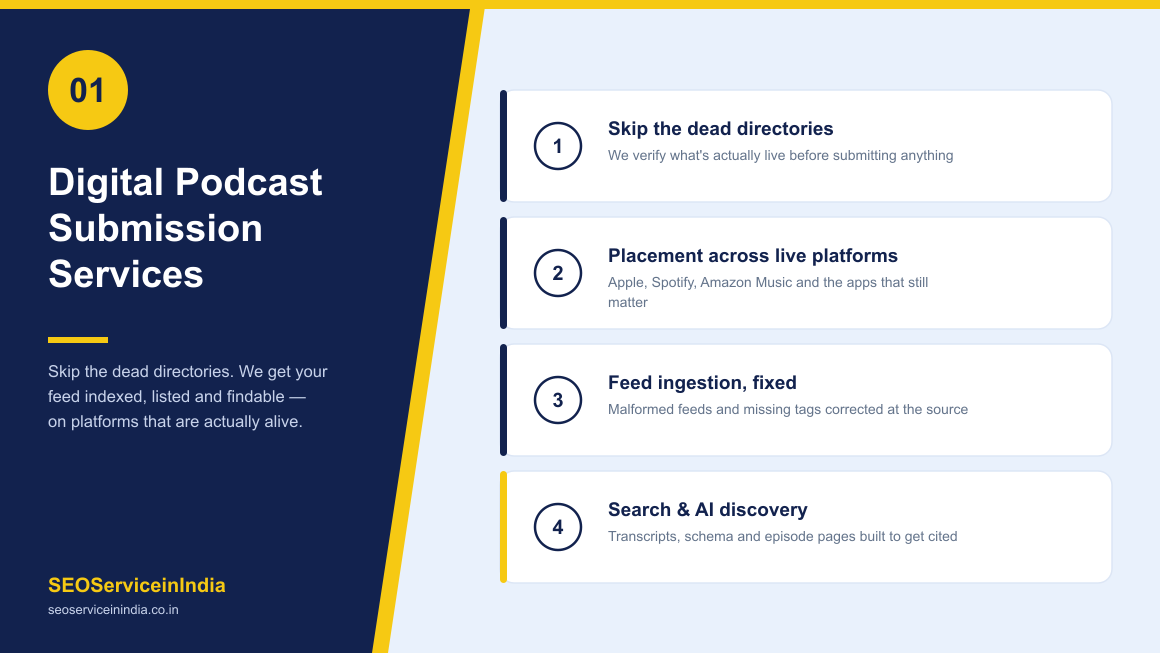
If you found this page after reading a "Top 50 podcast submission sites" list that included digitalpodcast.com, you deserve a straight answer before you spend anything: that directory is no longer operating. Our digital podcast submission services take the intent behind that search — getting your show indexed, listed and findable — and point it at platforms that are actually alive in 2026.
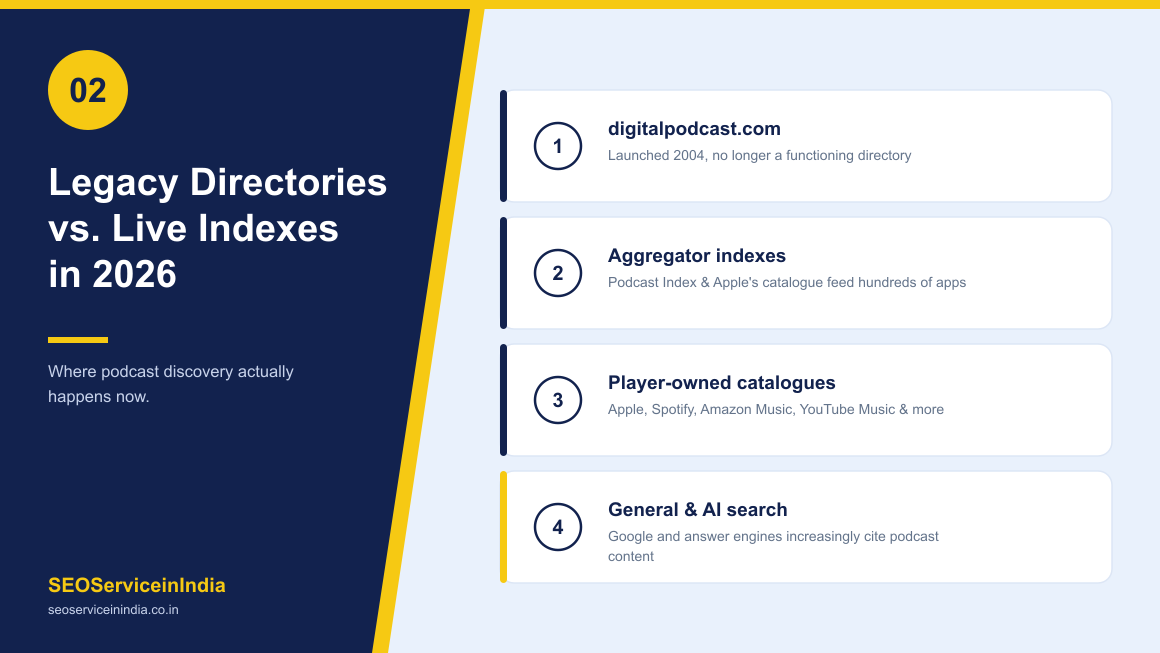
digitalpodcast.com launched in 2004 as one of the earliest podcast search engines. In the pre-Apple era it mattered. It carried category browsing, OPML feed exports and an open submission form, and for a few years it was a legitimate way to get a new show discovered.
It has not functioned as a working directory for a long time. Its OPML feeds return errors, the submission path no longer completes, and the domain does not serve a functioning index. What keeps the name alive is search: dozens of blog posts titled "50 places to submit your podcast" copy each other year after year without anyone checking whether the entries still exist. The list gets republished, the keyword keeps getting searched, and podcasters keep spending hours submitting to ghosts.
We are not going to sell you a submission to a site that cannot receive one. We have handled the same situation on other platform pages, and the answer is always the same — state the fact, then do the job the client actually needed. If your goal was "get my podcast indexed and discoverable," that goal is entirely achievable. It just runs through different infrastructure now.
Modern discovery
What Replaced The Old Podcast Search Engines
Discovery moved in three directions after the early directory era ended.
Aggregator indexes. Podcast Index, iTunes/Apple's public catalogue and similar open databases are now the source of truth that hundreds of smaller apps read from. Get into these and you appear in players you have never heard of, automatically.
Player-owned catalogues. Apple Podcasts, Spotify, Amazon Music, YouTube Music, iHeartRadio, Deezer, TuneIn, Podbean, Castbox, Pocket Casts, Player FM, Podchaser and fyyd each maintain their own listings, with their own submission or claim processes.
General and AI search. Google indexes episode pages, transcripts and structured data. Answer engines increasingly cite podcast content when the text of that content exists somewhere crawlable. This is the fastest-growing discovery channel and the one almost nobody optimises for, because it requires SEO work rather than form-filling.
Old-style directory submission solved one of these. Modern podcast visibility needs all three.
Visibility framework
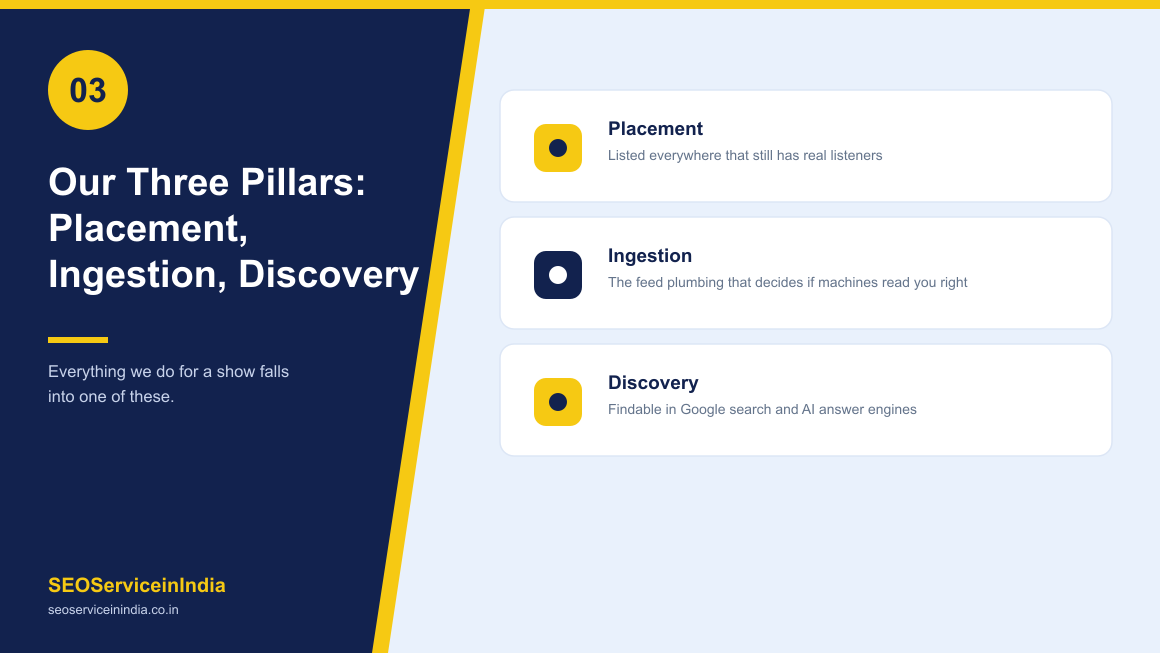
Our Three Pillars: Placement, Ingestion, Discovery
Everything we do for a show falls into one of these.
01
Pillar one — Placement
Getting your show listed everywhere that still has listeners. That means submitting to and verifying ownership across the live directories, claiming your show profile on each platform so you control the metadata, and cleaning up duplicate or abandoned listings from earlier attempts or host migrations.
02
Pillar two — Ingestion
Making sure machines can read your feed correctly. A directory listing is worthless if the feed behind it is malformed, if episodes silently fail to appear, or if your artwork does not meet specification. Ingestion is the plumbing, and it is where most "I submitted but nothing happened" stories actually break.
03
Pillar three — Discovery
Making your show findable in search — Google, and increasingly AI answer engines. This is transcripts, canonical episode pages on your own website, structured data, internal linking and episode-level keyword work. It is the part that keeps producing listeners long after the submissions are done.
Technical foundation
Feed Audit And Validation
Before any submission we validate the feed line by line.
We check that the RSS 2.0 structure is well-formed and publicly reachable, that enclosure URLs resolve and serve the correct MIME type, that episode GUIDs are stable and unique so platforms do not treat re-published episodes as duplicates, that the owner email tag is present and monitored because most verification codes are sent there, and that cover artwork meets the size and format rules the strictest platforms enforce. We confirm language declaration, category assignment, explicit flags and country of origin, and we look for the small errors that cause silent failures — stray characters in the XML, unescaped ampersands, relative URLs where absolute ones are required, and feeds that time out under crawler load.
We also check Podcasting 2.0 namespace tags. These are the modern additions that open indexes and newer apps read: a permanent podcast:guid that identifies your show across platforms regardless of feed URL changes, podcast:transcript pointing to machine-readable transcripts, podcast:locked to prevent unauthorised feed hijacking, plus chapters, funding and person tags. Most feeds we audit have none of them. Adding them costs nothing and materially improves how your show is represented across the open ecosystem.
Live directories
Submission To The Directories That Still Matter
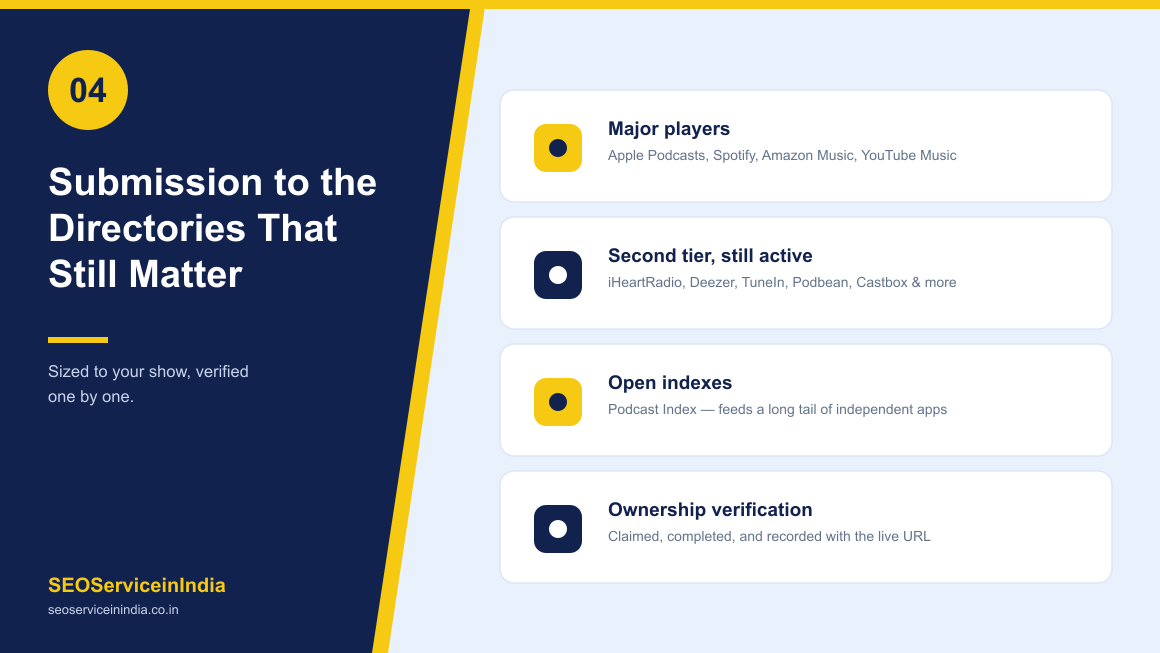
We handle submission and verification across the live catalogue, sized to your show and audience:
The major players first — Apple Podcasts, Spotify, Amazon Music and YouTube Music — because they account for the overwhelming majority of listening. Then the second tier that still delivers real traffic: iHeartRadio, Deezer, TuneIn, Podbean, Castbox, Pocket Casts, Player FM, Podchaser, Podcast Addict, Overcast, Goodpods and fyyd. Then the open indexes, particularly Podcast Index, which feed a long tail of independent apps.
For each one we submit correctly, complete verification, claim ownership where a claim process exists, and record the live URL. Where a platform has no submission form and ingests from Apple or from an open index, we say so rather than inventing a step — several popular apps work exactly this way, and the honest answer is that fixing the upstream listing fixes the downstream one.
Search discovery
Making Your Podcast Findable In Search
This is where the "digital podcast" search intent is genuinely served in 2026.
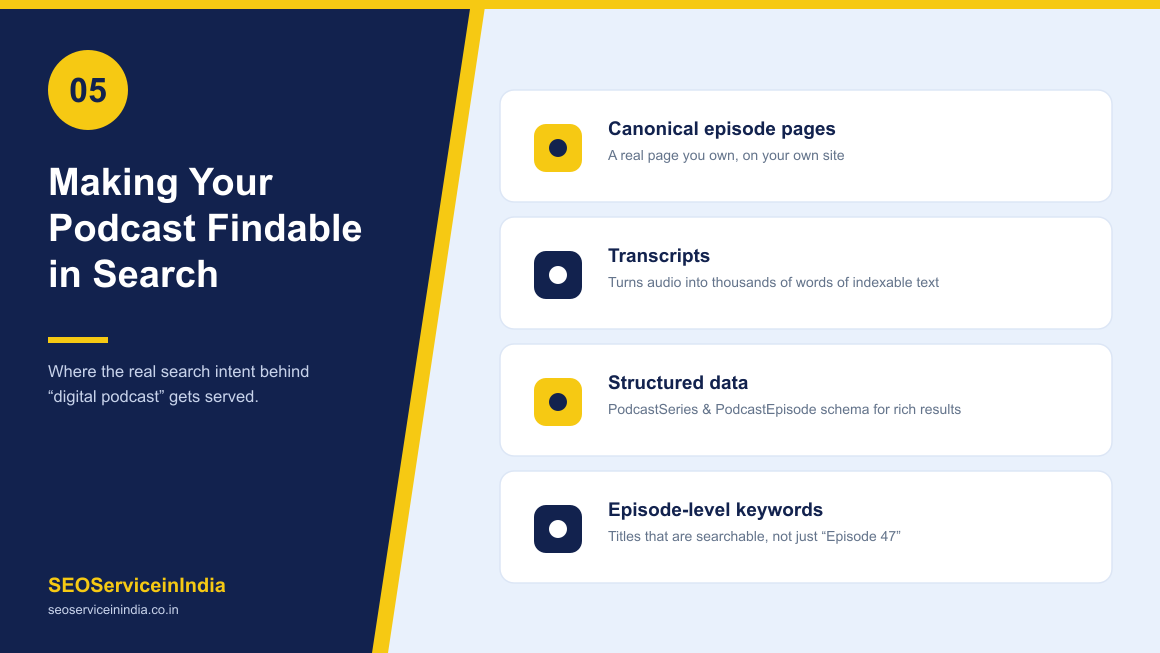
Canonical episode pages. Every episode gets a real page on your own website — title, description, embedded player, show notes and transcript. Directories own their listings; you own your site. Episode pages are the only podcast asset you fully control and the only one that builds domain authority for you.
Transcripts. Audio is invisible to search engines. A transcript turns a forty-minute conversation into several thousand words of indexable, quotable text. It also makes your show accessible, satisfies the podcast:transcript tag, and gives AI answer engines something to cite when someone asks a question your episode answered.
Structured data. PodcastSeries and PodcastEpisode schema on your site tells search engines exactly what the page contains and how episodes relate to the show. Combined with clean internal linking, it is how a podcast starts appearing in rich results rather than as a plain blue link.
Episode-level keyword work. Episode titles are indexed by directories, by Google, and by in-app search. "Episode 47" tells nobody anything. A title carrying the actual topic is searchable in every one of those places at once.
Answer-engine surfacing. When your transcripts, show notes and structured data are all in place, the content of your episodes becomes citable material. This is a compounding advantage and it is currently uncontested in most niches.
Problems we fix
Common Problems We Fix
Submitted months ago, still not listed. Usually a feed error the platform never reported back, or a verification email sent to an address in the feed that nobody reads.
Two listings for the same show. Almost always caused by resubmitting after changing hosts. The correct fix is a 301 redirect from the old feed plus a removal request, not a third submission.
Episodes stopped appearing. A broken feed URL, a malformed episode entry blocking everything after it, or a host change that was never propagated.
Artwork wrong or outdated across platforms. Cached feeds. We force refreshes and confirm each platform updates.
Listed everywhere, no listeners. This is the most common one and it is not a distribution problem. It is a discovery problem, and it is solved by pillar three, not by submitting to more directories.
Hours lost to dead submission sites. The reason this page exists. We maintain a working list and we do not bill for submissions that cannot complete.
Who it helps
Who These Services Are For
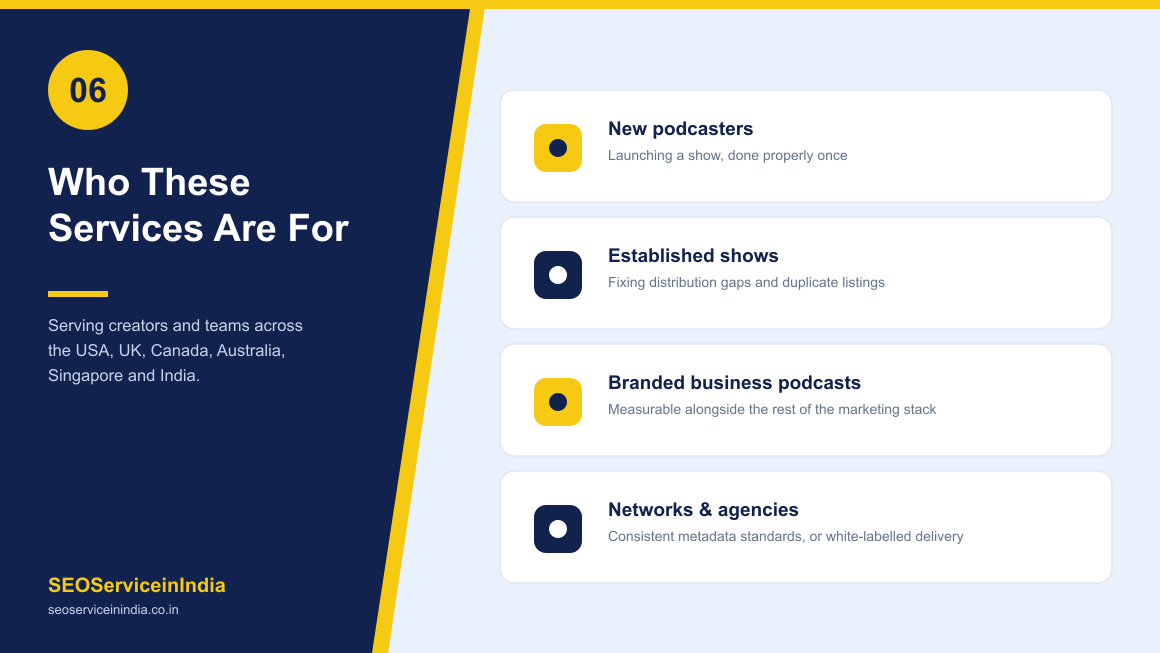
New podcasters launching a show who want it done properly once rather than fixed later.
Established shows with distribution gaps, duplicate listings or a feed that has quietly been broken for months.
Businesses running branded podcasts where the show supports lead generation and needs to be measurable alongside the rest of the marketing stack.
Media companies and networks managing multiple shows that need consistent metadata standards across a catalogue.
Agencies white-labelling podcast distribution and podcast SEO for their own clients.
We work with clients across the USA, UK, Canada, Australia, Singapore and India, and we schedule around your timezone rather than ours.
Why choose us
Why Work With SEOServiceinIndia
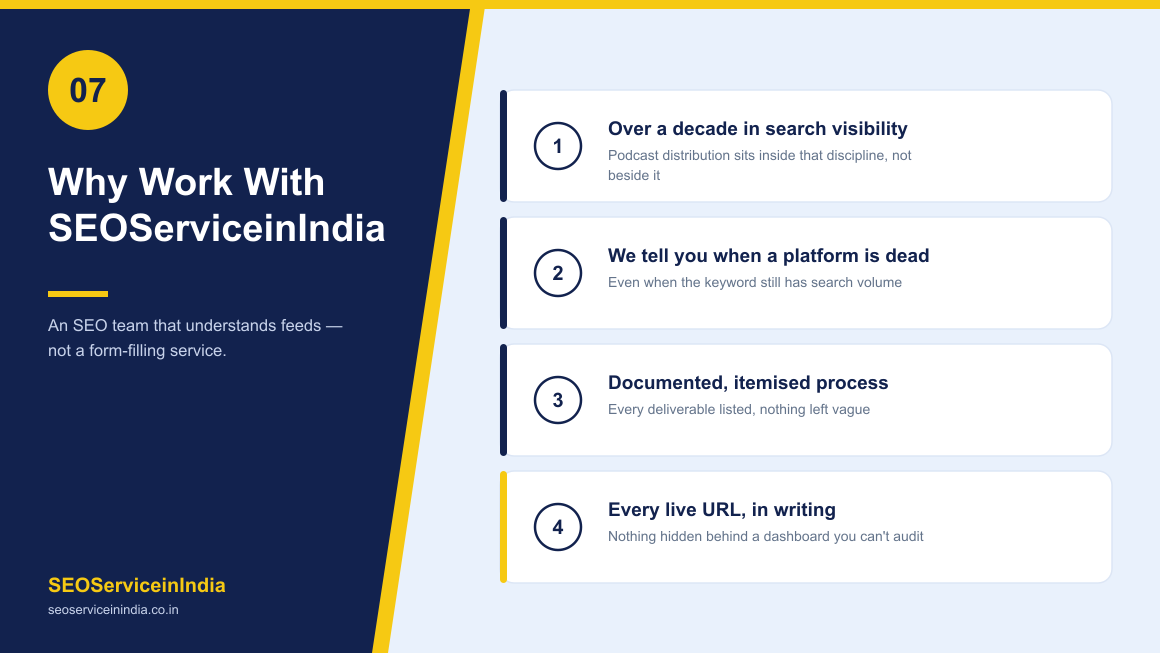
We have spent more than a decade on search visibility, and podcast distribution sits inside that discipline rather than beside it. An RSS feed is a structured document that machines parse — the same thinking that governs schema markup, crawl budget and indexation governs whether a show gets ingested, categorised and surfaced correctly. Most podcast submission providers are form-fillers. We are an SEO team that understands feeds, which is a different service.
That background is also why we tell clients when a platform is dead. This page could easily have sold you a digitalpodcast.com listing — the keyword has volume, the listicles keep feeding it, and you would not have known the difference for months. We would rather be the page that told you the truth and earned the work that follows.
Our process is documented, our deliverables are itemised, and you receive every live URL, every metadata change and every recommendation in writing. Nothing is hidden behind a dashboard you cannot audit.
Our workflow
Our Process, Step By Step
01
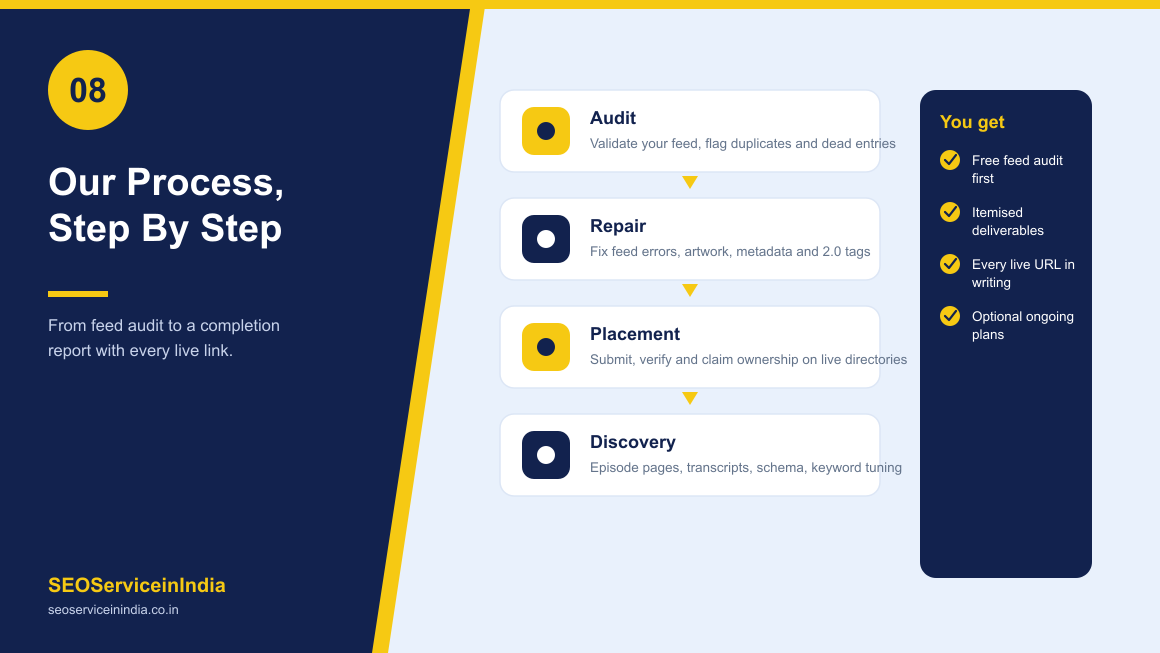
Step one — audit. We validate your feed, review existing listings, identify duplicates and dead entries, and report exactly what is blocking ingestion or discovery. You receive this whether or not you proceed.
02
Step two — repair. We fix feed errors, rebuild artwork to specification, rewrite show and episode metadata for both readers and search, and add the Podcasting 2.0 tags your feed is missing.
03
Step three — placement. We submit to and verify every live directory that fits your show, claim ownership profiles, and resolve duplicates through redirects rather than fresh submissions.
04
Step four — discovery. We build or optimise canonical episode pages, add transcripts, implement PodcastSeries and PodcastEpisode schema, and tune episode titles and descriptions for search.
05
Step five — reporting and maintenance. You get a completion report with every live link and every change made. Ongoing plans add monthly feed health checks, new-episode optimisation and consolidated performance reporting across platforms.
Free audit
Start With A Free Feed Audit
Send us your RSS feed. We will tell you what would pass, what would be rejected, which of your existing listings are broken or duplicated, and what is standing between your show and search visibility. No obligation, and the findings are yours either way.
Contact SEOServiceinIndia to get your podcast properly submitted, indexed and found.
No. It was one of the original podcast search engines from 2004, but it no longer operates as a functioning directory. It survives mainly in outdated "top podcast submission sites" listicles that get republished without anyone verifying the entries.
Submit to the platforms that still have listeners — Apple Podcasts, Spotify, Amazon Music, YouTube Music and the second tier of active apps — and then invest in search discoverability through transcripts, episode pages and structured data. That combination replaces what the old directories used to provide.
Roughly fifteen to twenty live platforms cover almost everyone who listens. Beyond that you are adding listings nobody browses. Volume is not the goal; the goal is being present everywhere real listening happens and being findable in search.
You need a valid, publicly accessible RSS feed. A host is the simplest way to have one, but if you generate your own feed we can work with that directly.
Yes. Diagnosing failed submissions, broken feeds and duplicate listings is a large part of what we do, and it is usually faster than starting over.
That normally follows a host migration. The correct fix is a 301 redirect from the old feed to the new one plus a removal request to the affected platforms — not another submission, which would create a third listing.
Yes. Search engines cannot read audio. A transcript converts each episode into indexable text, supports accessibility, satisfies the transcript tag in modern feeds, and gives AI answer engines something to cite.
They are newer RSS namespace tags — a permanent show GUID, transcript links, feed locking, chapters and more — read by open indexes and modern apps. They cost nothing to add and improve how your show is represented across the ecosystem.
The audit takes a few days. Feed repair and submissions typically complete within one to two weeks, with individual platform approvals ranging from a few hours to several days. Discovery work is ongoing by nature.
Yes. Most of our podcast clients are in the USA, UK, Canada, Australia and Singapore, and we schedule calls and reporting around your working hours.