Home/SEO for Software Companies | SaaS & IT Firm SEO Agency
SEO for Software Companies | SaaS & IT Firm SEO Agency
Software · SaaS · IT Firms
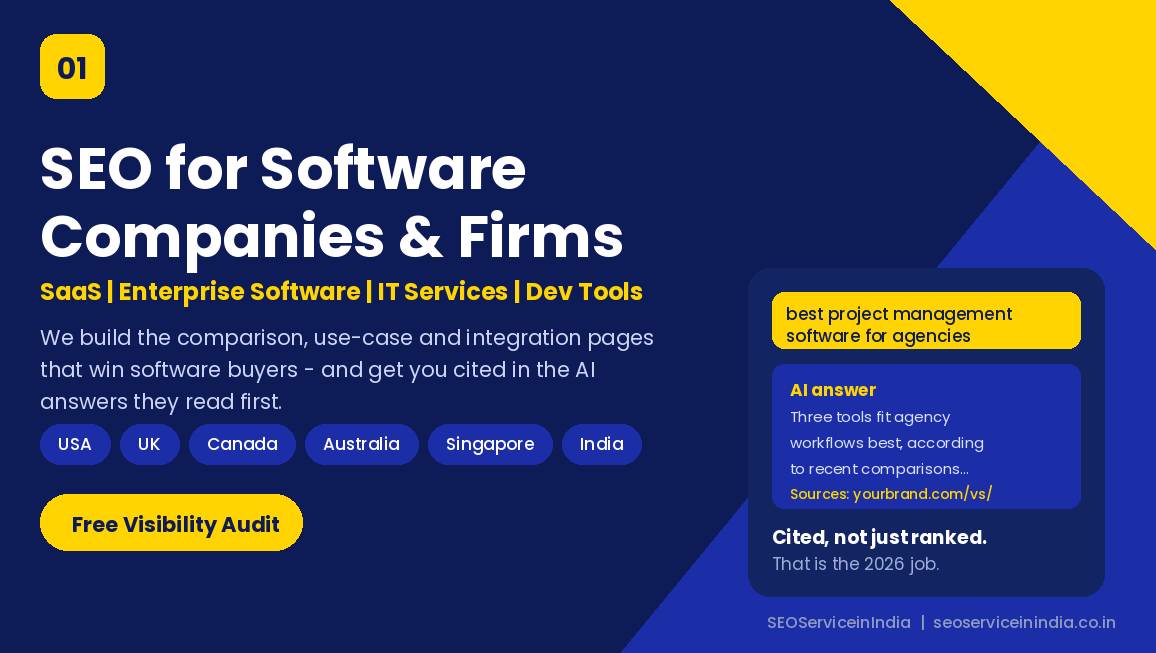
SEO for Software Companies and Firms: Get Found, Compared and Chosen
Software buyers no longer start on your website. They ask an AI assistant which tools fit their situation, read a comparison page written by someone else, scan a review site, and only then open two or three vendor sites with their shortlist already formed. By the time a buyer reaches your homepage, most of the evaluation has happened somewhere you were either present or absent. That is the whole job now: be present in those places, and give the buyer a reason to pick you when they finally arrive.
It is also why the old software SEO playbook has stopped paying. Publishing a hundred top-of-funnel blog posts to catch definitional searches worked when those searches produced clicks. They increasingly produce an AI answer instead. The leverage has moved down the funnel, to the comparison, use-case, integration and product pages that carry information no summary can replace. We build software SEO from that end upward, for SaaS products, enterprise software vendors, developer tools and IT services firms across the United States, the United Kingdom, Canada, Australia, Singapore and India — one of our SEO packages by industry.
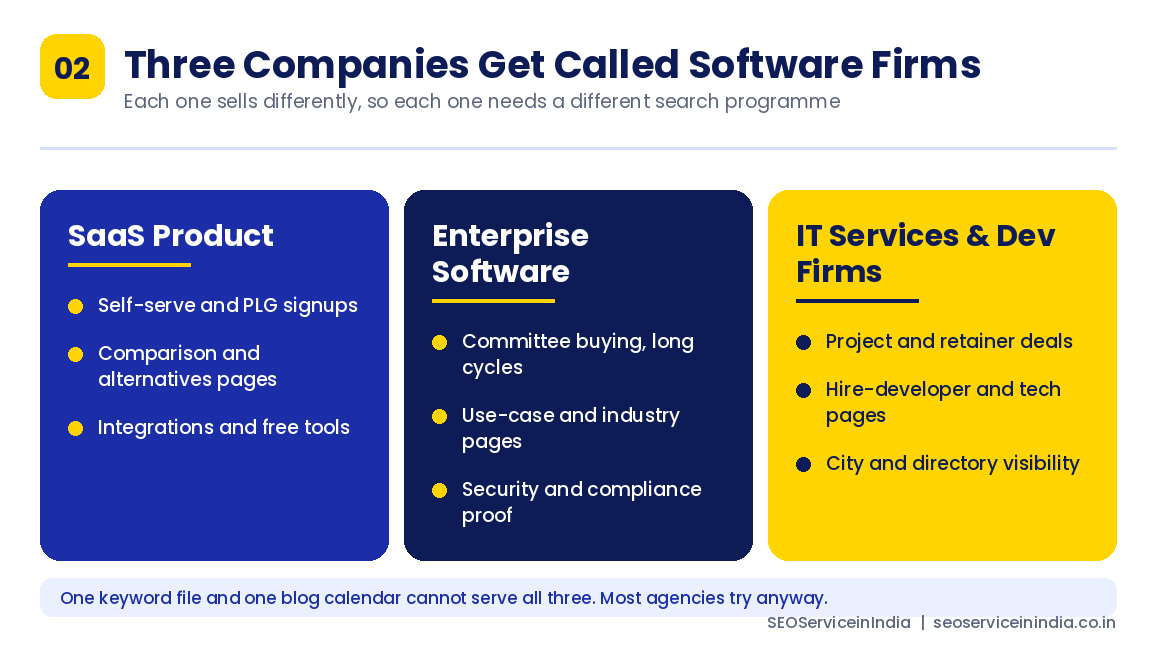
Three Very Different Companies Get Called Software Firms
Most agencies run one playbook across all three and wonder why two of them underperform. These businesses sell differently, to different people, over very different timeframes, so they have to be found differently. The first question we ask a new software client is which of the three they actually are — and a surprising number are two at once, running a product alongside a services arm, with one website trying to serve both.
SaaS products
The buyer self-serves. They search a category, compare two tools, check whether it connects to the rest of their stack, and start a trial without speaking to anyone. Comparison pages, alternatives pages, integration pages and free tools do the selling, and the metric that matters is qualified signups, not sessions. Head terms like 'best CRM software' are held by review aggregators; the winnable ground is everything more specific than that.
Enterprise software
A committee buys: a business owner, a technical evaluator, procurement and often security. The cycle runs for months and rarely starts with a search for your product. It starts with a problem, which is why use-case and industry pages outperform product pages, and why security, compliance and integration documentation belongs in the SEO scope rather than in a locked PDF. If a security reviewer cannot find your SOC 2 or data residency answer, that silence becomes an objection.
IT services and development firms
The deal is a project or a retainer, and the search is different again: hire developers, technology-specific pages, industry experience, and heavy city and country modifiers. Directory presence carries real weight here, and so does proof — named case studies, verifiable outcomes, and a portfolio that survives being read by a technical founder who has already been burned once.
Segments
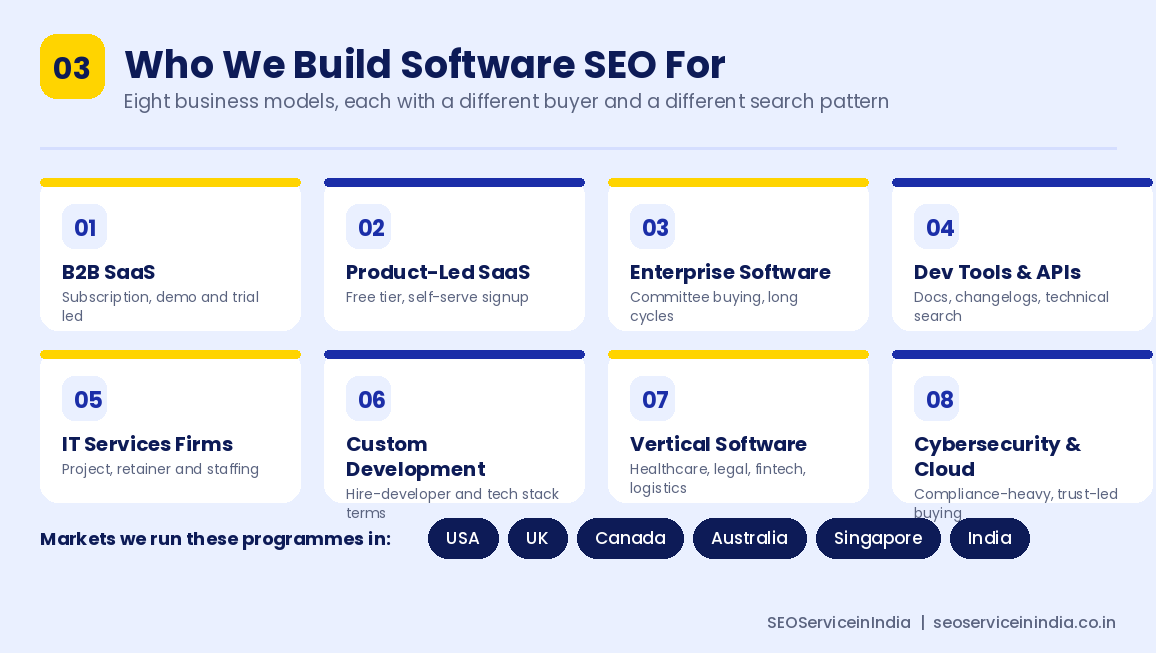
Who We Build Software SEO For
Eight business models, each with a different buyer and a different search pattern behind it.
B2B SaaS
Demo and trial led, where category, comparison and use-case pages carry the pipeline.
Product-led SaaS
Free tier and self-serve signup, where free tools, templates and integration pages do more work than the blog.
Enterprise software
Committee buying, where industry pages, security content and analyst-adjacent material matter most.
Developer tools and APIs
Documentation, changelogs, SDK and API pages, plus the technical searches developers actually run.
IT services firms
Project and staffing demand, city and technology pages, directory and review presence.
Custom development shops
Hire-developer terms, stack-specific pages and portfolio proof.
Vertical software
Healthcare, legal, fintech, logistics and similar, where the vocabulary of the sector is the ranking advantage — the same principle behind our SEO for logistics companies work.
Cybersecurity and cloud
Trust-led buying, where certifications, incident transparency and compliance content decide shortlists.
Software is genuinely borderless, so all six markets are real service delivery rather than a list of places we happen to have clients. What that demands structurally is planned early: how country content is separated, where hreflang belongs, which entity owns which regional page, and how to avoid the near-duplicate landing pages that multi-market software sites accumulate.
Architecture
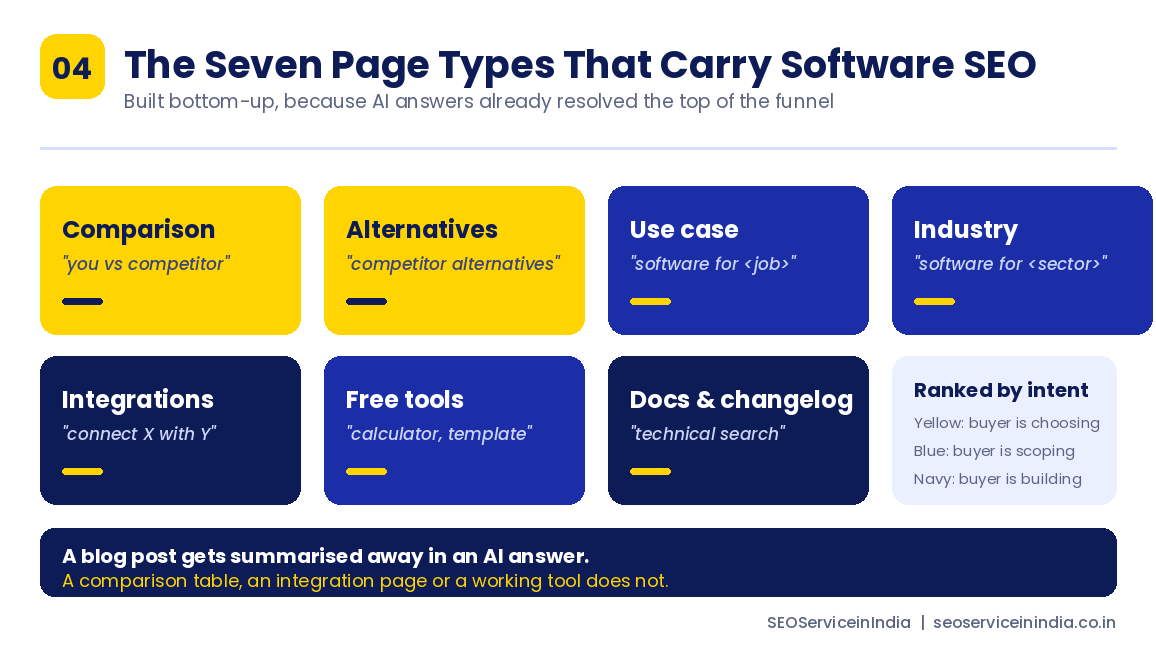
The Seven Page Types That Carry Software SEO
We build the architecture bottom-up. These page types are what buyers search for at the decision stage, and they are also what AI engines quote and attribute, because each one carries specifics a summary cannot flatten.
01
Comparison and alternatives pages
The highest-intent family in software search. Someone typing your name against a competitor is mid-evaluation; someone searching for alternatives to a category leader is qualified demand you did not have to create. One honest page per real competitor, led by a clean trade-off table that admits where the other tool wins. Pages that claim you are best at everything get discounted by buyers and by the engines quoting them.
02
Use-case and industry pages
Buyers do not search for your feature list; they search for the job they need done, or for software built for their sector. These pages take the same product and re-frame it around a workflow or an industry, which is also how enterprise buyers who start with a problem rather than a category find you at all.
03
Integrations, free tools and templates
Integration pages capture buyers checking whether you fit their existing stack, and they scale honestly across every real connector you support. Free calculators, generators and templates earn links and signups that a blog post cannot, and they are difficult to summarise away in an answer box because the value is in using them.
04
Documentation, changelogs and developer content
For developer tools this is the SEO programme, not a side project. Public documentation, versioned changelogs and quickstart guides rank for the technical searches your users actually run, and they are among the most heavily cited sources when an AI assistant answers an implementation question. We treat docs as indexable product surface: crawlable, structured, internally linked and measured.
One warning about scaling these page types. Comparison and integration pages are easy to mass-produce badly: a template, a competitor list scraped from a review site, and a hundred pages about products you do not really compete with. Those get thin, they get ignored, and at volume they can drag the whole domain. We build a page only where there is a genuine competitor, a real connector or a use case your product actually serves, and we retire pages that stop being true when a competitor changes their pricing or feature set.
Eight Workstreams
What Every Software SEO Engagement Includes
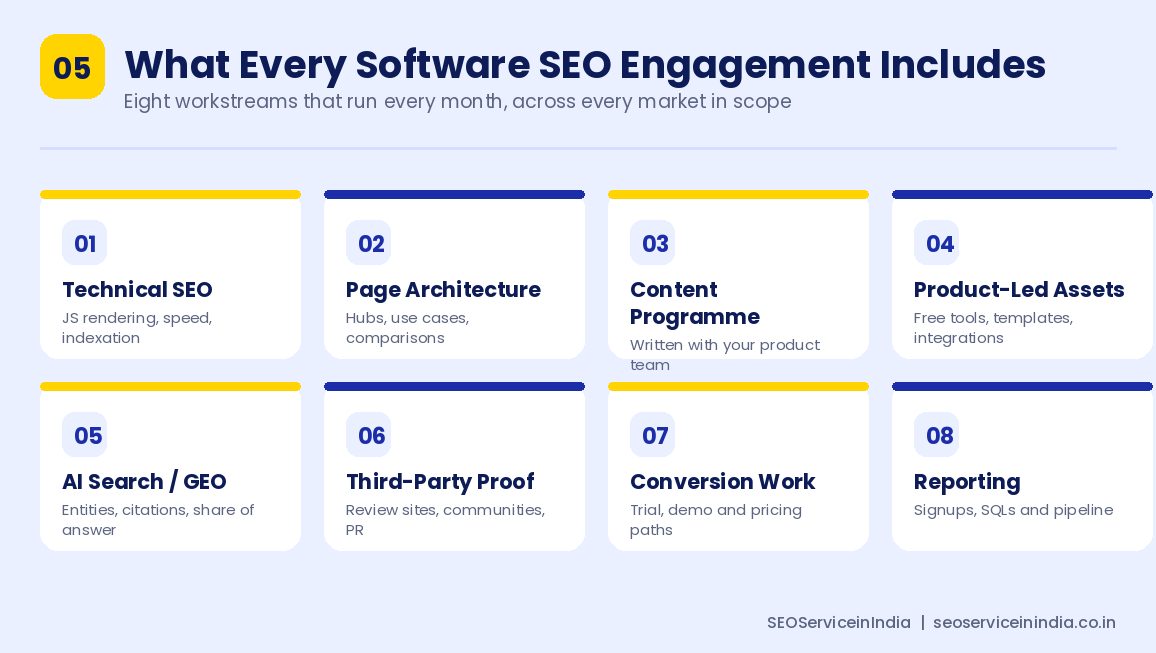
Eight workstreams run every month, across every market in scope. What changes between engagements is the number of competitors, use cases, integrations and countries covered.
01
Technical SEO
JavaScript rendering, Core Web Vitals, indexation control and site structure — the failure mode for modern software sites is a front end search engines cannot read. This is handled by the same team that runs our technical SEO services.
02
Page architecture
Hubs, use-case pages, comparison and alternatives sets, integrations and tools, mapped with internal linking planned before writing.
03
Content programme
Written with your product marketing and sales teams, using objection data from real deals rather than assumptions.
04
Product-led assets
Free tools, calculators, templates and integration hubs that earn links and signups instead of impressions.
05
AI search and GEO
Entity clarity, structured data, clean definitions and quotable formatting, so answer engines can attribute you correctly.
06
Third-party proof
Review platform presence, community visibility, digital PR and original data — validation that sits outside your own domain, including targeted link building services.
07
Conversion work
Trial, demo and pricing paths rebuilt so a comparison page ends in a signup rather than a contact form.
08
Reporting
Non-branded signups, page-type rankings, citations in AI answers and pipeline contribution, month over month.
Workflow
Our Six-Step Software SEO Process
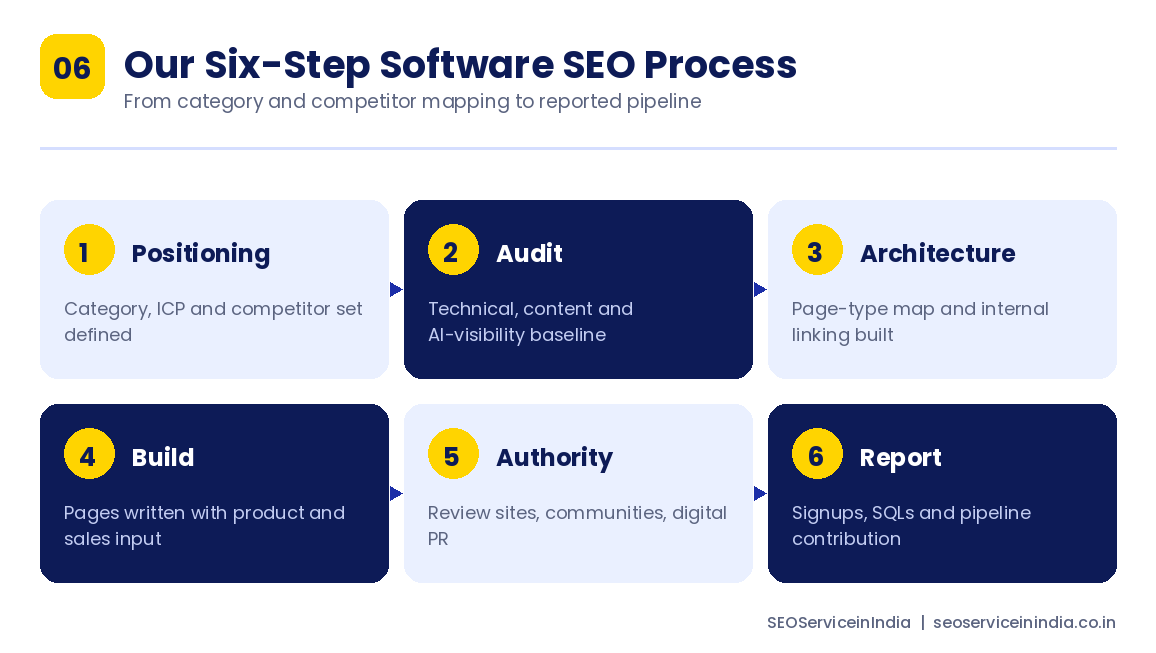
The same sequence runs on every account, whether you are a product-led SaaS in Singapore or an enterprise software vendor in the United States.
01
Step 1 — Positioning and competitor set
We define the category you are competing in, the ideal customer profile, and the exact competitors buyers weigh you against. Everything downstream — which comparison pages exist, which use cases get built — comes from this, and getting it wrong is the most expensive mistake in software SEO.
02
Step 2 — Audit and baseline
Technical health, content inventory, backlink profile and current visibility in both classic search and AI answers, benchmarked against three named competitors. You get it as a prioritised sheet, and it is yours whether or not you continue with us.
03
Step 3 — Architecture
The page-type map is built and signed off before writing starts: URL patterns, internal linking rules, how comparison and alternatives sets are structured, and how markets are separated. Retrofitting this later is expensive and usually partial.
04
Step 4 — Build
Pages are written in priority order, highest-intent first, using your product data and real objection handling. Drafts go to product and sales for accuracy, because a comparison page that misstates a competitor damages more than it earns.
05
Step 5 — Authority and validation
Review platform programmes, community presence, digital PR and original research. Software buyers and answer engines both weight third-party corroboration heavily, and neither is persuaded by your own site alone.
06
Step 6 — Report and iterate
Monthly reporting on non-branded signups, rankings by page type, AI answer citations and pipeline contribution, followed by the page priorities for the next cycle.
Intent Mapping
TOFU, MOFU and BOFU for a Software Buying Cycle
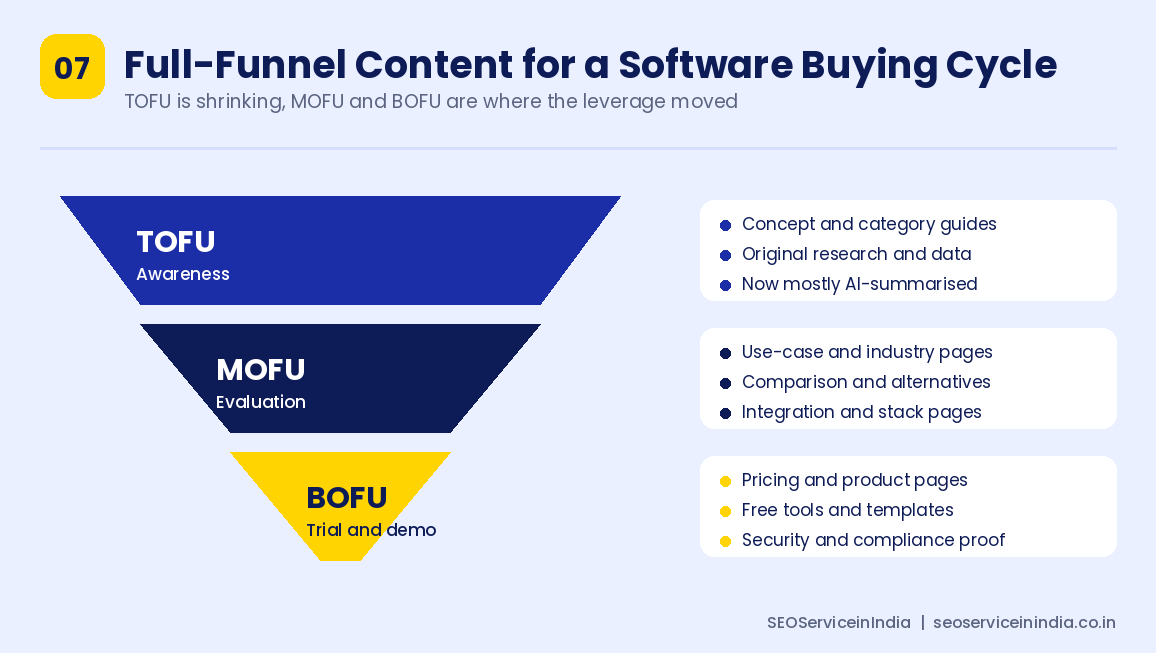
The classic funnel still describes how software gets bought. What changed is where the return sits.
Top of funnel
Thinner, but not dead
Concept explainers and category guides now often resolve inside an AI answer without a click. We still publish here, but selectively, and weighted towards original research and data that answer engines cite by name rather than definitions anyone can generate.
Middle of funnel
Where the leverage moved
Use-case pages, industry pages, comparisons, alternatives and integration content. This is the evaluation layer, the part of the journey that decides shortlists, and the format most frequently quoted when an assistant is asked which tool suits a specific situation — built and maintained through our content marketing services.
Bottom of funnel
The pages that close
Pricing, product and security pages, free tools, templates and trial paths. These convert the warmer traffic everything above delivers, which is why signup quality usually improves before signup volume does.
Reporting
Reporting You Can Take Into a Board Meeting
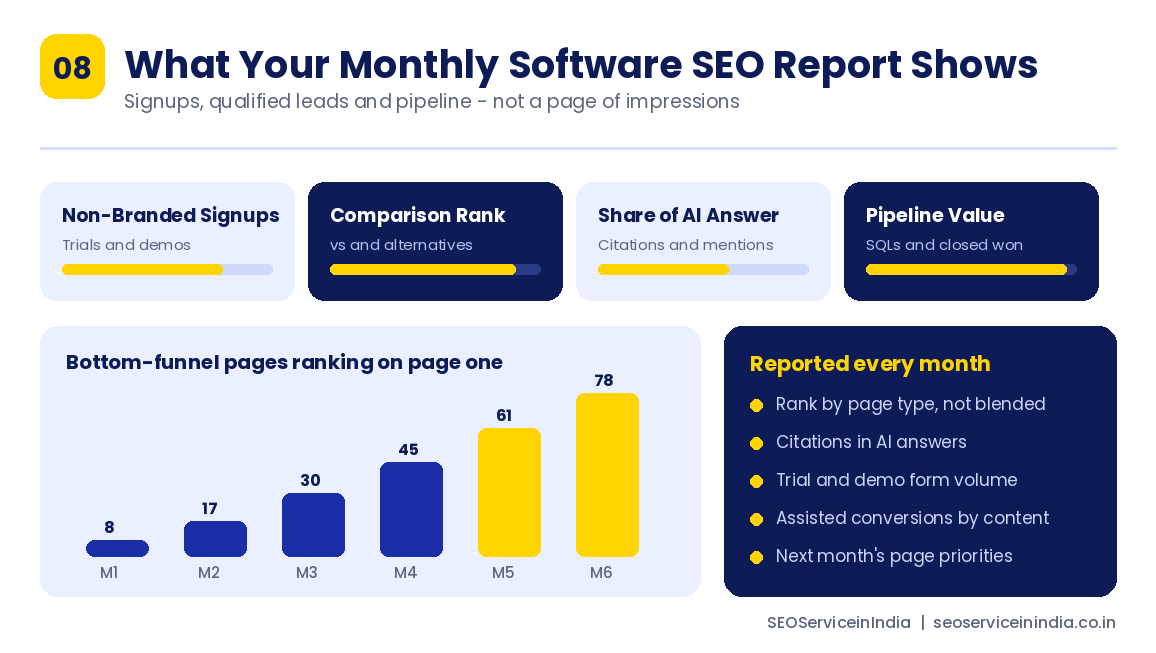
Sessions are a diagnostic, not a board metric, and blended rankings hide more than they show. Our monthly report leads with non-branded trials and demos from people who did not already know your name, then breaks rankings down by page type so you can see whether the comparison set is winning independently of the blog. Alongside that sit your citations and mentions in AI answers, assisted conversions by content, and pipeline value wherever your CRM lets us connect the two — read next to your Google Ads management numbers where paid runs in parallel. We separate branded from non-branded throughout, because a well-funded brand campaign can flatter an organic report that is otherwise flat. If a month goes badly, the report says so and explains what we are changing.
E-E-A-T
Why Software Companies Choose SEOServiceinIndia
SEOServiceinIndia has run search programmes since 2015 from our Delhi base, across North America, Europe and Asia-Pacific. Software is a category where generic agencies struggle, because the work depends on understanding how the product is evaluated, not only how search works.
We start from positioning and the competitor set, not from a keyword export.
Comparison pages written honestly, with product and sales review, so they hold up in front of a buyer.
AI search visibility treated as a measured workstream rather than a line in a pitch deck.
Multi-market structure planned before the build — hreflang, entity ownership and duplication control.
Reporting that names what did not work, with the correction attached.
We are also straight about timelines and about limits. Comparison and integration pages can move within two to three months because competition there is thin. Category-level authority takes longer, usually six to twelve. And no agency controls whether an AI engine cites you — we can make you the clearest, best-corroborated source in your category, which is what the evidence currently suggests those systems reward, but anyone selling you guaranteed AI placements is describing something they cannot deliver.
Bottom-funnel pages — comparisons, alternatives, integrations — often rank within two to three months because few competitors build them properly. Category-level terms and domain authority take six to twelve months. Pipeline impact usually becomes readable somewhere around month five or six.
Yes, but a smaller and sharper one. Definitional posts that any model can generate are no longer a good use of budget. Original research, benchmark data, opinionated technical writing and content tied to your own product usage still earn links, citations and trust.
It is the work of making your content understandable, attributable and quotable by answer engines: clear entity definitions, structured data, consistent naming and third-party corroboration. If your buyers ask assistants which tools to shortlist, then yes — and in software, most of them do.
Almost always. Those searches happen whether or not you show up, and if you do not answer them, an affiliate site with no product knowledge will. The rule is honesty: state where the competitor is genuinely stronger, keep the claims current, and check them with your sales team.
Yes, with a different architecture. Services firms lean on technology and industry pages, hire-developer terms, city-level visibility, directory presence and case-study proof. The comparison layer shifts from product-versus-product to approach, stack and delivery-model content.
They do different jobs. Paid buys immediate coverage on terms you want tomorrow and produces conversion data fast; organic builds the channel you eventually stop paying for. Most of our software clients run both, using paid data to prove which terms convert before committing content budget.
Analytics and Search Console access, your CMS, your competitor list and positioning, and one person in product marketing who can answer questions and check drafts. The audit runs without any of it; the build does not.
Partly through referral data, which is improving but still incomplete, and partly through direct measurement: tracking which prompts in your category return your brand, how you are described, and whether the citation points at a page you control. We report visibility and sentiment alongside referral traffic, because at this stage the mention often matters more than the click.
Free Audit
Start With a Free Software SEO Visibility Audit
Send us your site and your competitor set, and we will come back with a prioritised audit: which comparison and use-case searches you are absent from, who holds them, how you currently appear in AI answers for your category, and what a realistic twelve-month picture looks like. No obligation, no generic template, and the findings are yours to keep.
Request your free SEO audit through the enquiry form, call us, message us on WhatsApp, or email the team — whichever suits your time zone.