
The first is the catalogue dump. A firm handling four hundred line items publishes four hundred near-identical pages, each with one photo, two lines of description and a contact button. Google reads this as a large set of thin, duplicated pages and indexes almost none of them. Crawl budget drains into pages that were never going to rank, and the handful of pages that could compete never get discovered often enough to earn trust.
Import · Export · Distribution
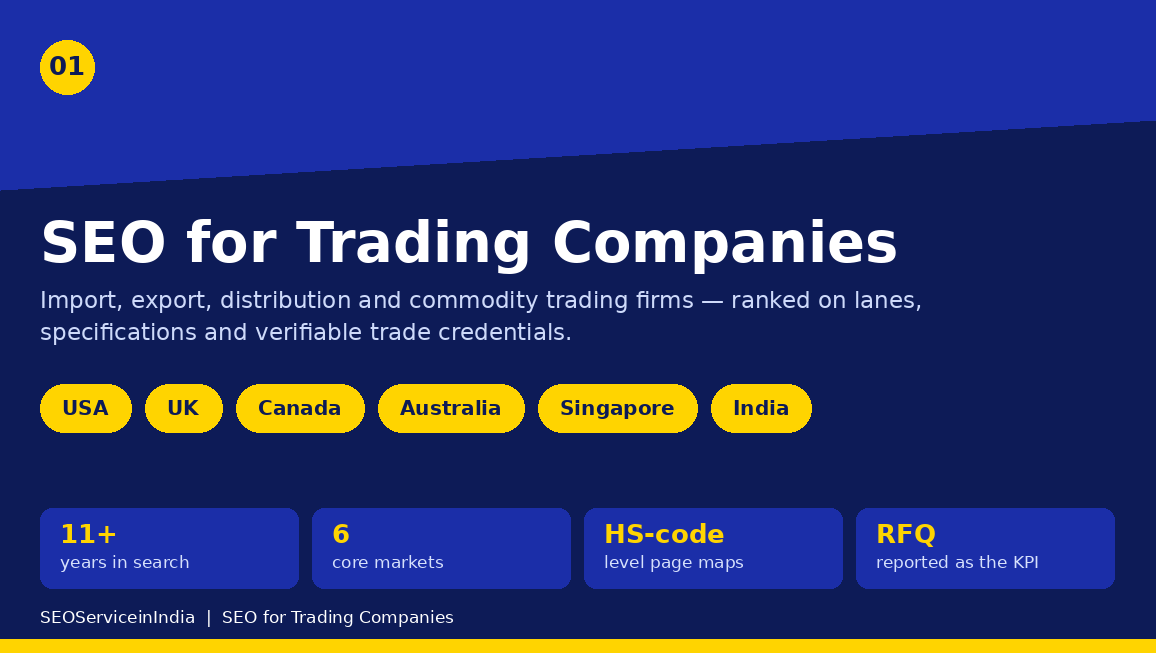
SEO for Trading Companies
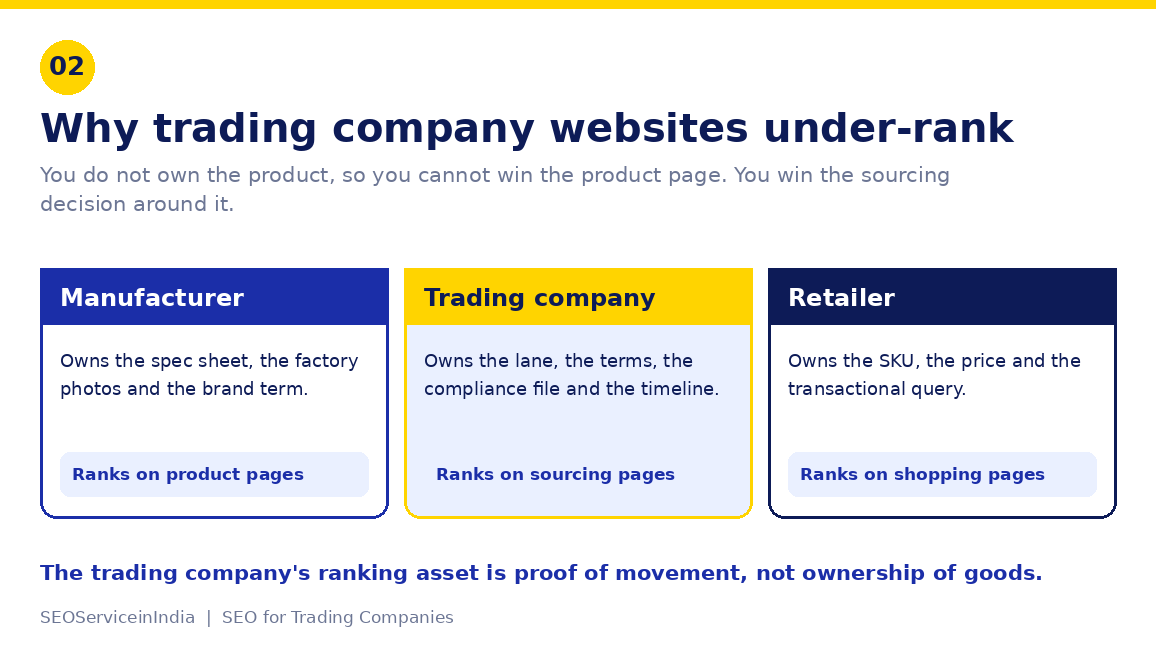
A trading company sits between the factory and the buyer, and that position makes search harder rather than easier. You do not own the product, so brand terms belong to someone else. You do not sell single units, so consumer shopping results are the wrong battlefield. What you do own is the route, the terms, the paperwork and the reliability — and those are exactly what a procurement manager is searching for at the moment they are ready to send an enquiry.
SEOServiceinIndia builds search programmes for import houses, export firms, distributors, wholesale suppliers and commodity traders selling into the USA, UK, Canada, Australia, Singapore and India. We rank you for the sourcing decision, not for a product you resell.
Diagnosis
01
02
03
Why Trading Company Websites Under-Rank
Most trading websites fail in three predictable ways, and all three are structural rather than cosmetic.
The second is the "we deal in everything" homepage. Chemicals, textiles, machinery and agri-commodities on one page produces topical depth on nothing. Search engines reward specificity, and a buyer looking for one grade of one polymer sees no evidence you have handled it before.
The third is invisibility on the terms that actually convert. Sourcing queries carry small monthly volumes, often under fifty searches, so keyword tools mark them low priority and generalist agencies skip them entirely. Yet one ranking for a term like "polypropylene granules supplier Australia" can be worth more than ten thousand visits from a general blog post, because the person typing it has a purchase order waiting.
The fix is not more content. It is content that proves something a competitor cannot copy: the lanes you genuinely run, the grades you genuinely stock, the certifications you genuinely hold and the ports you genuinely clear through. That proof also happens to be what a technical SEO audit surfaces first when we look at a trading site.
Search Behaviour
What Buyers Actually Type When They Are Sourcing
A procurement buyer does not search the way a consumer does. They begin broad, narrow with every unanswered question, and grow more technical as the shortlist tightens. Their journey moves through five recognisable rungs.
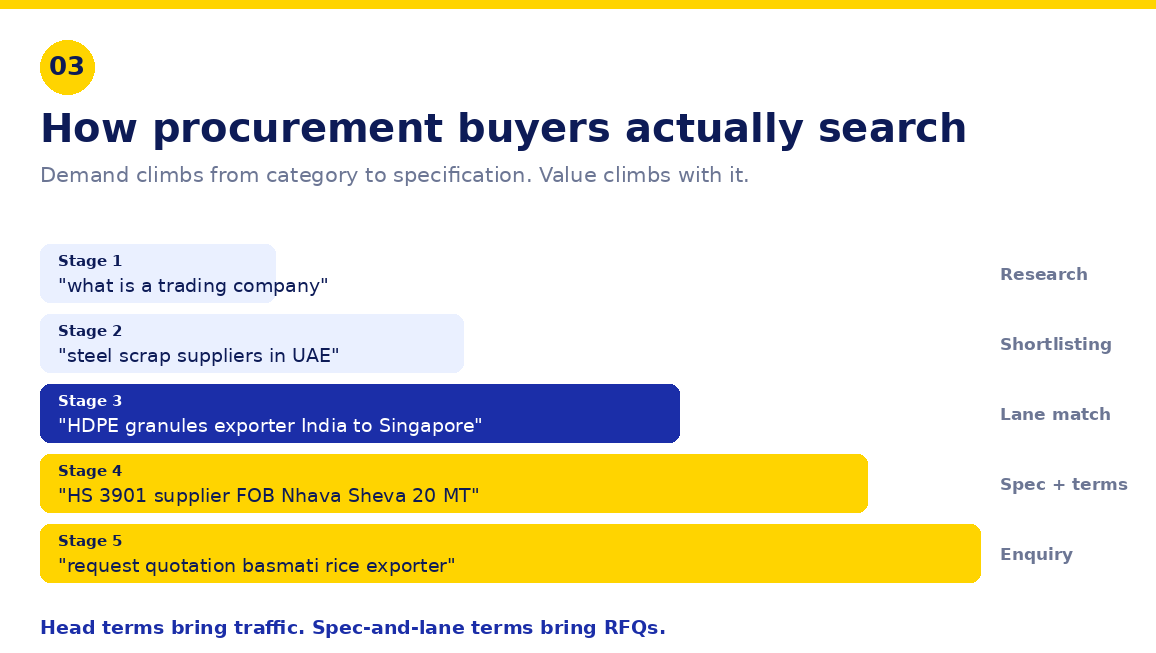
- 01Category research — "what is a trading company", "trading company vs manufacturer". Curiosity, no budget attached yet.
- 02Supplier discovery — "steel scrap suppliers in UAE", "rice exporters list". A shortlist is being assembled.
- 03Lane matching — "HDPE granules exporter India to Singapore". Origin and destination enter the query, which is the moment a trading company becomes relevant rather than a factory.
- 04Specification and terms — "HS 3901 supplier FOB Nhava Sheva 20 MT". Grade, incoterm, port and quantity all appear. Almost nobody publishes for this rung.
- 05Enquiry — "request quotation basmati rice exporter". The buyer is looking for a form, a WhatsApp number or an email address.
Most trading websites are built only for rungs one and two, which is why their traffic looks acceptable while their enquiry sheet stays empty. Our keyword map is deliberately weighted towards rungs three, four and five, where volume is smaller and contract value is far higher. That weighting is also why we track qualified enquiries as the headline metric rather than sessions.
The Framework
Our Five-Layer SEO Framework for Trading Companies
Each layer depends on the one beneath it. Building layer five before layer two is the most common way trading firms waste an annual SEO budget.
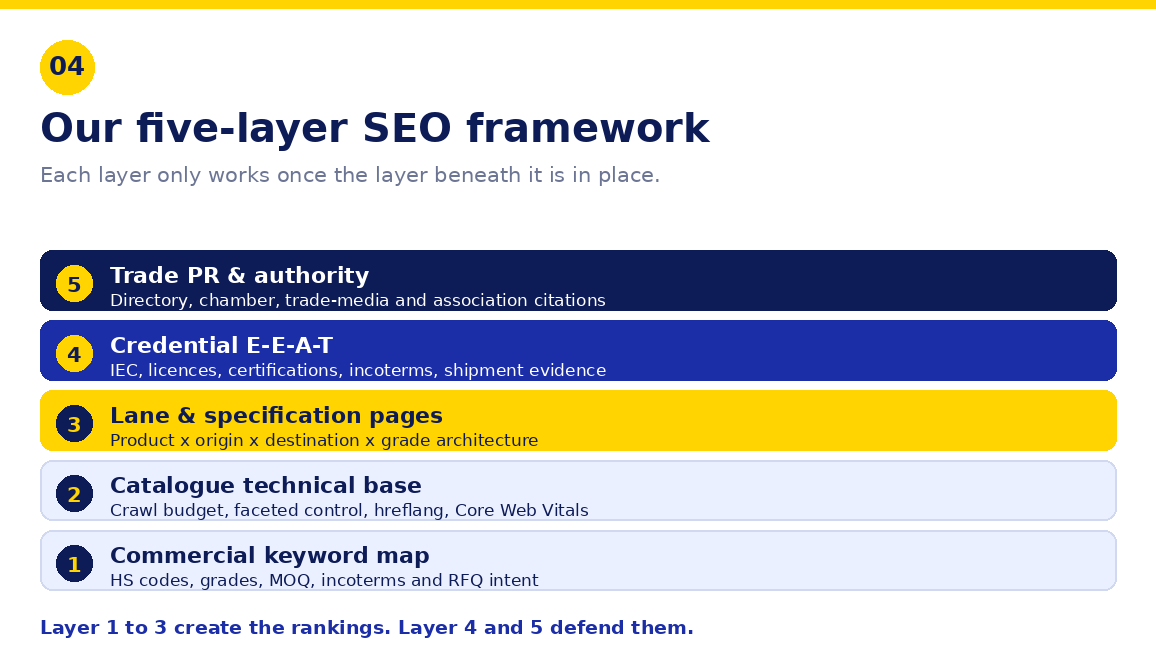
Layer 1 — Commercial Keyword Mapping
We build the map from your commercial reality, not from a keyword tool export. Every line becomes a combination of product, grade or HS code, origin, destination, quantity band and incoterm. Terms are then scored on contract value rather than search volume, so a query with twenty searches a month and a container-sized order beats a query with two thousand searches and no buying intent.
Layer 2 — A Technical Base That Survives a Large Catalogue
Before a word is written we fix what stops the catalogue being crawled: duplicate specification pages, uncontrolled faceted navigation, pagination that hides depth, PDF spec sheets sitting outside the index, slow product templates and unstable Core Web Vitals. On a large trading catalogue this alone often lifts indexed pages by several multiples.
Layer 3 — Lane and Specification Page Architecture
This is the layer competitors rarely reach. Instead of one page per product, we build pages that cross product with route and grade — the origin-to-destination pages, port pages and grade pages that match rungs three and four of the buyer ladder. Each page carries specification tables, MOQ, packing detail, lead time and accepted incoterms, then links laterally to related grades so the cluster reinforces itself. Where the catalogue is transactional, this connects directly to your ecommerce SEO structure.
Layer 4 — Credential-Led E-E-A-T
Google's quality guidelines ask for experience, expertise, authoritativeness and trust, and a trading company can evidence all four more concretely than most industries. We publish your IEC or equivalent registration, chamber of commerce membership, ISO and product-specific certifications, named trade heads with real biographies and years in the sector, photographs of your own warehouse and consignments rather than stock imagery, and case notes describing actual shipments with volumes, routes and timelines. Buyers verifying a supplier from six thousand kilometres away read exactly these signals before they send a first email.
Layer 5 — Trade PR and Off-Page Authority
Links for trading companies come from where the industry actually gathers: trade directories, chambers of commerce, export promotion councils, sector associations and trade publications that cover commodity movement and price commentary. This is slower than generic outreach and considerably more durable, and it is the part of our link building services most often applied to this sector.
Six Markets
SEO Across Your Trading Markets
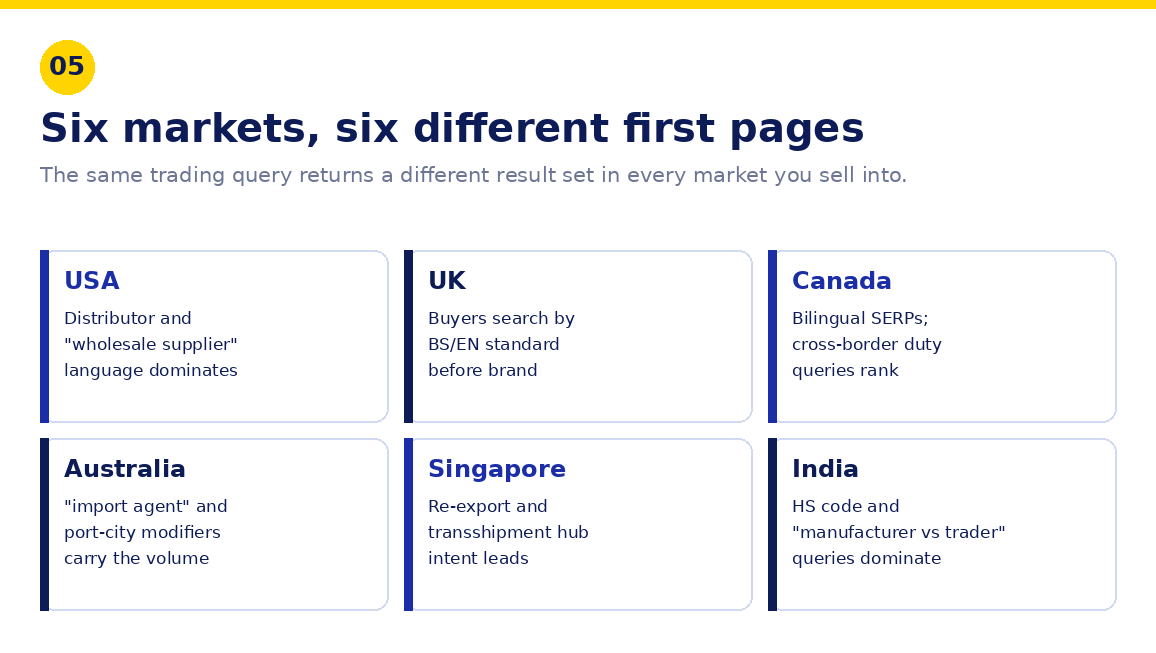
The same query returns a different first page in every country you sell into, so market selection has to come before keyword selection. In the United States, buyers and search engines both favour "distributor" and "wholesale supplier" over "trading company", which changes the entire on-page vocabulary. In the United Kingdom, procurement teams qualify by standard — BS, EN or equivalent — before they look at who is supplying, so specification pages outperform company pages.
Canada mixes bilingual results with cross-border duty and clearance queries that sit alongside supplier terms. Australia rewards port-city modifiers, with Sydney, Melbourne, Brisbane and Fremantle behaving almost like separate markets. Singapore's demand skews heavily towards re-export and transshipment intent, reflecting its hub role rather than its domestic consumption. India returns the most technical results of the six, where HS codes and "manufacturer versus trader" comparisons dominate the first page.
We handle this with market-specific page sets, correct hreflang and country targeting, currency and unit conventions that match local procurement practice, and separate rank tracking per market. This is standard practice in our international SEO work and it is the single biggest reason six-market programmes succeed or stall.
Segments
Import Houses, Distributors and Financial Trading Firms Are Three Different Problems
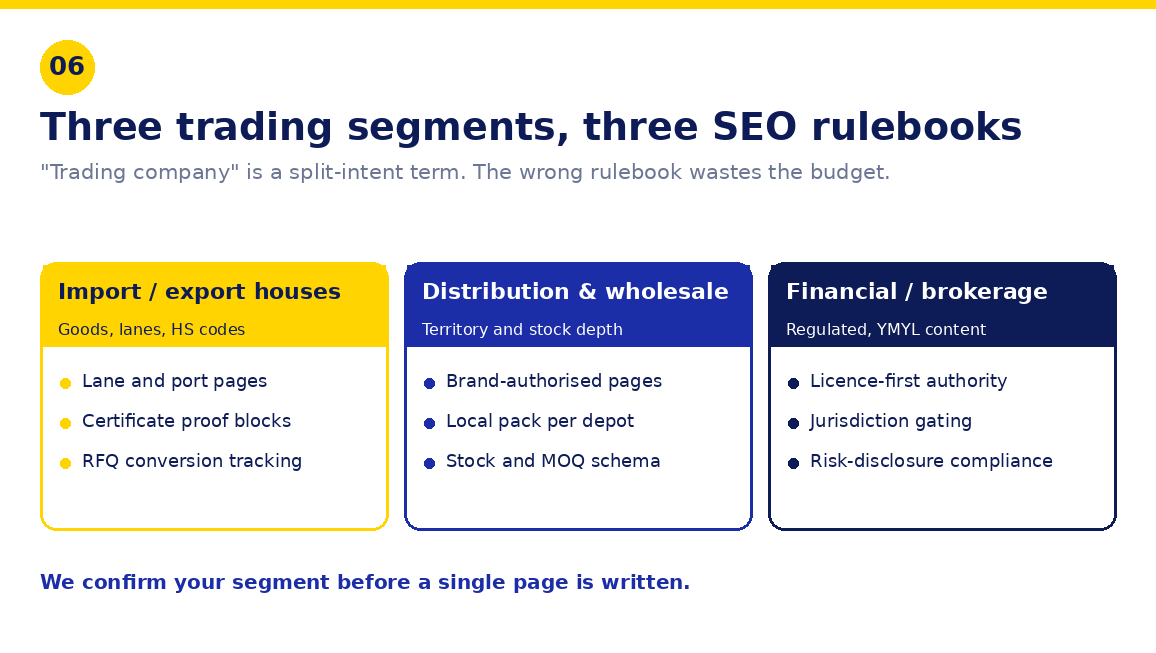
"Trading company" is one phrase covering three businesses that need completely different search strategies. Confirming which one you are is the first thing we do on a call, because the wrong rulebook burns a budget quietly for months.
Import and Export Houses
Import and export houses live on goods, routes and documentation. Their SEO is lane architecture, HS-code depth, certificate proof blocks and RFQ tracking, exactly as described above.
Distribution and Wholesale Businesses
Distribution and wholesale businesses live on territory and stock depth. Their strategy leans on brand-authorisation pages, availability and MOQ information, and a genuine local SEO presence for every depot or branch, because a large share of their demand is regional rather than international.
Financial and Brokerage Trading Firms
Financial and brokerage trading firms are a different category entirely. Their content is regulated and falls under Google's your-money-your-life treatment, with licensing, jurisdiction restrictions and mandatory risk disclosure shaping what can be published and where it can be shown. We take on this work, but under a separate compliance-led scope — never by reusing the import-export playbook.
Roadmap
How a Trading Company Engagement Runs
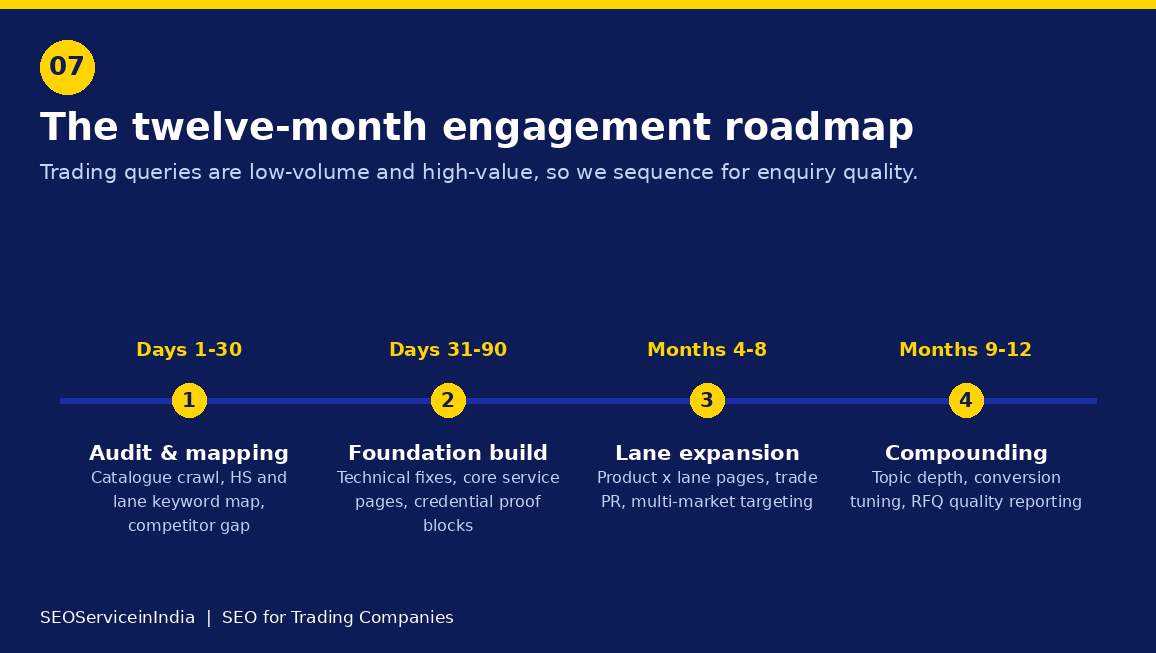
Sourcing queries are low in volume and high in value, so we sequence the work for enquiry quality rather than for early traffic charts.
In the first thirty days we crawl the catalogue, build the HS-code and lane keyword map, and run a competitor gap analysis across your priority markets. Days thirty-one to ninety cover the foundation build: technical remediation, the core service and category pages, and the credential proof blocks that carry your E-E-A-T signals.
From month four to month eight we expand into lane and specification pages at volume, begin trade PR outreach, and switch on additional market targeting. Months nine to twelve are about compounding — deepening topical coverage, tuning enquiry forms and quotation flows, and reporting on the quality of enquiries rather than their count. Most trading clients see meaningful movement on long-tail sourcing terms between months three and five, with head terms following later. Our published SEO packages follow the same sequencing.
Packages
SEO Packages for Trading Companies
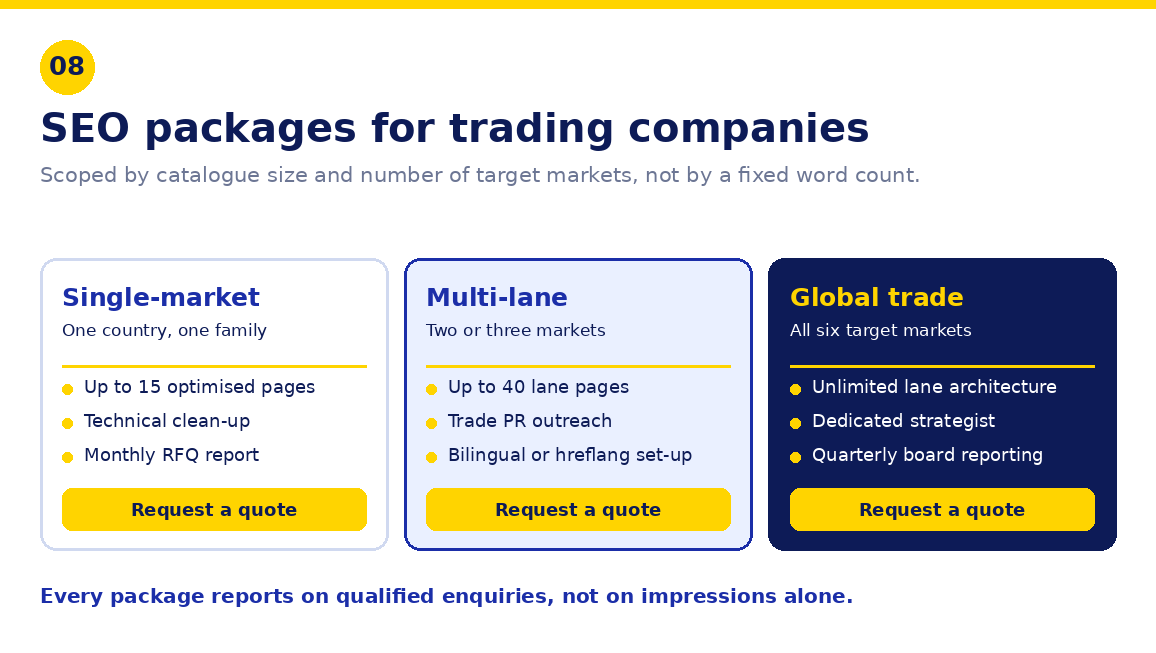
Scope is set by catalogue size and number of target markets, not by a fixed monthly word count. Three shapes cover most trading businesses.
Single-Market Package
The single-market package suits a firm selling one product family into one country, and covers up to fifteen optimised pages, full technical clean-up and monthly enquiry reporting.
Multi-Lane Package
The multi-lane package fits two or three markets and several product families, adding up to forty lane pages, trade PR outreach and hreflang or bilingual set-up.
Global Trade Package
The global trade package covers all six markets and the full catalogue, with unlimited lane architecture, a dedicated strategist and quarterly reporting written for a board rather than a marketing team.
Pricing is quoted after the audit because catalogue size varies so widely in this sector. [CONFIRM: insert your current price bands and minimum engagement term here.] Whichever package you take, our content writing services produce the specification-level copy that these pages depend on.
What Your Monthly Report Shows
Reporting for a trading company is not a rankings screenshot. Each month you receive movement on the sourcing terms that matter, broken down by market, with the pages responsible for each gain identified. Alongside that sits enquiry data: how many quotation requests arrived from organic search, which product families and which lanes they came from, and how they compare with the previous period.
We also report on indexation health for the catalogue, technical issues found and fixed, links earned with the source and its relevance, and the content published with the queries it targets. Where your CRM allows it, we close the loop by matching organic enquiries to quoted and won value, which is the only metric that settles whether the programme is paying for itself.
Why Trading Companies Work With SEOServiceinIndia
We have been running search programmes since 2015 [CONFIRM year] from Delhi, for clients across six English-language markets, and the industry work sits inside a larger practice rather than being a side offering. That matters for trading businesses in two specific ways.
First, we already understand the vocabulary. You will not spend the first two months explaining what an incoterm is, why an HS code matters or why a page about a lane is worth more than a page about a product. Second, we treat verification as an SEO deliverable. A buyer in London or Melbourne assessing a supplier they have never met is making a trust decision, and the pages we build are designed to answer the trust question and the sourcing question at the same time. Our wider SEO firm India practice supports this page with technical, content and outreach specialists rather than a single generalist account manager.
Free Audit
Start With a Trading Company SEO Audit
Send us your website and the two or three markets that matter most. We return a written audit covering your current indexation, the sourcing queries you are missing, the lane and specification pages your competitors already hold, and a prioritised ninety-day plan with the likely enquiry impact of each item.
There is no obligation attached to the audit, and it is written to be useful even if you take it to another agency. [CONFIRM turnaround time.] Call us on the number in the header, or send your website address and target markets through the enquiry form on this page and we will come back with dates.
Yes, but the measure of success is different. Volumes on sourcing queries are small, so traffic charts stay modest while enquiry value rises. A trading company that receives fifteen qualified quotation requests a month from organic search is performing extremely well, even though the same traffic figure would look poor for a consumer site. We set expectations against enquiry value from the first month.
Long-tail lane and specification terms usually begin moving between months three and five, because competition on them is thin and the pages are new to the index rather than fighting entrenched rankings. Head terms such as your product category plus country typically take nine to twelve months. Sites with a large existing catalogue often move faster, because fixing indexation releases pages that were already written.
We start with the two or three lines that carry your highest margin and your most repeatable lanes, build depth there, and only then expand. Spreading a first-year budget evenly across a wide catalogue produces shallow coverage everywhere and rankings nowhere. Which lines lead is a commercial decision we make with you during the audit.
They do different jobs. Marketplace listings put you in front of buyers who are already browsing that platform, and you compete there mainly on price and response time. Search brings buyers who are looking outside the platforms, usually for a specific grade or route, and the enquiry arrives on your own site with no intermediary. Most trading firms run both, with search taking the higher-specification enquiries.
Specification-level pages are written against the technical inputs you supply — grades, packing, MOQ, lead times, accepted incoterms and certifications — and are reviewed by your trade head before publication. We do not invent specifications, and any page containing a claim about your capability goes back to you for sign-off first.
Yes, but under a separate scope. Financial trading content falls under Google's your-money-your-life treatment, which raises the evidence bar considerably and brings licensing, jurisdiction and risk-disclosure requirements into the content itself. We scope that work with your compliance team rather than applying the import-export approach described on this page.
Yes. Our client base spans the USA, UK, Canada, Australia, Singapore and India, and a large share of the work involves Indian exporters selling into the other five. We run separate rank tracking, hreflang configuration and market-specific content for each territory in the programme.
