
The designing half
Everything a customer sees and touches: information architecture, category and product page layouts, the cart and checkout flow, mobile behaviour, and the visual system that carries your brand across every template.
Your Magento store is not really a website. It is the machine that carries your catalog, your pricing rules, your tax logic, your fulfillment and your margin — every hour of every day. Built properly, it absorbs growth quietly. Built badly, every new SKU, every new market and every seasonal promotion costs you developer hours nobody budgeted for.
Our Magento eCommerce development packages are built to prevent the second outcome. We design, develop, migrate, optimize and maintain Magento Open Source and Adobe Commerce stores for merchants across the USA, UK, Canada, Australia, Singapore and India — with a documented scope, a fixed timeline and code you own outright at handover.
A package is simply a defined block of design and development work with a written deliverable list, a price and a delivery date attached to it. It replaces the open-ended hourly arrangement that makes most Magento projects overrun.
Everything a customer sees and touches: information architecture, category and product page layouts, the cart and checkout flow, mobile behaviour, and the visual system that carries your brand across every template.
Everything they do not see: theme code, custom modules, catalog structure, payment and shipping logic, indexing, caching, server configuration and third-party integrations.
Bundling the two matters more on Magento than on hosted platforms. Magento gives you almost unlimited freedom in how a store behaves, which means design decisions and development decisions constantly constrain each other. When one team owns both, you stop paying for the translation gap between a beautiful mockup and what the platform can actually render at speed.
Magento's position has narrowed but hardened. It is no longer the default choice for a merchant selling forty products, and it should not be. It remains the strongest option for stores where catalog complexity, pricing logic or multi-market operations would break a simpler platform.
The platform is also actively maintained. Magento Open Source and Adobe Commerce 2.4.9 shipped in May 2026 with PHP 8.5 support, MySQL 8.4 LTS and MariaDB 11.4 LTS compatibility, the jQuery file uploader replaced by Uppy, ExtJS retired in favour of jsTree, and more than 500 quality fixes. Security patches moved to a monthly cadence in 2026, and support for the 2.4.5 and 2.4.6 branches ended in August 2026 — which is why upgrade work now makes up a large share of the packages we scope.
Beyond the release notes, four capabilities keep merchants on the platform:
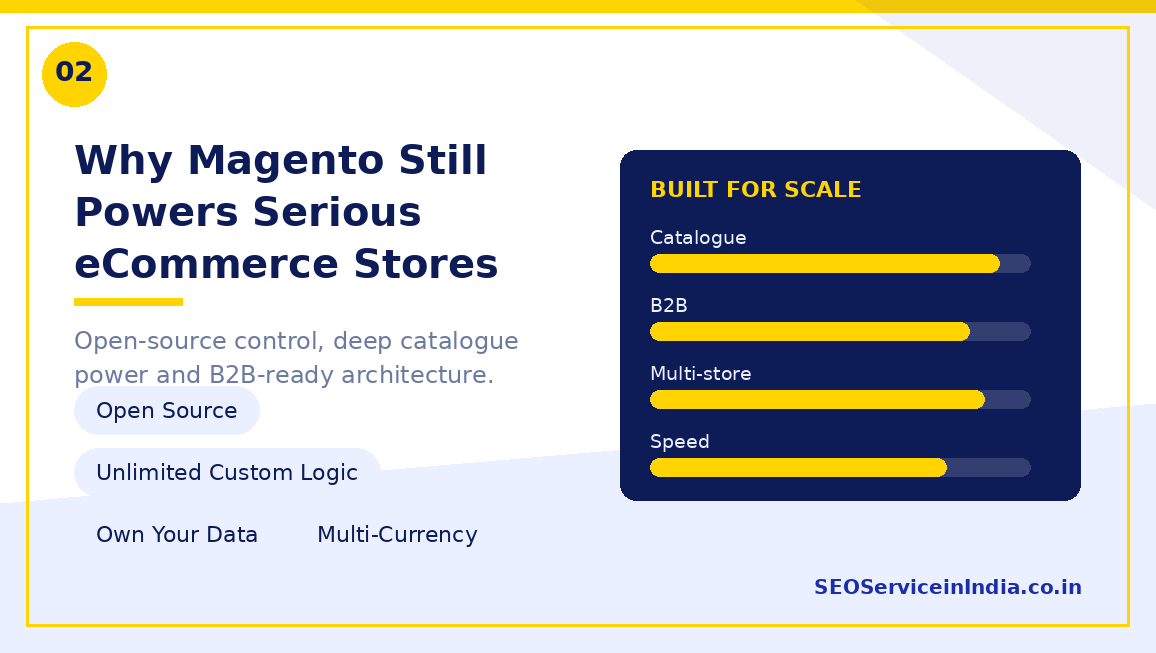
Tens of thousands of SKUs, configurable and bundled products, per-store-view attributes and tier pricing without bolt-on apps.
Company accounts, quote requests, custom catalogs and negotiated pricing that hosted platforms treat as add-ons.
Several storefronts, currencies, tax regimes and languages running from one admin and one catalog.
The codebase, the database and the customer data sit on infrastructure you control, with no platform transaction fee on top of your payment gateway.
These packages fit a specific kind of merchant. If you recognise your business in this list, the scope will be familiar territory rather than a discovery exercise.
Retailers with 1,000 to 100,000+ SKUs where category filtering, attribute sets and search relevance decide conversion rate.
Businesses that need company accounts, customer-group pricing, minimum order quantities and quote workflows.
Brands selling into several countries and needing separate storefronts, currencies, tax rules and languages from a single back office.
Stores hitting app limits, transaction fees or plugin conflicts on a platform that has stopped keeping up with the catalog.
Stores stranded on Magento 1, 2.4.5 or 2.4.6 that now need an upgrade path onto a supported branch.
D2C brands chasing frontend speed through Hyvä themes or a headless PWA build without abandoning the Magento backend.
Six workstreams run inside every package. What changes between tiers is depth, not whether a workstream exists.
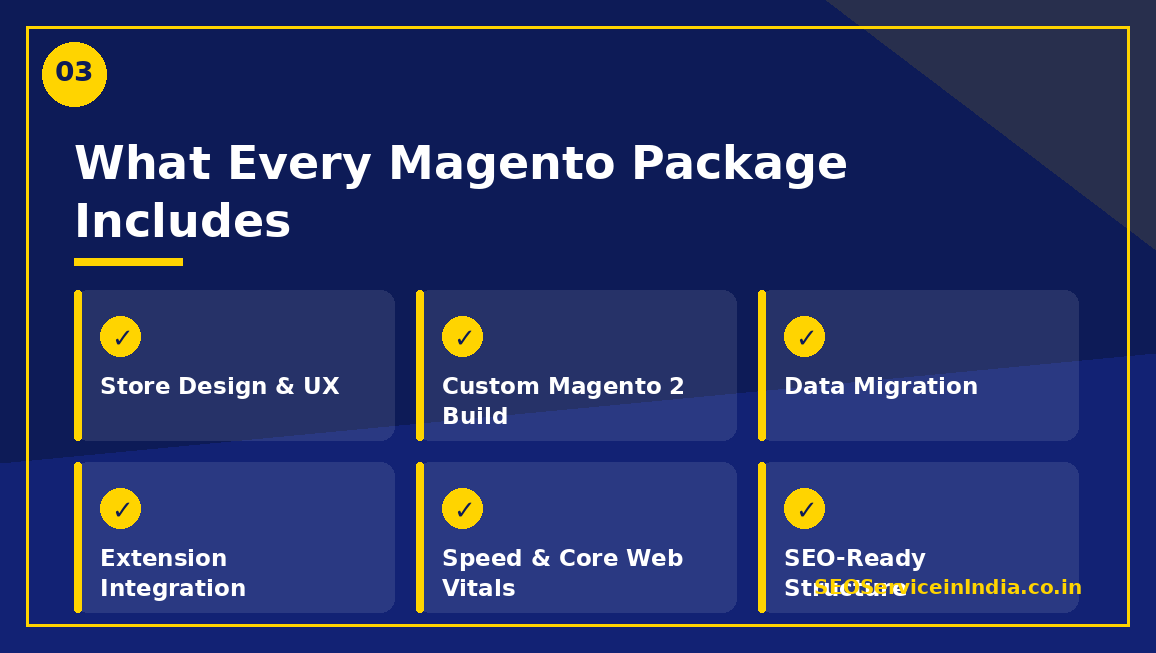
We start with the shopping path, not the homepage. Category templates, filtered navigation, product detail layouts, cart behaviour and a shortened checkout are wireframed first, reviewed against your actual analytics, then designed. Every layout is drawn mobile-first, because that is where most of your traffic already sits, and every template is delivered as a working Magento theme rather than a static file handed to someone else to interpret.
Theme development on Luma, Hyvä or a headless frontend, plus custom modules for the logic your business actually runs on — shipping rules, bundle configurators, subscription handling, loyalty mechanics, delivery slot selection. Custom work is written as proper Magento modules following Adobe's coding standards, so it survives the next core upgrade instead of blocking it.
Magento 1 to Magento 2, Shopify or WooCommerce to Magento, or an in-place upgrade from an end-of-life 2.4.x branch to 2.4.9. Products, customers, order history, URLs and SEO equity are mapped before anything moves, migrated to a staging environment, reconciled record by record, then cut over with 301 redirects in place so rankings hold through the switch.
Payment gateways including Stripe, PayPal, Klarna, Authorize.Net and Razorpay; shipping carriers and rate APIs; ERP, PIM, CRM and accounting systems such as SAP, NetSuite, Odoo, Zoho and QuickBooks. Third-party extensions are audited for code quality and upgrade compatibility before installation — a bad extension is the single most common cause of a Magento store that cannot be updated.
Varnish full-page caching, Redis or Valkey session storage, Elasticsearch or OpenSearch tuning, image optimization, critical CSS, JavaScript bundling and database index configuration. We benchmark before and after against Largest Contentful Paint, Interaction to Next Paint and Cumulative Layout Shift, and apply the current security patch level on a monthly schedule so your store never drifts into an unsupported state.
Clean URL structure, canonical handling for layered navigation, correct pagination, XML sitemaps, hreflang for multi-country storefronts, and Product, Offer, BreadcrumbList and Organization schema output on the right templates. Search visibility is designed into the build rather than retrofitted after launch, which is where most replatforming traffic losses actually come from.
Three tiers, each with a written deliverable list. Final pricing depends on catalog size, integration count and design complexity, and is confirmed in writing after a short discovery call.
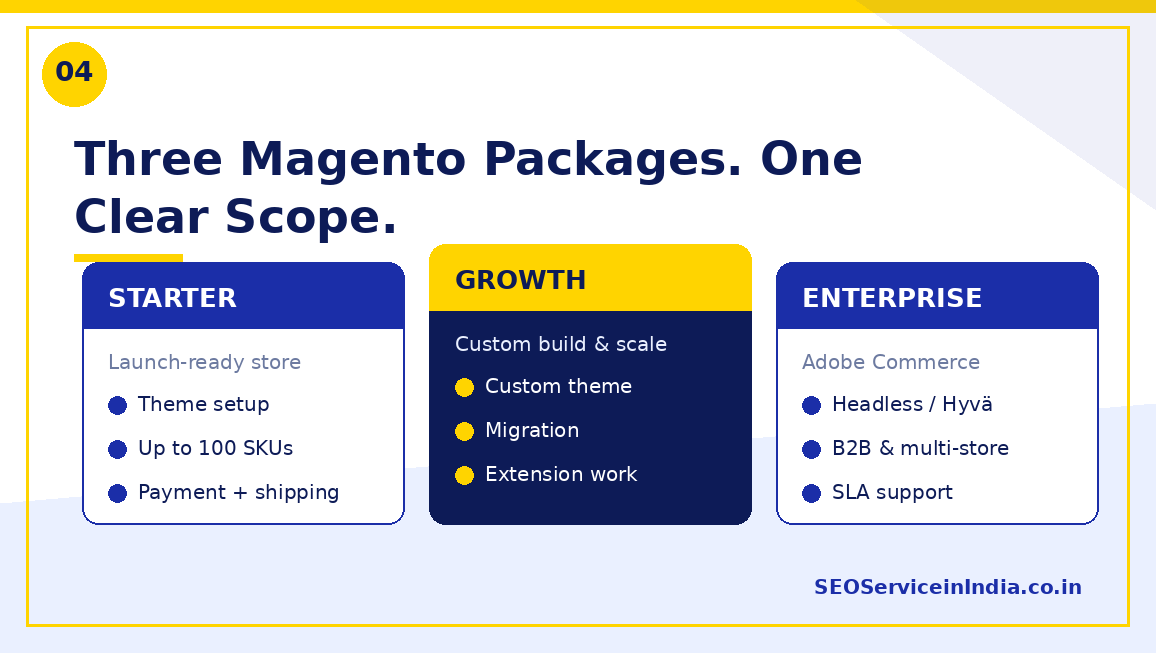
For new merchants and single-market stores that need to be trading quickly on a clean, upgradeable foundation. Includes Magento 2.4.9 installation and hardening, a customised premium theme, up to 100 products configured with attribute sets, payment and shipping setup, basic on-page SEO, GA4 and Search Console configuration, and 30 days of post-launch support. Typical delivery: 3 to 5 weeks.
Our most-commissioned tier. Includes a fully custom theme designed from scratch or a Hyvä frontend build, catalog migration from your existing platform, up to five third-party integrations, custom module development, speed optimization to Core Web Vitals thresholds, multi-currency setup and 90 days of support. Suits stores in the 1,000 to 20,000 SKU range. Typical delivery: 8 to 12 weeks.
For high-volume, multi-region and B2B operations. Includes Adobe Commerce implementation or headless PWA build, B2B module configuration, multi-store and multi-warehouse architecture, ERP and PIM integration, load testing, a staging-plus-production deployment pipeline, and an SLA-backed maintenance retainer. Typical delivery: 12 to 20 weeks, phased.
Every tier includes source code handover, documentation and admin training. There is no licence lock-in and no ongoing commission on your sales.
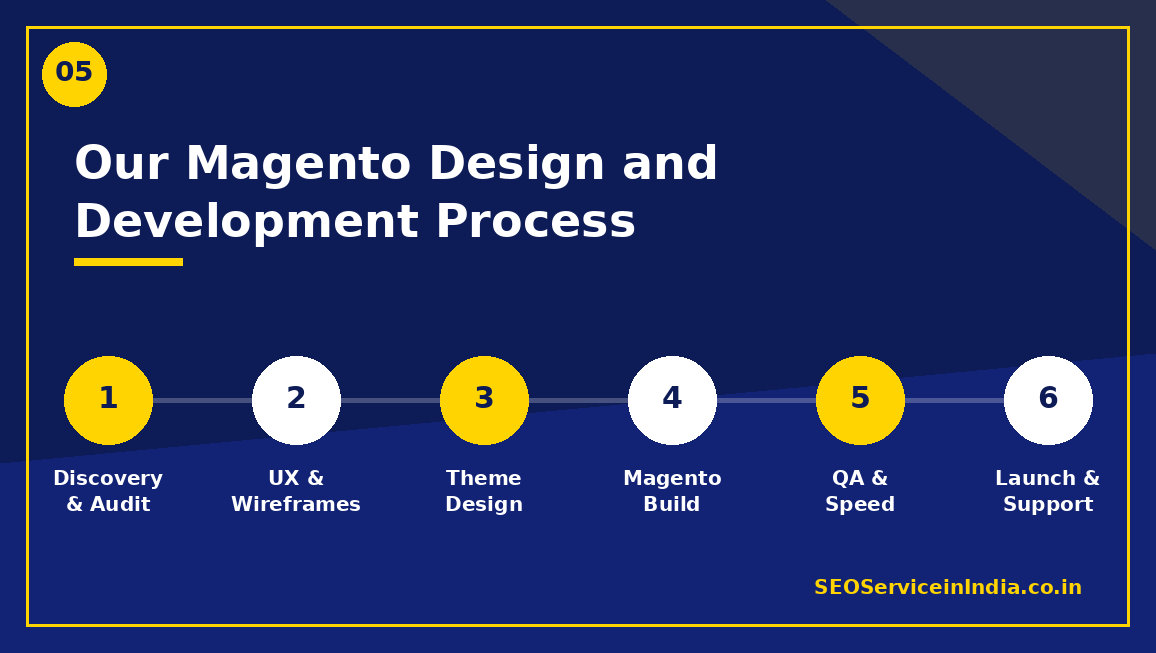
The process is deliberately front-loaded. Most Magento overruns are caused by decisions deferred past the point where they are cheap to change.
Catalog structure, current platform, integration inventory, traffic and conversion baselines, and the commercial goal the store has to hit.
The shopping path mapped screen by screen and signed off before any visual design begins.
Templates designed mobile-first in your brand system, delivered with component states rather than static pictures.
Theme and module development in sprints on a staging environment you can review at any point, with weekly demos.
Cross-browser and device testing, load testing, Core Web Vitals benchmarking, payment testing in sandbox, and a security patch check.
DNS cutover, redirect mapping, indexing checks, admin training, then the support window included in your tier.
We build on all three, so this is a recommendation rather than a sales position. Magento is the right answer less often than Magento agencies suggest.
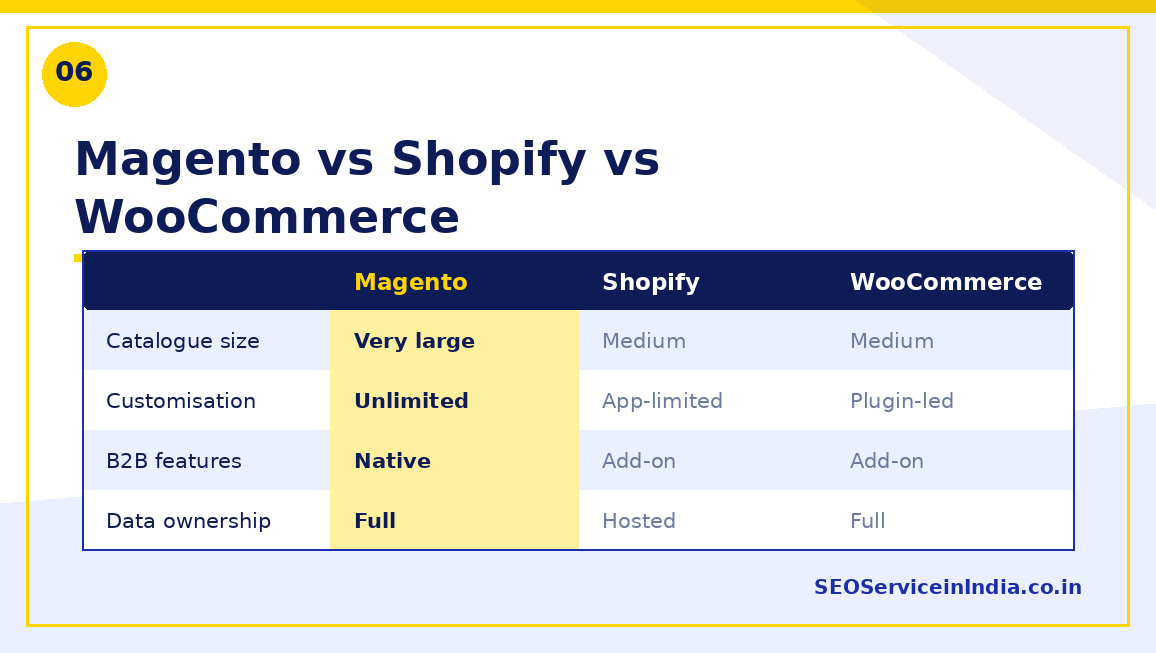
Shopify wins on speed to market and operational simplicity. If you sell a few hundred SKUs in one or two markets with standard pricing, Shopify will get you trading faster and cost less to run. Its constraints appear when you need pricing logic, catalog rules or checkout behaviour that its app ecosystem does not cover — and when platform fees start scaling with revenue you would rather keep.
WooCommerce wins on cost and familiarity for content-led brands already running WordPress. It handles moderate catalogs comfortably. It becomes fragile when the plugin count climbs, because performance and upgrade safety then depend on code from a dozen unrelated authors.
Magento wins where complexity is the point: very large catalogs, per-customer-group pricing, native B2B workflows, several storefronts under one admin, and full ownership of data and code. The trade-off is honest — it costs more to build and needs a maintenance budget. If your catalog and pricing rules are genuinely complex, that cost is lower than the workaround tax you would pay elsewhere. If they are not, we will tell you so during discovery.
We have been building and ranking eCommerce stores since before Magento 2 existed, and we have migrated stores off Magento as often as onto it. That perspective shapes how we scope work.
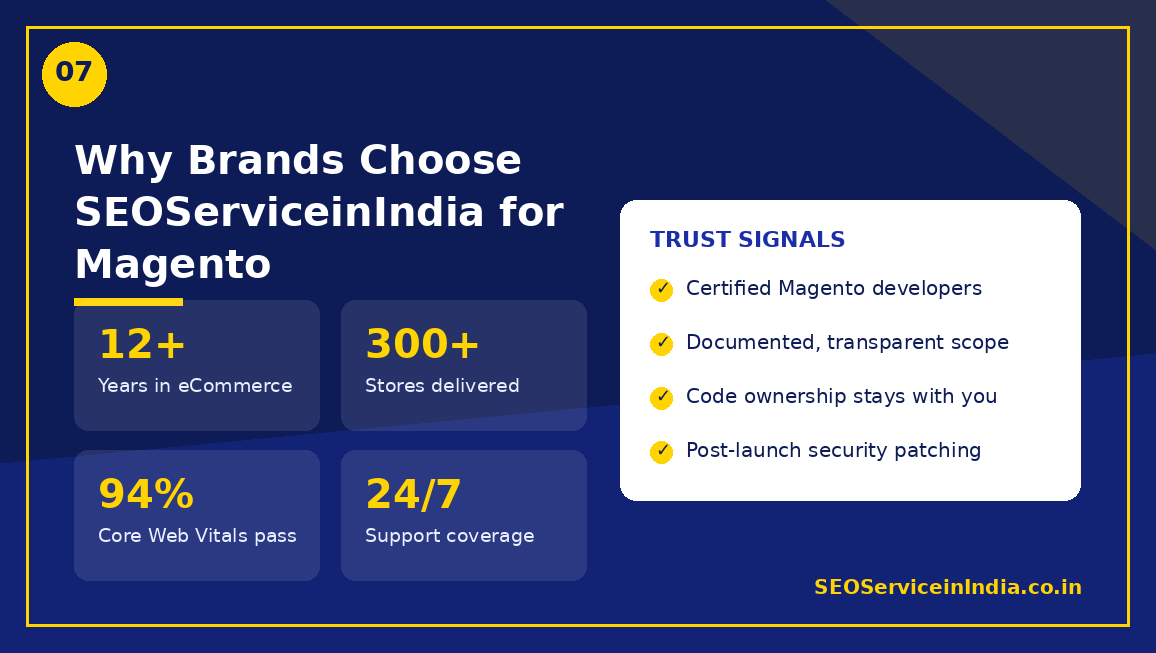
We are an SEO firm that builds Magento stores, not a dev shop that added SEO later. Crawl budget, indexation, canonical logic and Core Web Vitals are build decisions here, not a post-launch cleanup — the same discipline behind our eCommerce SEO services.
Adobe-certified developers and frontend specialists on staff, with no undisclosed subcontracting of your build.
Every package ships with a written deliverable list, a sprint plan and an agreed change-request process, so scope creep is a decision rather than an invoice surprise.
Repository access from day one and complete handover at close. You are never held hostage by an agency-owned codebase.
Monthly security patching, uptime monitoring and a named point of contact rather than a shared ticket queue.
References from merchants in your market and size band are available on request before you commit to anything.
We deliver globally from Delhi with overlapping working hours arranged per client. What changes by market is compliance and commercial context, not build quality.
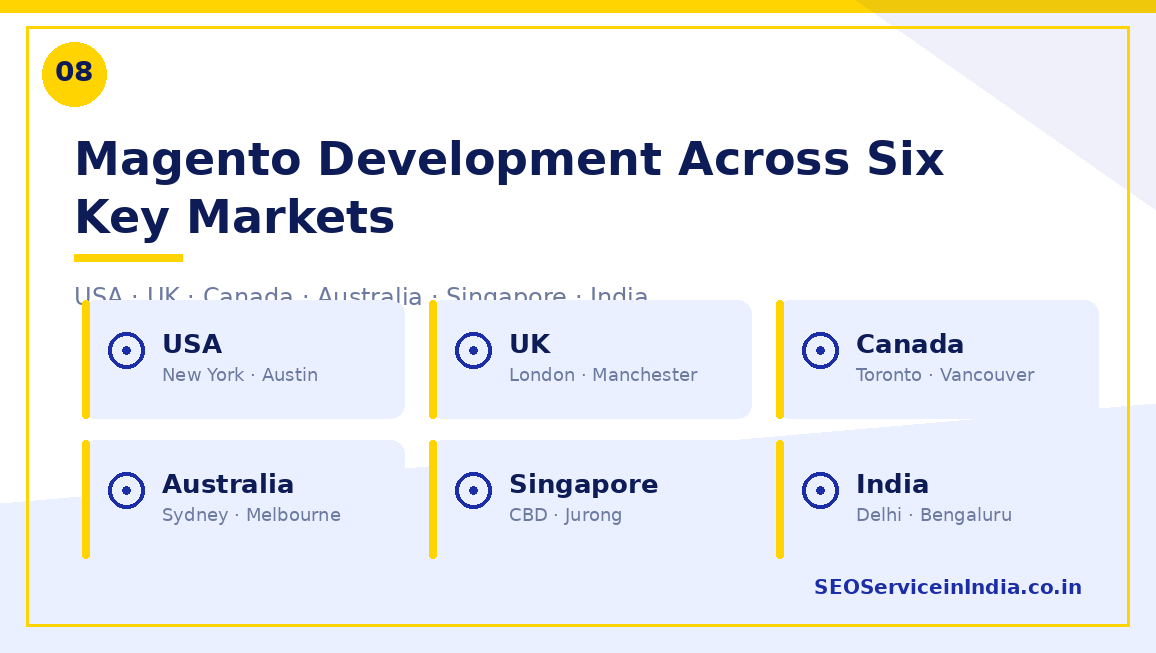
Sales tax automation via Avalara or TaxJar, ADA and WCAG-conscious frontends, and integration with the fulfilment and 3PL stack most US merchants already run.
Post-Brexit VAT and duty handling, UK carrier integrations and GDPR-compliant data flows.
Federal and provincial tax configuration, bilingual English and French storefronts, and Canadian payment rails.
GST configuration, Australia Post and courier integrations, and hosting positioned for local latency.
GST handling, regional payment methods including PayNow and GrabPay, and multi-country storefronts for wider APAC expansion.
GST-compliant invoicing, Razorpay, PayU and UPI integration, and COD workflows with courier aggregator support.
A Magento store is a living application. Adobe now ships security patches monthly, browsers change, payment providers deprecate APIs, and your own catalog grows in ways the original build never anticipated.
Our maintenance retainers cover patch application on a monthly schedule, extension and core upgrades, uptime and error monitoring, database and index health, incremental conversion improvements, and a defined support response window. Clients on a retainer also get a quarterly performance review covering Core Web Vitals, organic visibility and checkout conversion, with the next quarter's priorities agreed from the data rather than from opinion.
Cost is driven by catalog size, design complexity and integration count rather than by page count. A Starter build on a customised theme sits at the low end, a custom Growth build with migration and integrations in the middle, and an Adobe Commerce or headless Enterprise implementation at the top. We quote a fixed price in writing after discovery so you are never working from a range.
Three to five weeks for a Starter store, eight to twelve weeks for a custom Growth build with migration, and twelve to twenty weeks phased for Enterprise. Data readiness is the usual variable — clean product data can shorten a migration by weeks, and messy legacy data can extend it.
Magento Open Source has no licence fee and covers the needs of most merchants under roughly $5 million in annual revenue. Adobe Commerce adds B2B modules, advanced merchandising, customer segmentation and Adobe support, which starts to justify its licence cost at higher volumes or with complex B2B requirements. We model both against your numbers during discovery instead of defaulting to one.
Yes. Support for the 2.4.5 and 2.4.6 branches ended in August 2026, so any vulnerability discovered after that date stays permanently unpatched on those versions. Merchants processing card payments also carry a PCI-DSS obligation to run a patched environment. The current destination is 2.4.9, with 2.4.8 supported through April 2028 as a shorter hop.
Not if URL mapping and redirects are handled before cutover. We export the existing URL set, map every page to its new destination, implement 301 redirects, preserve metadata and structured data, and monitor Search Console daily for the first fortnight. Short-term fluctuation is normal; sustained loss is a planning failure, not an inevitability.
Yes. We regularly take a defined workstream — a theme rebuild, a migration, a speed programme — alongside an in-house team, working in your repository under your branching and review conventions.
Every package includes a post-launch support window of 30 to 90 days depending on tier. Beyond that, monthly maintenance retainers cover security patching, upgrades, monitoring and a defined response time for incidents.
We work with merchants across the USA, UK, Canada, Australia, Singapore and India, and with clients elsewhere on request. Communication runs in overlapping hours agreed at kickoff, with weekly demos and a named project manager throughout.
The fastest way to know what your project actually costs is a scoping call. Bring your current store URL or your catalog spreadsheet and we will come back within two working days with a written recommendation: which package fits, what sits inside it, what falls outside it, a delivery timeline and a fixed price.
If Magento turns out to be the wrong platform for where your business is right now, we will say that too — and tell you what we would build instead. Talk to our Magento team today and get a scoped, fixed-price proposal with no obligation attached.

Speak with our SEO Company Experts
Give us a Ring, e-Mail, WhatsApp, or Skype.