
A multiregional site
Targets several countries that may share a language, such as the USA, UK, Canada, Australia and Singapore all operating in English.
Ranking well in one country teaches you almost nothing about ranking in six. The same query returns a different result set in Chicago than it does in Manchester, Toronto, Melbourne, Singapore or Bengaluru — different competitors, different search intent, different vocabulary, different trust signals. A page that dominates at home can be invisible three time zones away because Google was never told which market it was written for.
Our international SEO packages are built for brands that have outgrown a single-country strategy. We plan the site architecture, get the technical signals right, research keywords market by market in the language customers actually use, and build the authority each region needs — all delivered from India at a cost structure that lets you fund six markets for what one agency in New York or London charges for two.
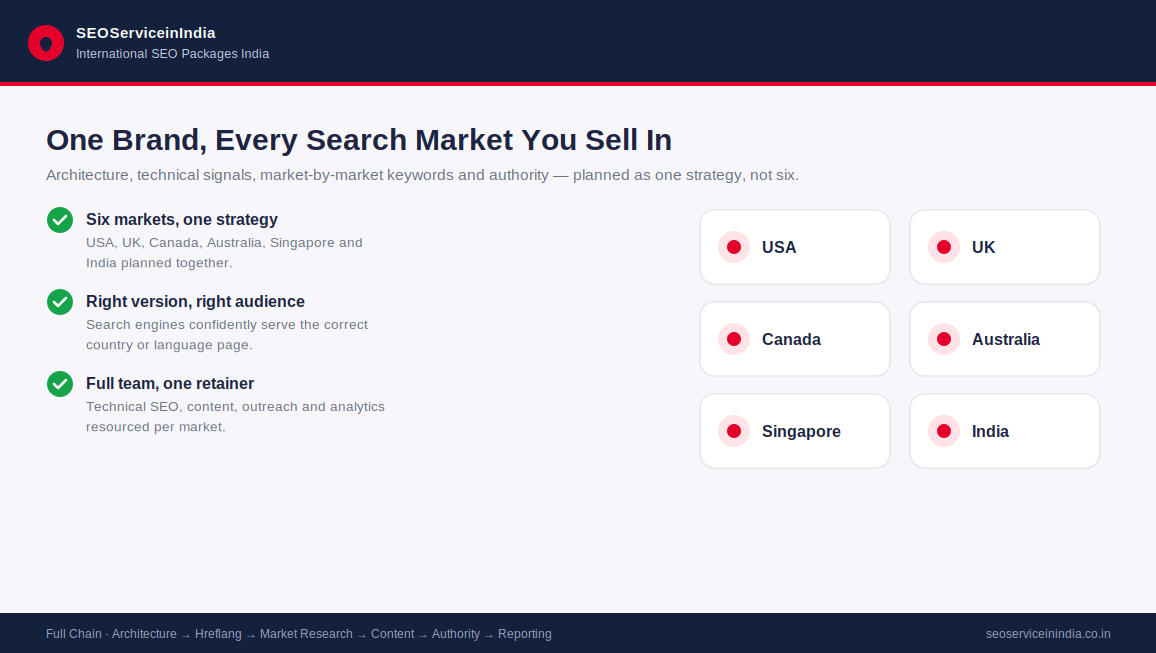
International SEO is the practice of structuring, targeting and optimizing a website so that search engines confidently serve the right version of your content to the right audience — by country, by language, or by both.
There is an important distinction most businesses miss.
Targets several countries that may share a language, such as the USA, UK, Canada, Australia and Singapore all operating in English.
Targets several languages, such as English and French for Canada, or English, Mandarin, Malay and Tamil for Singapore. Many growing brands are both at once, and each situation demands a different technical setup.
Get it wrong and the failure modes are predictable: your UK page outranks your US page in American results, near-duplicate country pages compete against each other, hreflang tags fire without return references and get ignored entirely, or an automatic IP redirect blocks Googlebot from ever seeing your regional content. These are not cosmetic problems. They suppress traffic across every market simultaneously.
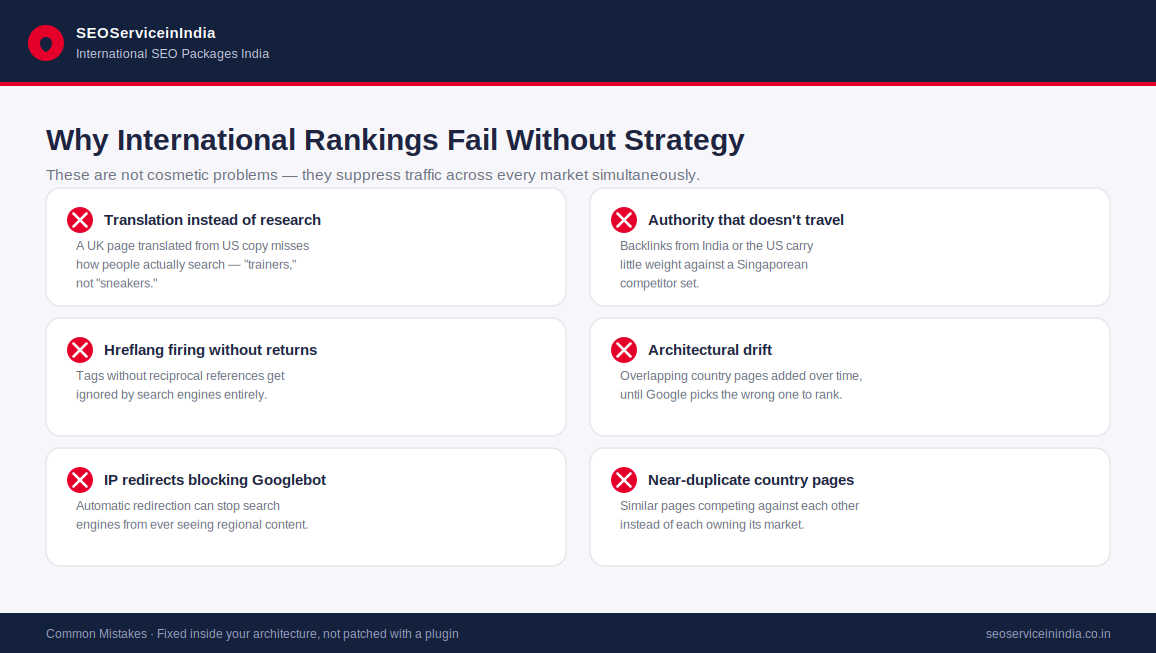
The single most common cause of poor global performance. Translating a US page into British English does not make it competitive in the UK, because the phrases people search are genuinely different. Americans search "sneakers," Britons search "trainers." Americans search "moving company," Australians search "removalists." Americans search "cell phone plans," Indians search "mobile recharge plans." A translated page can be linguistically perfect and commercially useless.
Backlinks from Indian or US publications carry limited weight when the query is being judged against a Singaporean competitor set. Each market needs its own citations, its own mentions, its own local proof.
Country pages added over time without a governing structure, until the site has three overlapping versions of the same service page and Google picks the wrong one to rank.
Every engagement is scoped after a free audit, because the right package depends on how many markets you sell in, how many languages you publish in, and whether you are entering new territories or defending existing ones. All three tiers below are monthly retainers with no lock-in beyond the initial three-month strategy period.
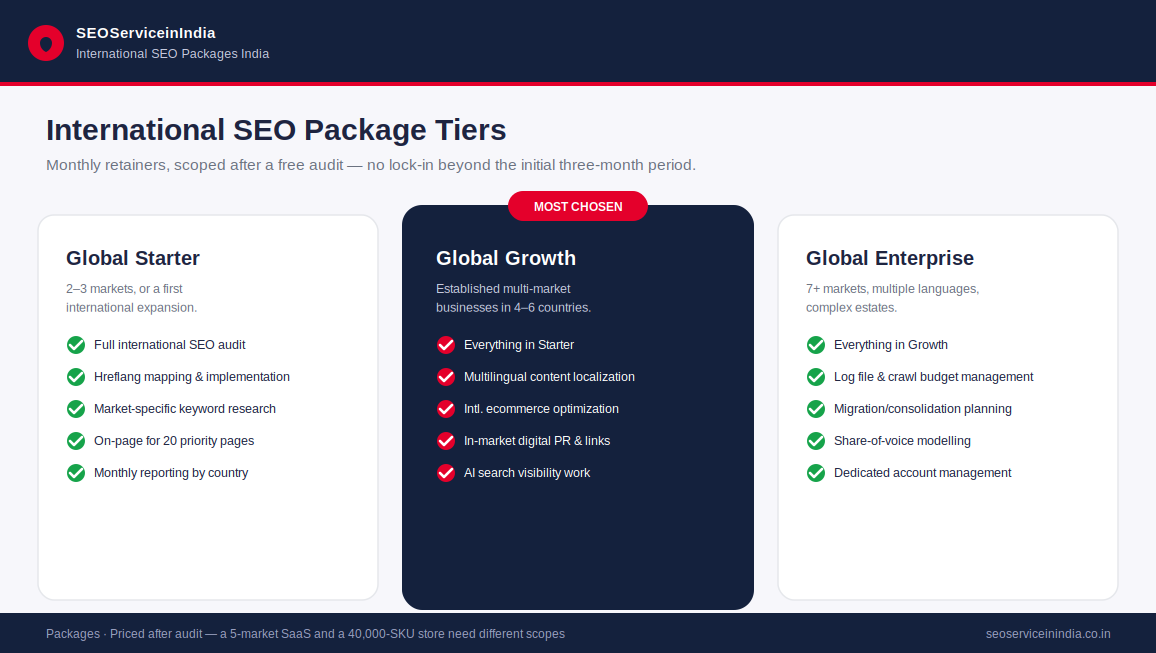
For brands active in two or three markets, or testing a first international expansion. Includes a full international SEO audit, architecture recommendation, hreflang mapping and implementation support, market-specific keyword research for each target country, on-page optimization of up to 20 priority pages, monthly localized content, foundational in-market link acquisition, and monthly reporting split by country.
For established multi-market businesses in four to six countries. Everything in Starter, plus multilingual keyword research and content localization, expanded content production per market, country-level technical monitoring, international ecommerce optimization for category and product pages, competitor tracking within each individual SERP, digital PR and link building executed in-market, and AI search visibility work for answer engines.
For large catalogues, complex multi-domain estates, or brands operating across seven or more markets and multiple languages. Everything in Growth, plus log file analysis and crawl budget management, migration or consolidation planning, enterprise CMS and dev-team collaboration, market-level forecasting and share-of-voice modelling, dedicated account management, and quarterly strategy sessions with your leadership team.
Pricing is quoted after the audit rather than published, because a five-market SaaS site and a five-market ecommerce store with 40,000 SKUs need very different levels of work — and quoting a flat number before seeing your site would be guesswork dressed up as a proposal.
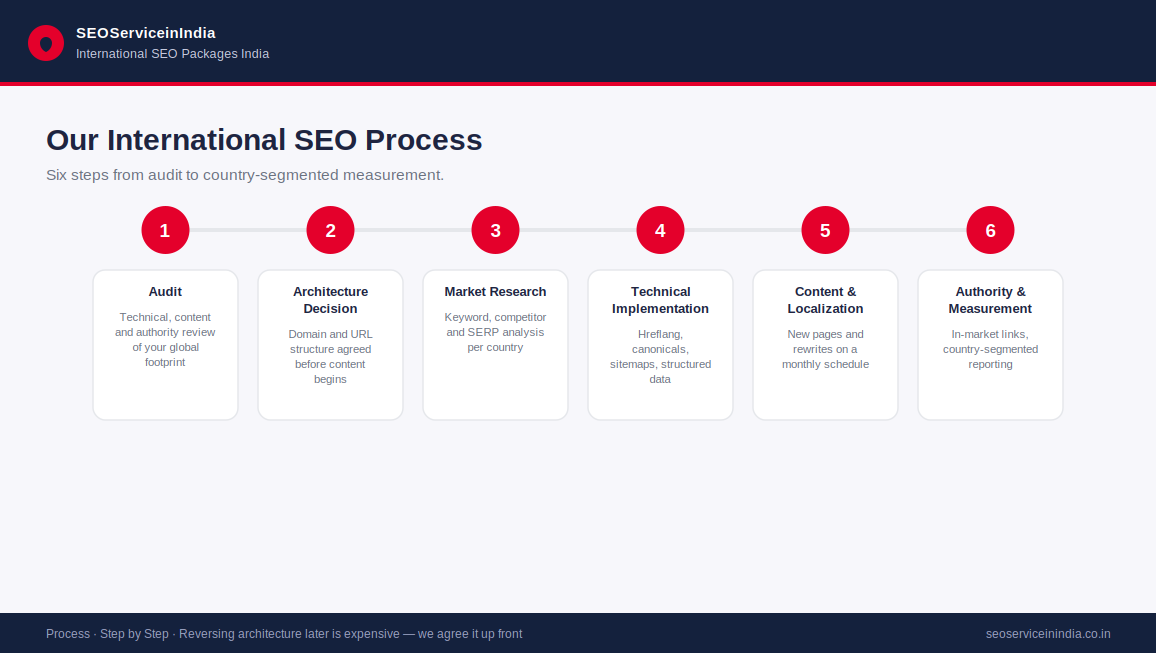
Six workstreams run on every retainer, from the architecture decision through to in-market authority — each one reported separately so you can see where the work went.
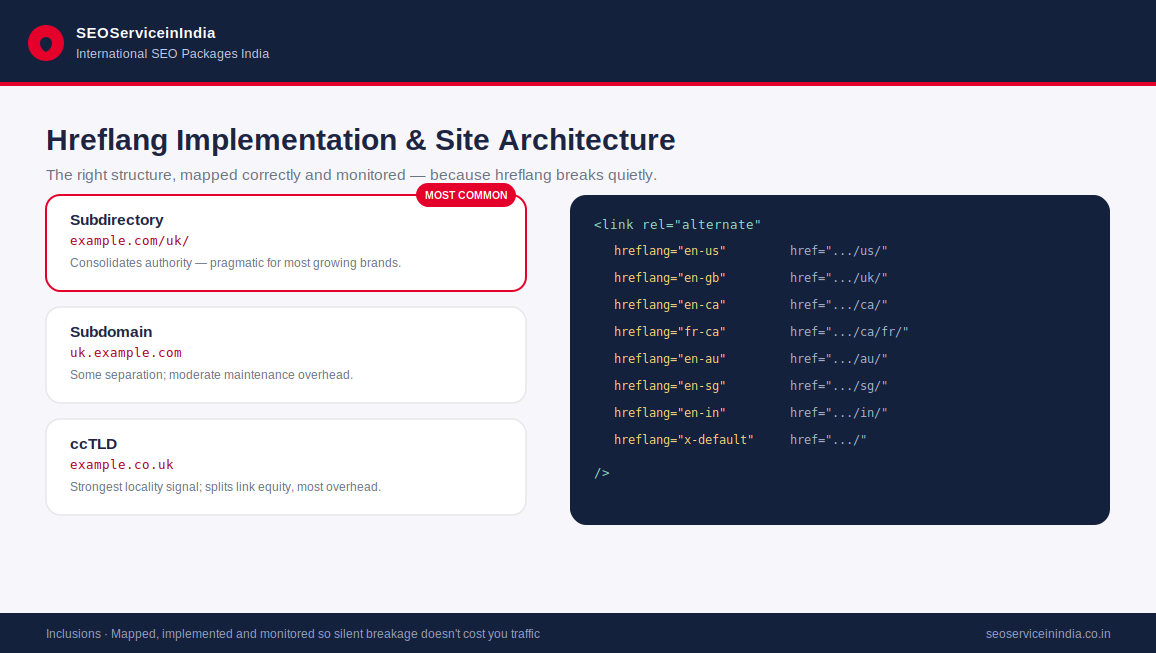
We start by recommending the right structure for your business — country-code domains, subdirectories on a single domain, or subdomains. Subdirectories consolidate authority and are the pragmatic choice for most growing brands. Country-code domains signal locality most strongly but split your link equity across separate properties and multiply your maintenance overhead. We advise based on your resources and roadmap, not on a template.
We map every language and region combination, implement the tags in your sitemap or head section, add the x-default fallback for unmatched visitors, and confirm every reference returns correctly. Then we monitor them, because hreflang breaks quietly whenever URLs change and nobody notices until traffic drops.
Separate research for every target country, built from local search data rather than translated head terms. We map each keyword to search intent and to a funnel stage, so informational demand, comparison demand and buying demand each get pages built for them.
We adapt rather than translate — rewriting for local idiom, spelling, currency, units, examples, regulations and cultural reference points. A US case study means little to a Singaporean CFO; a Singapore-specific one converts.
Search Console country targeting, canonical hygiene across regional variants, geo-redirect handling that never blocks crawlers, CDN configuration so Core Web Vitals hold up in every region, and structured data implemented per market.
Digital PR, editorial placements, industry directories and partnership mentions sourced inside each target country, plus Google Business Profile and local citation work wherever you hold a physical presence.
Six storefront markets, six competitor sets, six vocabularies. Each one gets its own research, its own copy decisions and its own authority plan.
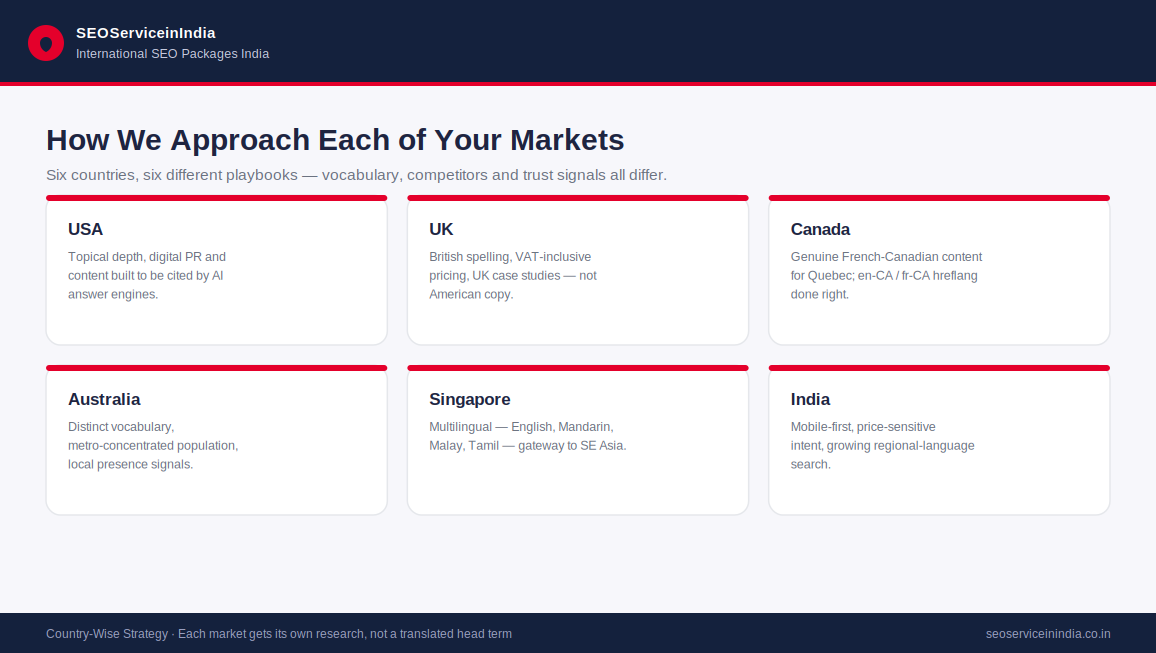
The most competitive and most fragmented English-language market. Rankings vary by state and metro, established domains hold entrenched positions, and AI Overviews now sit above traditional results for a large share of informational queries. Our US work leans on topical depth, demonstrable expertise signals, strong digital PR and content built to be cited by answer engines as well as ranked.
Smaller volume, sharper competition, and a search audience that responds badly to obviously American copy. British spelling, VAT-inclusive pricing, UK phone formats and UK-based case studies are conversion factors, not cosmetic details. Coverage across England, Scotland, Wales and Northern Ireland needs explicit consideration.
Bilingual by law and by market reality. Quebec requires genuine French-Canadian content — not European French, and not machine translation. We handle the en-CA and fr-CA hreflang pairing properly and localize pricing to Canadian dollars with correct provincial tax context.
Distinct vocabulary, a heavily concentrated population across a handful of metros, and a market where local presence signals matter disproportionately. Time zone realities mean support and contact expectations get built into the page copy, not left to chance.
A compact, high-value, multilingual market and the natural gateway to wider Southeast Asian expansion. English dominates commercial search, but Mandarin, Malay and Tamil audiences exist and reward brands that address them. Regional competitors from Malaysia and Indonesia frequently appear in Singaporean results, so the competitor set is wider than the country.
Enormous volume, extremely price-sensitive intent, heavy mobile skew, and a growing share of regional-language and voice search. Winning here means fast pages on modest connections, transparent pricing, and content that answers questions rather than posturing.
The same six steps run on every account, whether you are defending three established markets or opening your first two.
A full technical, content and authority review of your current international footprint, including how Google is currently interpreting your country signals.
We agree the domain and URL structure before any content work begins, because reversing this later is expensive.
Keyword, competitor and SERP analysis for every target country, delivered as a prioritized opportunity map.
Hreflang, canonicals, sitemaps, geo-targeting, structured data and performance fixes, executed with your dev team or by us.
New pages and localized rewrites shipped on a monthly production schedule against the opportunity map.
In-market link acquisition running continuously, with country-segmented reporting on rankings, traffic, conversions and share of voice.
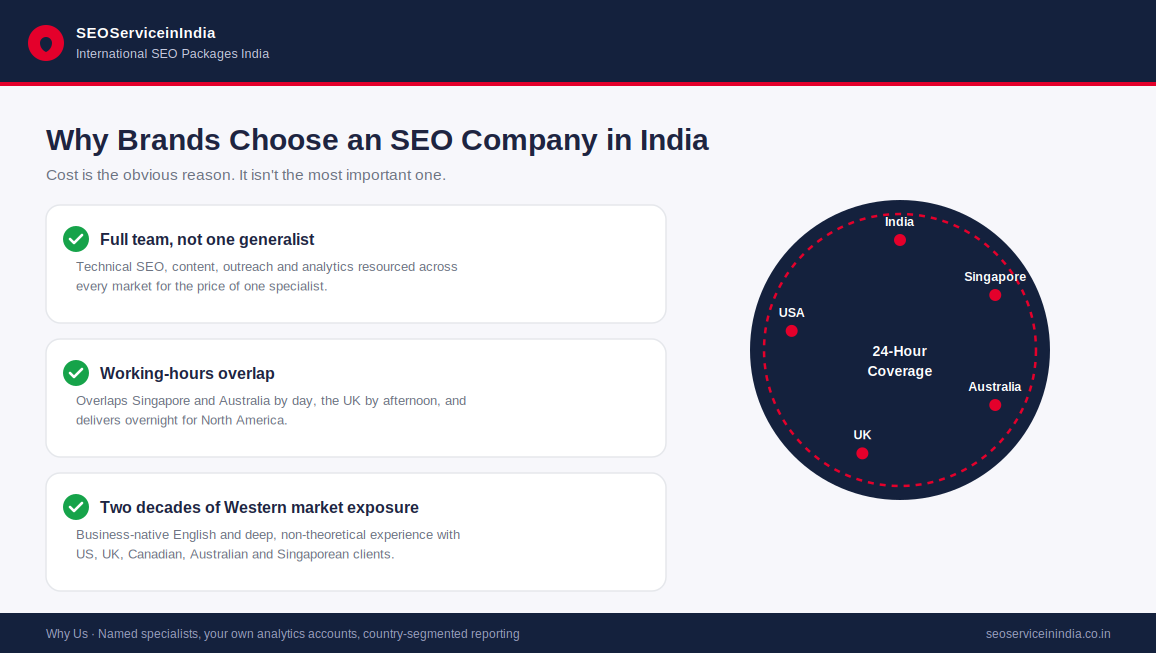
Cost is the obvious reason, but it is not the most important one. What matters is what the cost difference buys you: a full team rather than a single generalist. For the budget of one mid-level in-house specialist in the US or UK, you get technical SEO, content, outreach and analytics resourced properly across every market you operate in.
Working hours help too. An India-based team overlaps with Singapore and Australia during the day and with the UK in the afternoon, and delivers overnight for North American clients — so work progresses while your team sleeps.
And the market experience is real. Indian agencies have serviced US, UK, Canadian, Australian and Singaporean clients for two decades. The English is native-standard for business communication, and the exposure to Western search markets is deep rather than theoretical.
Our international work is led by practitioners who have implemented hreflang across multi-thousand-page ecommerce estates, migrated country subdomains into consolidated subdirectory structures without losing rankings, and rebuilt link profiles market by market after algorithm updates. We publish the reasoning behind our recommendations, not just the recommendations.
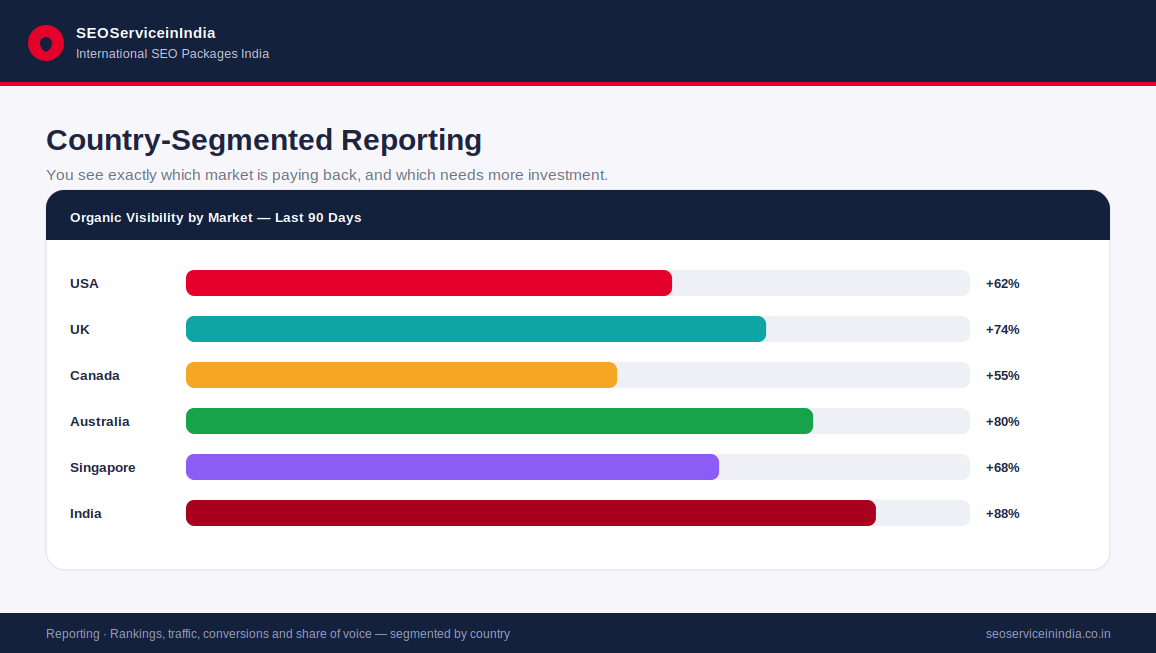
You get named specialists, not an anonymous queue. You get access to your own Search Console, Analytics and rank-tracking properties — everything stays in accounts you own. You get monthly reporting segmented by country, so you can see exactly which market is paying back and which needs more investment.
We do not promise fixed positions or guaranteed timelines. International SEO typically shows early technical gains within six to ten weeks and meaningful ranking movement across three to six months, with competitive markets taking longer. Anyone quoting you certainties is selling something else.
Pricing depends on the number of markets, the number of languages, the size of your site and how competitive your sector is in each region. We quote after a free audit so the number reflects actual scope rather than a guess. Most multi-market retainers sit meaningfully below what a single-market Western agency charges.
For most businesses, subdirectories on one strong domain are the better choice — they consolidate authority and cost far less to maintain. Country-code domains make sense when you have genuinely separate operations, local entities or legal requirements in each market. We recommend after reviewing your setup.
Not necessarily. If your target markets all buy in English, you need localization rather than translation — adapted spelling, currency, examples and terminology. Full translation becomes necessary when you are targeting a non-English audience such as French Canada or Mandarin-speaking Singapore.
Technical corrections such as hreflang fixes can improve indexing within weeks. Ranking and traffic improvements generally build over three to six months, and highly competitive markets like the United States often take longer. Each market moves at its own pace.
Yes. Many clients keep a domestic agency for their home market and use us for international expansion, or run us alongside an internal team as the technical and content engine. We integrate with your existing workflow and reporting.
Not when it is handled correctly. Properly implemented hreflang tells Google these are regional variants rather than duplicates. That said, genuinely localized content performs better than near-identical copies, which is why we rewrite rather than clone.
We recommend starting with the markets where you already see organic impressions, existing customers or product-market fit, then expanding outward. The audit identifies where you already have unrealized visibility, which is usually the cheapest growth available.
Tell us which markets you sell in and we will show you exactly where your international visibility is leaking — architecture issues, hreflang errors, missing local intent, authority gaps by country — along with a prioritized plan and a package recommendation.
No obligation, no lock-in, and no template proposals. Get in touch and we will have your audit back within three working days.

Speak with our SEO Company Experts
Give us a Ring, e-Mail, WhatsApp, or Skype.